Threat Detection vs. Threat Hunting: Key Differences
June 9, 2026
Dark Web Scanning: Finding Leaks Before Hackers
June 11, 2026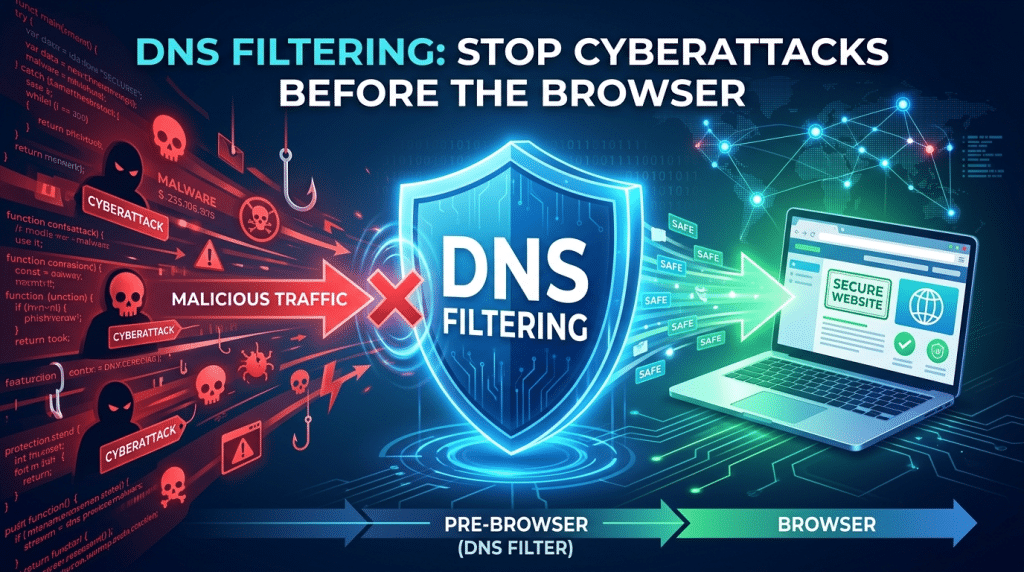
The Digital Phonebook Shield: How DNS Filtering Blocks Threats Before They Touch Your Network
Every time your employees use the internet—whether they are opening a cloud-based CRM, tracking a client shipment, or clicking a link in an email—their computers interact with a foundational piece of internet infrastructure known as the Domain Name System (DNS).
Often called the phonebook of the internet, the DNS translates human-readable web addresses into machine-readable numerical IP addresses. This process happens quietly in the background, tens of thousands of times a day across your firm, taking less than a millisecond to complete.
Because this translation layer is an absolute prerequisite for any internet connection, it represents a powerful, often overlooked defensive boundary.
If your organization relies solely on standard web browsers or local antivirus software to stop malicious downloads, you are waiting until a threat is already knocking on your workstation’s front door. To build true operational resilience and secure your corporate capital, you must implement a proactive layer of protection that completely neutralizes threats at the infrastructure level: DNS Filtering.
The Blind Spot of Browser-Level Defense
To understand why DNS filtering is an essential component of a modern network, consider how a standard cyberattack unfolds.
An employee receives a sophisticated, highly personalized phishing email. The message includes an urgent request to review a pending invoice via a linked URL. When the employee clicks that link, the web browser immediately contacts a standard DNS server to find the destination’s IP address. Once the address is delivered, the browser navigates to the page, connects to the malicious server, and begins downloading a hidden malware script or loading a fraudulent credential-harvesting form.
If your network only inspects data after it reaches the browser, your defense is operating in a reactive state. The malicious payload has already entered your local memory space. If the hacker has deployed a brand-new “zero-day” exploit that slips past your local antivirus scanners, your workstation is immediately compromised.
How DNS Filtering Acts as an Internet Gatekeeper
DNS filtering changes the rules of engagement. Instead of letting your computers talk to any server on the internet blindly, a DNS filter inserts a smart, highly secure gatekeeper right at the translation layer.
When an employee clicks a link or types a web address, the request is routed through a secure DNS filtering recursive resolver. Before the resolver hands back the numerical IP address required to open the site, it runs a real-time integrity check against an enterprise-grade global threat ledger.
The system evaluates the destination using three strict criteria:
- Known Malicious Domains: If the requested URL is found on a continuously updated blocklist of verified malware command centers, ransomware distribution sites, or phishing portals, the filter refuses to return the real IP address. Instead, the connection is instantly severed, and the employee is redirected to a safe, internal warning page.
- Dynamic Content Classification: DNS filtering can block entire categories of high-risk or non-work-related content—such as gambling sites, unverified peer-to-peer file-sharing networks, or adult entertainment repositories—eliminating entire threat vectors before your team can ever interface with them.
- Real-Time Domain Age Analysis: Sophisticated threat actors frequently register thousands of brand-new domains, use them for a three-hour phishing campaign, and then discard them before security software can flag the signatures. An advanced DNS filter automatically drops connections to hyper-recent domains (e.g., registered within the last 24 hours), stopping zero-day delivery systems cold.
Because the translation is blocked, the malicious code never reaches your computer. The connection to the dangerous server is aborted before a single packet of malicious data can travel down your network line.
Stopping the Silent Malware “Callback”
The power of DNS filtering extends far beyond stopping employees from clicking dangerous links. It is equally effective at neutralizing malware that has already found a way onto a device via a rogue USB drive or an unmanaged guest asset.
Once inside a network, advanced malware typically remains silent initially. To execute its payload or begin encrypting files, it must contact its creator’s server to download an encryption key or receive operational commands—a process known as a Command-and-Control (C2) Callback.
To establish this callback channel, the malware runs a built-in script that queries the DNS for its control server’s address. If your network is protected by a DNS filter, the system instantly identifies the malicious callback domain request, blocks the translation, and immediately alerts your security operations center. The malware is left entirely blind, deaf, and paralyzed, allowing your technical team to locate and remove the infected hardware with zero data exposure.
Implementing Frictionless Infrastructure Protection
Hardening your network through infrastructure-level filtering does not mean creating a slow, frustrating web browsing experience for your workforce. True technical maturity relies on deploying smart cloud-native tools that protect your team invisibly in the background.
At Krypto IT, we help organizations build this human-friendly environment by systemizing enterprise-tier DNS perimeters across all corporate assets:
- Ubiquitous Mobile Enforcement: We ensure your DNS protection doesn’t stop when an employee leaves the physical office building. Our configurations protect company-managed laptops, tablets, and smartphones continuously, whether your team is working from home or connecting to a public Wi-Fi network.
- Zero Latency Execution: We route traffic through elite, global Anycast DNS networks, ensuring that threat validation happens in microsecond intervals, often accelerating your team’s standard page-load times while multiplying their safety.
- Frictionless Administration: We combine your internet guardrails with identity-first access controls, reducing repetitive authentication loops and allowing your staff to focus entirely on hitting their operational deadlines safely.
Conclusion: Block the Threat at the Horizon
In the modern digital landscape, the most efficient way to survive a cyberattack is to ensure it never reaches your local hardware. Relying entirely on traditional end-point scanners to fight off highly targeted, AI-driven internet threats is a dangerous operational gamble. By moving your primary line of defense to the DNS layer, you build an institutional shield that neutralizes threats at the horizon, keeping your data, your capital, and your corporate reputation completely secure.
Are your employees browsing the web without an infrastructure shield? Contact Krypto IT today for a comprehensive “Network Infrastructure and Edge Security Review” and let’s secure your internet gatekeeper.