Inside the Sandbox: Testing Threats Safely
June 7, 2026
DNS Filtering: Stop Cyberattacks Before the Browser
June 10, 2026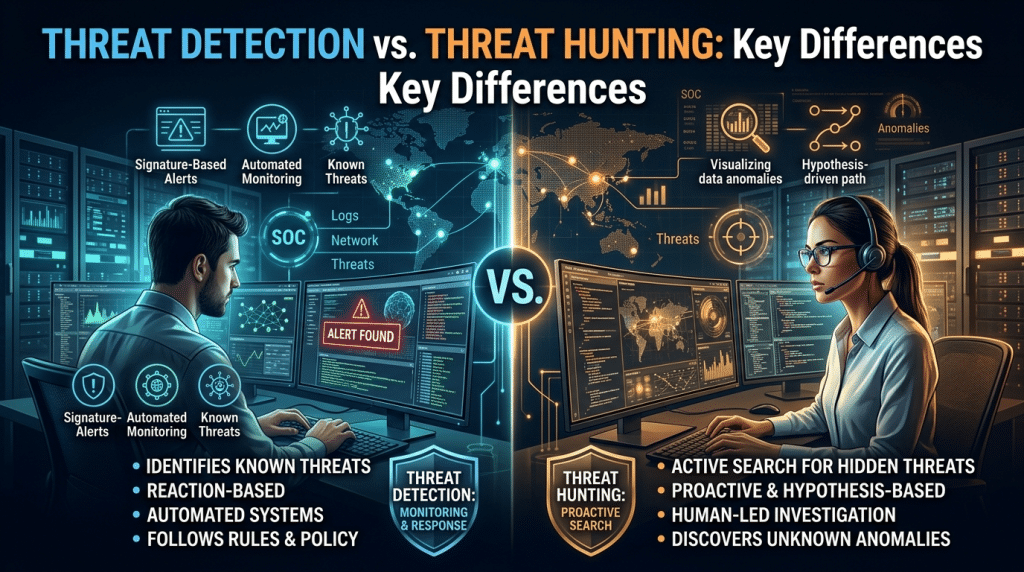
Beyond the Alarm: The Difference Between Threat Detection and Threat Hunting
When business owners and corporate executives look at their cybersecurity reports, they often see a long list of automated security tasks. They see firewall logs, antivirus updates, patch management schedules, and indicators showing that “Threat Detection” systems are actively scanning the environment. For many leadership teams, this provides immediate peace of mind. They assume that because they have high-tier monitoring tools installed, their digital perimeters are entirely secure against any intrusion.
As we navigate the highly complex threat landscape of 2026, relying on that assumption is a significant corporate liability.
Threat detection is an essential baseline, but it is only half of a mature defense strategy. There is a profound operational difference between waiting for a piece of software to sound an alarm and actively hunting down a silent, sophisticated intruder who has already slipped past your gates. To guarantee true business continuity and protect your corporate capital, you must understand the distinction between Threat Detection and Threat Hunting.
Threat Detection: The Digital Security Guard
Threat detection is a reactive, technology-driven security process. It relies on pre-configured rules, code signatures, and behavioral baselines to spot known malicious activity within your infrastructure.
Think of threat detection as an enterprise-grade home security system. You install motion sensors on the doors, glass-break detectors on the windows, and cameras around the perimeter. If a known bad actor attempts to force entry, or if an automated script performs an action that explicitly violates a security rule, the alarm trips, the system blocks the action, and your IT team receives an alert.
Common examples of threat detection include:
- Antivirus Alerts: Spotting a known ransomware file signature as an employee attempts to download an attachment.
- SIEM Alerts: A Security Information and Event Management system flagging that an internal user account is suddenly attempting to log in from two different countries simultaneously.
- Firewall Blocks: Automatically dropping incoming network traffic originating from a blacklisted, malicious IP address.
Detection tools are phenomenal at processing massive volumes of data and neutralizing routine, automated cyberattacks in real-time, keeping your everyday operations running efficiently without human intervention.
Threat Hunting: The Elite Detective
If threat detection is an automated alarm system, threat hunting is a human-led, proactive investigation. Threat hunting operates on a critical, aggressive premise: The assumption that sophisticated attackers have already bypassed your perimeter defenses and are sitting silently inside your network right now.
Modern cybercriminals frequently deploy “low-and-slow” methodologies. They do not trigger loud security alarms. Instead, they steal legitimate employee credentials, use built-in administrative tools (a tactic known as “living off the land”), and move quietly across your servers for weeks or months, mapping out your infrastructure, locating sensitive banking data, and preparing a devastating, coordinated strike.
Threat hunting does not wait for an alert to trigger. Instead, elite cybersecurity analysts act as digital detectives. They form a hypothesis based on global threat intelligence, dive deep into your historical network logs, analyze endpoint memory states, and search for the microscopic footprints that software scanners miss.
A threat hunt answers the question: What dangerous anomalies are hiding in our network right now that our automated tools think are completely normal?
How Detection and Hunting Collaborate for Uptime
A resilient business infrastructure does not choose between detection and hunting; it integrates both into a seamless operational loop.
At Krypto IT, we help businesses move away from reactive technical firefighting and build a comprehensive, multi-layered defensive posture:
- Establishing the Automated Baseline (Detection): We deploy next-generation endpoint detection and cloud-native monitoring to continuously scrub out 99% of automated, routine internet background noise, allowing your network to operate at peak performance.
- Launching Focused, Human-Led Sweeps (Hunting): We use the clean data generated by those monitoring systems to perform proactive threat hunts across your environment. Our analysts look for subtle indicators of compromise—such as unusual service account creation or minor registry modifications—neutralizing sophisticated threats before they can execute a full-scale corporate data breach.
- Continuous Feedback Loops: When our threat hunters uncover a new evasion technique or hidden vulnerability inside an environment, they immediately write a new rule into our automated threat detection engines. This continuously hardens your daily defenses, making your entire enterprise smarter, sharper, and safer every single day.
Conclusion: Defensive Maturity Demands Initiative
In the modern digital economy, expecting an automated software subscription alone to stop every targeted, human-driven cyberattack is an impossible standard. True operational resilience requires pairing your automated tools with proactive human ingenuity. By balancing high-speed threat detection with regular, deliberate threat hunting, you transform your company’s network into a self-healing fortress, ensuring your data, your reputation, and your capital remain entirely under your control.
Are you certain your security stack isn’t missing a silent intruder? Contact Krypto IT today for a comprehensive “Disaster Recovery and Threat Assessment Audit” and let’s verify your network integrity.