Windows Defender for Business: Is Out-of-the-Box Enough?
July 21, 2026
Legacy Macro Risks: Excel Files as Security Nightmares
July 25, 2026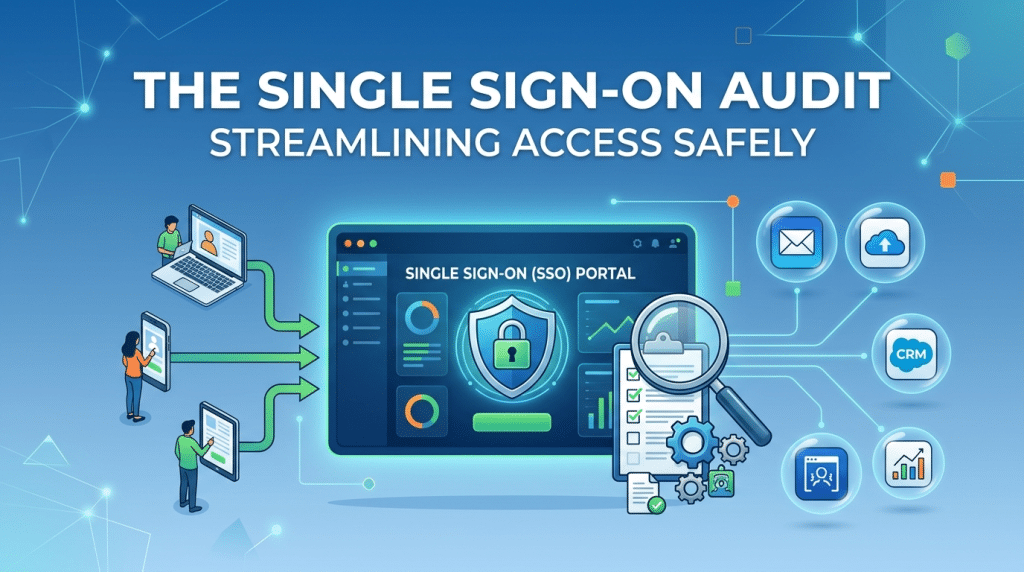
The Single Sign-On (SSO) Audit: Streamlining Access Safely for Your Team
Single Sign-On (SSO) has become the golden standard for modern workplace efficiency. By allowing employees to log in once and seamlessly access dozens of SaaS applications—from cloud storage and CRM software to internal chat tools—SSO eliminates password fatigue and reduces help desk ticket volumes.
However, convenience can easily turn into vulnerability. When you centralize identity, you essentially create a single master key to your entire digital infrastructure. If an SSO deployment is left unmonitored or configured incorrectly, a single compromised identity can grant an attacker unrestricted access across your entire software ecosystem.
Conducting a regular Single Sign-On audit is essential to ensure that your streamlined access remains fully secured against evolving cyber threats.
Why SSO Environments Drift Into Risk Over Time
When companies first deploy SSO platforms like Microsoft Entra ID (formerly Azure AD) or Okta, the integration is usually tight and well-structured. Over time, however, organizational drift sets in. Departments adopt new cloud tools, employees change roles or leave the company, and third-party vendors require temporary connections.
Without continuous governance, several major security gaps develop within SSO environments:
1. The “Keys to the Kingdom” Single Point of Failure
If an employee’s central SSO credentials are stolen through targeted phishing or session hijacking, the attacker instantly inherits access to every connected application. Without secondary challenges, continuous conditional risk scoring, or strict multi-factor authentication (MFA), a single breach scales exponentially across your corporate data assets.
2. Shadow IT and Unintegrated Apps
While core systems are usually wired into SSO, employees frequently adopt unsanctioned SaaS applications (“Shadow IT”) for daily tasks. These off-grid applications sit outside your central identity provider, meaning when an employee leaves the company and their SSO access is revoked, their standalone logins to those third-party tools often remain active.
3. Excessive Permissions and Provisioning Drift
As employees move between departments or take on new responsibilities, they accumulate application access. However, old access privileges are rarely stripped away. This leads to over-provisioned user profiles where a single staff member retains administrative or sensitive viewing rights across tools they no longer need for their current role.
Key Pillars of a Comprehensive SSO Audit
A Single Sign-On audit evaluates both the technical configuration of your identity provider and the operational policies governing user access. The goal is simple: ensure frictionless access for legitimate users while enforcing zero-trust verification at every entry point.
At Krypto IT, we conduct rigorous SSO audits that focus on hardening identity infrastructure across four critical areas:
- App Integration Discovery: We scan and map all software applications in use across your organization to identify unlinked SaaS tools, ensuring every entry point is brought under centralized SSO control and monitoring.
- MFA and Conditional Access Policies: We review multi-factor authentication requirements, ensuring legacy authentication protocols are disabled and enforcing location-, risk-, and device-aware access rules across every connected application.
- Role-Based Access Control (RBAC) Alignment: We audit existing user permissions against strict least-privilege principles, trimming over-provisioned accounts and establishing automated provisioning and de-provisioning workflows for automated employee onboarding and offboarding.
- Session Management and Timeout Enforcements: We analyze active session durations and token refresh parameters to prevent prolonged, unverified logins on unmanaged or personal devices.
Moving Toward a Zero-Trust Identity Model
An SSO audit is not a one-time project; it is the foundation of a Zero-Trust architecture. In a modern security environment, identity is your true network perimeter. Treating SSO as a dynamic, continuously verified framework rather than a static “set-it-and-forget-it” tool ensures that productivity gains do not come at the expense of data protection.
Conclusion: Secure Your Central Identity Hub
Single Sign-On is one of the most powerful tools for driving employee productivity, but its central role makes it a prime target for modern cybercriminals. Regular auditing ensures that your master key opens doors only for the right people, under the right conditions, at the right time.
Is your SSO configuration keeping your team safe, or is it secretly expanding your attack surface? Contact Krypto IT today for an Identity and SSO Security Audit, and let’s lock down your central access points.