DNS Filtering: Stop Cyberattacks Before the Browser
June 10, 2026
The Magic of Immutable Backups: Un-deletable Data
June 13, 2026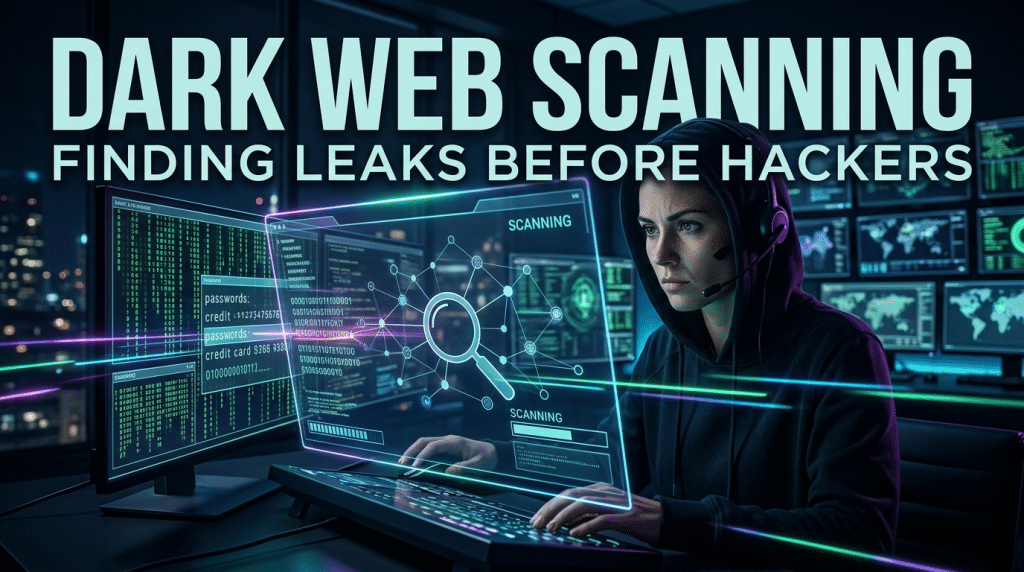
The Preemptive Strike: How Dark Web Scanning Locates Your Exposed Data Before Hackers Exploit It
When corporate executives review their security budgets, they focus heavily on their active perimeter. They invest in technical firewalls, secure endpoint monitoring, restricted access permissions, and continuous data backup vaults. The assumption driving these investments is logical: as long as our internal defenses are properly maintained, our company secrets will remain secure inside our environment.
However, the reality of cybercrime reveals a major blind spot in this perimeter-only logic.
The vast majority of modern enterprise breaches do not begin by cracking an active network barrier from the outside. They succeed because a valid employee credential was stolen from an external third-party platform or unmanaged personal device, packaged into a structured log, and sold in the underground digital economy. Once an intruder purchases a working password, they don’t need to hack your firewall—they simply log straight in through your front door.
To prevent credential-based network intrusions, organizations must move away from purely reactive local scanning and deploy an active, outward-facing defense mechanism: Dark Web Scanning. Here is how this technology reaches into the cybercrime ecosystem to locate your leaked assets before threat actors can use them to compromise your corporate treasury.
The Industrialized Lifecycle of a Stolen Credential
To understand how dark web scanning protects your cash flow and operations, you must understand how your data surfaces in the cybercrime economy. The path from an employee’s computer to an underground marketplace follows a highly coordinated, industrialized lifecycle.
Phase 1: The External Harvest
Threat actors rarely target a mid-sized business directly to harvest basic passwords. Instead, they deploy highly aggressive infostealer malware (such as the RedLine, Lumma, or Raccoon strains) across the internet. This malware hides inside cracked software installers, compromised web plugins, or malicious links targeted at personal devices that sit entirely outside the visibility of your corporate IT department.
When an employee logs into a personal personal service, a retail portal, or an unmanaged third-party vendor application from their laptop or phone, the infostealer silently copies their plaintext usernames, passwords, browser autofill data, and active session cookies directly from the device’s local memory.
Phase 2: The Stealer Log Aggregator
Once harvested, these credentials are automatically compressed into structured datasets called “stealer logs.” These logs are not kept secret; they are quickly uploaded to private Telegram channels and restricted dark web marketplaces by initial access brokers. Cybercriminals bundle tens of millions of unique credential pairs and sell them in bulk, allowing malicious actors to filter the data by targeted corporate domains, geographic regions, or high-value SaaS administrative portals.
Phase 3: The Automated Attack Loop
An automated credential-stuffing tool parses the fresh logs and instantly runs thousands of login attempts against your corporate endpoints. If an employee has reused their compromised personal password for their corporate email or CRM account, the hacker gains immediate, authenticated entry into your infrastructure.
How Dark Web Scanning Interrupts the Chain
Traditional internal security controls—like local antivirus software—are completely blind to this underground ecosystem. Your local scanner cannot see that an employee’s password was leaked during a massive third-party breach or harvested from a personal tablet at their home.
Dark web scanning solves this visibility gap by functioning as a high-speed intelligence scout. The scanning engines operate 24/7/365, utilizing automated scrapers, API integrations, and human threat intelligence to continuously crawl deep web forums, restricted chat networks, peer-to-peer data repositories, and verified breach dumps.
The moment the system detects your company’s domain name appearing within a fresh dataset, it triggers an immediate, contextual alert to your security team containing critical data points:
Data Provided by Alert Strategic Purpose –
Exposed Email & Account
Pinpoints exactly which employee profile has been compromised.
Plaintext Password String
Identifies if the leaked password matches your active corporate complexity rules.
Source & Leak Context
Reveals if the data came from an infostealer log or an old third-party vendor breach.
Exposed Session Cookies
Flags whether active authentication tokens were compromised alongside text passwords.
By delivering this intelligence instantly, dark web scanning allows your technical team to take a preemptive strike. You can force an administrative password reset, invalidate active session tokens, and lock out the credential before the initial access broker can sell the log to a ransomware affiliate. You convert what would have been an enterprise-wide network crisis into a routine, sixty-second password update.
Systemizing Threat Intelligence into Frictionless Security
Deploying comprehensive threat intelligence does not mean establishing an intrusive, high-friction working environment that slows down your workforce. True operational resilience relies on marrying dark web intelligence with smart, automated access controls that protect your capital quietly in the background.
At Krypto IT, we help organizations build this human-friendly environment by systemizing enterprise-grade identity perimeters:
- Automated Active Directory Syncing: We integrate our dark web scanners directly with your core identity management systems. If a corporate credential is listed on an underground forum, our automation engines can instantly flag the account and force a secure reset without requiring manual IT intervention.
- Biometric Passwordless Infrastructure: We eliminate the vulnerability of text passwords entirely by transitioning your team to secure biometric authentication (such as Windows Hello and Touch ID). Because biometric identity is bound to a physical device enclave, a stolen text password becomes useless to an external hacker.
- Cryptographic Hardware Tokens: For high-stakes administrative and financial accounts, we mandate the use of physical, cryptographic security keys, ensuring that even if an active session cookie is harvested by an infostealer, the intruder cannot authenticate a transaction without physical possession of the hardware token.
Conclusion: Control Your Identity, Protect Your Brand
In the modern digital landscape, data privacy boundaries have expanded far beyond the brick-and-mortar office building. Your employee information lives across dozens of external platforms, and threat actors are continuously scanning the global underground economy for an easy backdoor into your network. Relying entirely on passive perimeters to defend your assets is an outdated approach that leaves your data exposed. By deploying active dark web scanning, you seize control of your digital footprint, neutralize threats at the source, and keep your corporate capital completely safe, secure, and under your absolute control.
Are your corporate login credentials currently circulating on the underground market? Contact Krypto IT today for a comprehensive “Dark Web Exposure and Identity Risk Audit” and let’s discover what’s hiding outside your perimeter.