Email Encryption 101: Keep Messages Private
June 7, 2026
Threat Detection vs. Threat Hunting: Key Differences
June 9, 2026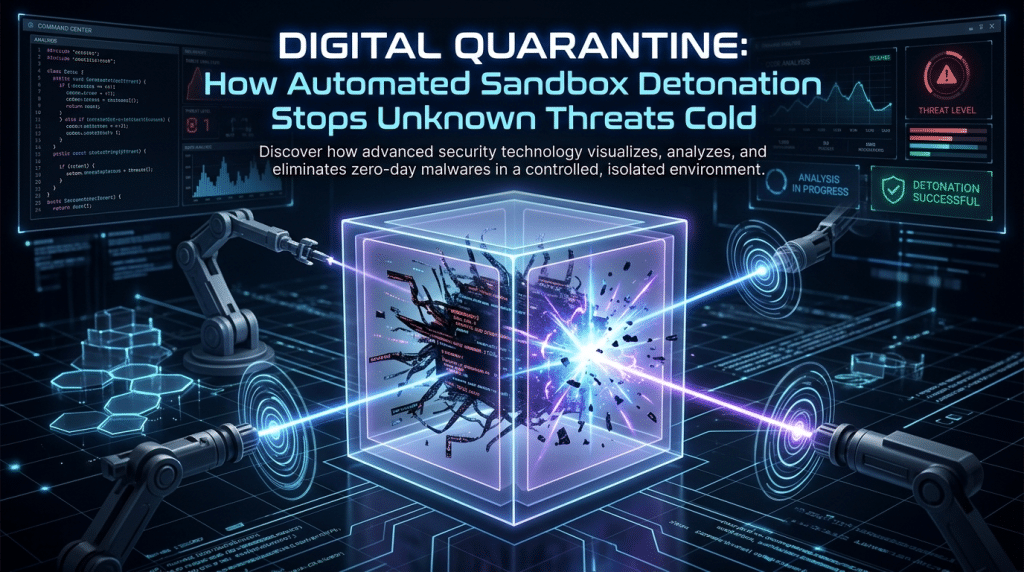
Digital Quarantine: How Automated Sandbox Detonation Stops Unknown Threats Cold
Every business day, your network is bombarded with incoming digital files. Your team downloads supplier invoices, opens resume attachments, clicks tracking links, and accesses shared project folders. To your employees, these are standard steps required to hit their daily deadlines. But to a cybercriminal, every single one of these interactions is a potential delivery vehicle for malicious code.
For years, standard corporate defense relied on signature-based antivirus software to protect the perimeter. This legacy software works like a digital security guard holding a book of mugshots; if an incoming file matches a known piece of malware on file, it is blocked.
But what happens when a hacker mutates their code, uses polymorphic encryption, or deploys a brand-new “zero-day” exploit that has never been seen by the security community?
The mugshot book becomes useless. If your defense relies solely on scanning for known threats, the unknown file slips straight through your filters and onto your network. To defeat modern, evasive cyberattacks without slowing down your business operations, your infrastructure must deploy an advanced technical containment protocol known as Automated Sandbox Detonation.
What Is a Cybersecurity Sandbox?
In the physical world, a sandbox is a self-contained, low-risk space designed for safe play and experimentation. In network engineering, the definition is functionally identical.
A cybersecurity sandbox is an isolated, highly secure virtual environment that mimics a real corporate workstation, complete with an operating system, web browsers, user registries, and fake system memory. It is completely detached from your live production network, your company data, and your active server rooms.
When an unknown or suspicious file enters your ecosystem—such as an unverified email attachment or a high-risk link—the security system immediately quarantines it. Instead of running it on your employee’s laptop, the file is automatically diverted into the sandbox. There, the system deliberately “detonates” or executes the file.
Because the sandbox is an absolute digital quarantine zone, if the file contains a hidden ransomware script or an aggressive Trojan, the virus runs rampantly inside the isolated container, destroying nothing but temporary virtual code while your actual network remains completely untouched.
Beyond Scanners: The Power of Behavioral Analysis
The core technical advantage of sandboxing is that it shifts your network defense from static inspection to Dynamic Behavioral Analysis. A sandbox does not care what a file looks like or what its code signature says; it cares entirely about what the file does when it is running.
While a file executes inside the secure sandbox, automated background monitoring systems track every single interaction. Security systems monitor for critical runtime indicators that immediately expose malicious intent:
- Unauthorized System Writes: Is the file attempting to modify critical Windows registry keys or write hidden execution paths directly into your system directories?
- Process Injection: Is the document attempting to spawn background scripts or inject unverified code into trusted system applications like
svchost.exeorexplorer.exe? - Command-and-Control Callbacks: Is the file quietly attempting to establish an outbound network connection to a known malicious IP address or a foreign server to download encryption keys?
By observing these live behavioral patterns, the sandbox can assign an accurate, dynamic risk score to completely unknown threats, identifying zero-day malware in real-time before it can establish a foothold in your enterprise.
Defeating Advanced Evasion and “Sandbox-Aware” Threats
As defensive technology has evolved, cybercriminals have built highly sophisticated counter-measures. Modern malware is frequently engineered to be “sandbox-aware”. When an advanced payload drops onto a machine, it will run silent diagnostic checks, looking for virtual machine artifacts or long delay cycles to determine if it is sitting inside an IT testing facility.
To bypass simple defenses, some modern threats use “human presence” verification loops. For instance, a virus might query the operating system and freeze execution until it detects smooth, multi-directional mouse movements that prove a physical human is interacting with the device. If the input looks like a simulated straight-line script, the malware stays dormant, pretending to be a safe, benign file to cheat the scan.
At Krypto IT, we neutralize these sophisticated evasion tactics by deploying next-generation, high-interaction sandboxing architectures:
- Simulated Human Interaction: Our advanced detonation chambers actively inject realistic, synthetic user inputs—including random mouse paths, task switching, and variable keystrokes—fooling sandbox-aware code into executing its malicious behavior early.
- Extended Detonation Windows: To defeat “long sleep” evasion tricks where malware waits hours before activating, our systems run extended, adaptive analysis windows that flag excessive execution delays as a primary risk indicator.
- Bare-Metal Emulation: We run deep, external behavioral monitoring that sits entirely outside the test environment, stripping away the virtual machine markers that hackers use to hide their footprints.
Conclusion: Absolute Containment, Zero Interruption
In the modern digital economy, threat actors move fast, but your containment systems must move faster. Expecting your employees to manually spot every highly targeted, AI-generated phishing file is an impossible operational standard that creates constant internal friction. By implementing an automated, cloud-delivered sandboxing pipeline, you ensure that every unknown asset is cryptographically verified and safely detonated behind bulletproof glass. Your data stays locked, your servers stay clean, and your team stays focused on hitting their deadlines.
Are unknown email attachments playing Russian roulette with your corporate data? Contact Krypto IT today for a comprehensive “Threat Detection and Network Security Audit” and let’s secure your digital quarantine.