Zero Trust: Why We Don’t Trust Your Office Wi-Fi
June 3, 2026
Backup vs. Snapshot: Why the Difference Matters
June 5, 2026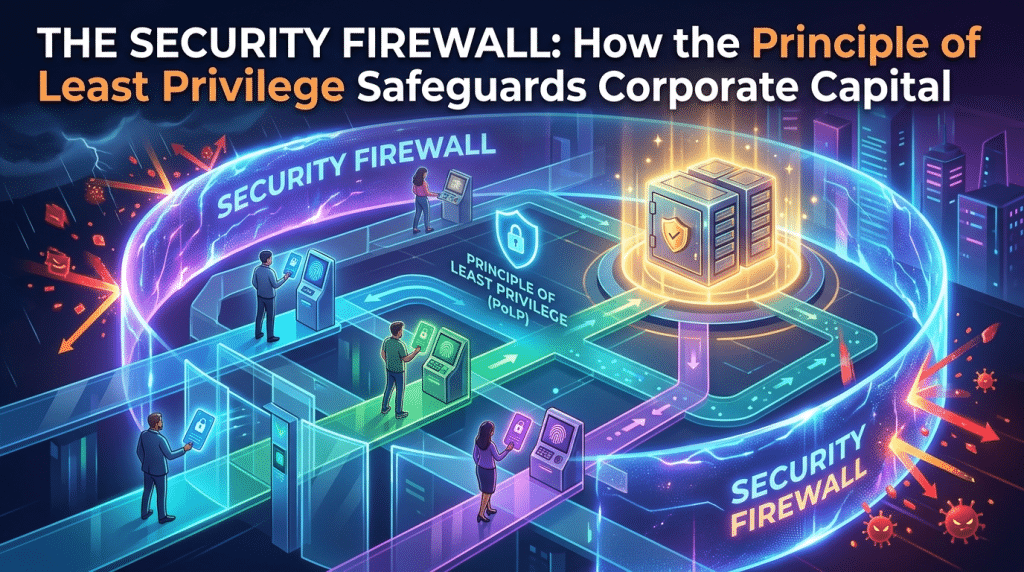
The Security Firewall: How the Principle of Least Privilege Safeguards Corporate Capital
When business owners and financial executives think about protecting their corporate bank accounts, they immediately focus on external barriers. They think about complex passwords, automated transaction alerts, multi-factor authentication (MFA) prompts, and deep banking fraud detection systems. While these external layers are critical parts of a modern security posture, they all share a fundamental vulnerability: they assume that the greatest danger comes from someone cracking the perimeter from the outside.
As we navigate the corporate threat landscape of 2026, the data tells a completely different story.
The most devastating financial breaches—including fraudulent wire transfers, unauthorized vendor creation, and sudden payroll redirection—frequently succeed by exploiting excessive internal access permissions. When an employee has more access to systems and information than they actually need to perform their daily duties, a single compromised account can give an intruder the keys to your entire corporate treasury.
To safeguard your capital and ensure long-term business continuity, organizations must implement a foundational security concept known as the Principle of Least Privilege (PoLP). Here is how this protocol works and why it acts as an absolute firewall for your corporate bank accounts.
Understanding Least Privilege: Operational Need vs. Open Access
The Principle of Least Privilege is a data security standard built on a simple, restrictive rule: Every user, application, and device within your organization must be granted the absolute minimum level of access necessary to complete their specific, immediate job function—and nothing more.
Historically, many small to mid-sized businesses operated under a model of default administrative privilege. To minimize technical friction and avoid constant permission requests, companies gave broad, sweeping administrative access to entire teams. A marketing manager, an operations coordinator, and a senior accountant might all share the exact same unrestricted access permissions across the company’s primary cloud environments and shared storage drives.
This open access creates an immense operational liability. If a cybercriminal uses a targeted phishing email or session-hijacking software to compromise the marketing manager’s credentials, the hacker doesn’t just gain control of your social media schedule. Because that account carries excessive internal trust, the intruder can instantly navigate straight into corporate file repositories, locate sensitive banking information, and harvest the credentials needed to initiate a catastrophic financial transfer.
The Functional Anatomy of Financial Defense
Implementing the Principle of Least Privilege systematically reconstructs your internal data perimeters, ensuring that a localized human error or minor breach cannot escalate into an existential corporate cash drain. PoLP builds a robust financial shield through three core operational mechanisms:
1. Minimizing the Lateral “Blast Radius”
If a hacker compromises a user account that has been restricted under a least-privilege framework, their path is immediately blocked. If a field technician’s credentials are stolen, the intruder is tightly locked inside the service ticketing software. They cannot move laterally into human resources records, they cannot touch vendor billing systems, and they have absolutely zero pathway to view or alter your corporate banking portals. The damage is entirely contained within an isolated, low-risk segment of your business.
2. Enforcing Strict Separation of Duties (SoD)
Least privilege prevents a single compromised identity from executing high-stakes financial transactions end-to-end. For example, your corporate accounting workflow should require two completely separate user profiles to move capital: one profile possesses the authority to create a new vendor or invoice, while a completely distinct, restricted profile possesses the authority to approve and execute the actual bank wire. By splitting these technical privileges, a hacker who compromises a single employee’s account cannot independently drain your corporate treasury.
3. Erasing the Risk of “Privilege Creep”
As employees advance within a firm, shift departments, or take on temporary cross-functional projects, they naturally accumulate access permissions to various corporate applications. Over time, this leads to a dangerous accumulation of trust known as “Privilege Creep.” If left unchecked, long-term employees eventually carry sweeping, undocumented administrative access to dozens of sensitive platforms. Least privilege eliminates this vulnerability by mandating automated, regular permission audits, systematically revoking historical permissions the moment an operational project closes.
Implementing Frictionless Least Privilege
Hardening your financial perimeters through least privilege does not mean establishing a slow, rigid working environment that prevents your team from hitting their daily deadlines. True technical maturity relies on deploying smart, automated access controls that protect your capital quietly and efficiently in the background.
At Krypto IT, we help organizations implement seamless, low-friction least-privilege architectures by deploying modern identity-first guardrails:
- Role-Based Access Control (RBAC): We map out precise technical boundaries for every job profile within your organization. Access to file servers, client financial histories, and cloud databases is granted automatically based on verified professional roles, eliminating manual permission guesswork.
- Just-In-Time (JIT) Elevated Privileges: For high-stakes operations that require occasional administrative access—such as modifying primary software integrations or reviewing end-of-quarter payroll runs—we implement temporary, expiring permissions. The system grants elevated clearance for a specific, monitored window (e.g., two hours) and then automatically downgrades the account back to baseline safety.
- Cryptographic Multi-Factor Tokens: We protect your core corporate banking environment by mandating dedicated, hardware-based multi-factor authentication (like physical security keys) for any identity attempting to interface with your financial infrastructure, instantly neutralizing the threat of automated credential theft.
Conclusion: Control Your Access, Protect Your Cash
In the modern digital economy, expecting software perimeters alone to stop every sophisticated external threat is a dangerous gamble. True operational resilience requires building a structure where an individual account compromise cannot bring down the entire enterprise. By embracing the Principle of Least Privilege and restricting technical access to a strict need-to-know standard, you turn your internal architecture into a highly resilient defensive network, keeping your corporate capital completely safe, secure, and under your absolute control.
Are excessive user permissions leaving your corporate treasury exposed to an internal breach? Contact Krypto IT today for a comprehensive “Privilege Audit and Access Control Review” and let’s secure your financial perimeter.