Leading Your Clients Through a Cyber Crisis
May 27, 2026
Why Executive Protection Is the New Security Frontier
May 30, 2026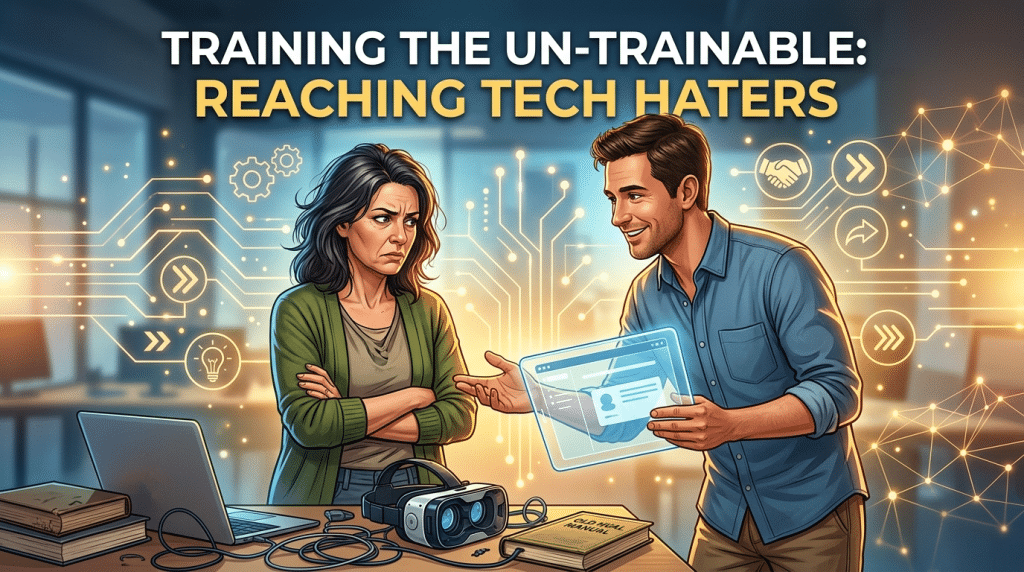
Overcoming Resistance: How to Teach Cybersecurity to Employees Who Hate Technology
Every business has them. They are the seasoned account executives who prefer paper notebooks, the field operations managers who find mobile apps frustrating, or the administrative staff who treat every new software update like an personal attack. They aren’t bad employees; in fact, they are often the backbone of your company’s operational success. But when it comes to technology, they are loudly, proudly, and stubbornly “un-trainable.”
To a business owner or IT administrator trying to roll out mandatory cybersecurity protocols, these tech-averse employees represent a massive operational vulnerability. A single unpatched device, an ignored password policy, or a misclicked link from an unengaged team member can open a backdoor into your entire corporate environment.
Traditional training programs—which rely heavily on dense slides, technical jargon, and automated quizzes—completely fail to reach this demographic. To secure your organization, you must discard the one-size-fits-all training manual and learn how to communicate critical security habits to the people who hate technology the most.
Understanding the Roots of Tech Resistance
To effectively train the tech-averse, leadership must first step back and diagnose the underlying cause of their resistance. It is rarely a lack of intelligence or a deliberate desire to leave the company exposed; instead, it is driven by two primary psychological blocks:
1. Software Fatigue and Friction
The modern professional is forced to interact with a continuous, shifting stream of digital interfaces. Between email clients, CRM software, HR portals, and inventory systems, employees are exhausted by digital changes. When management introduces complex new security requirements—like rotating token codes, biometric prompts, and mandatory authentication loops—the tech-averse employee doesn’t see a shield; they see an unnecessary layer of operational friction designed to slow them down.
2. The Fear of Public Failure
Technology moves fast, and for someone who didn’t grow up with a smartphone attached to their hand, the pace can be intimidating. When forced into high-pressure, collective training environments, tech-averse staff often worry about looking incompetent in front of their peers or superiors. To protect their professional dignity, they check out mentally, rush through training modules just to get them over with, or adopt a defensive posture of aggressive indifference.
The Strategy for Reaching the Disengaged
Securing a diverse, multi-generational workforce requires shifting away from abstract, technical instructions and anchoring your defense in human-centric, intuitive teaching methods. Here is how to turn your most tech-averse staff into an active layer of defense:
1. Strip Away the Technical Jargon
If your cybersecurity training begins with definitions of “ransomware vectors,” “phishing protocols,” or “malicious packet filtering,” you have already lost your audience. The tech-averse think in terms of practical workflows, not abstract code. Replace technical terminology with clear, real-world analogies:
- Instead of explaining Full-Disk Encryption (FDE), compare it to putting corporate files inside a high-security vault that self-destructs if someone tries to pry open the door.
- Instead of lecturing on Multi-Factor Authentication (MFA), explain it as a two-lock security gate where a thief needs both a physical key and a personal fingerprint to gain access.
By grounding security in physical concepts, you make the defense immediately understandable.
2. Integrate Security Into Personal Protection
One of the fastest ways to build an organic “security mindset” in a tech-averse employee is to show them how these habits protect their personal life. Spend the first fifteen minutes of your training showing them how to lock down their personal bank accounts, secure their family’s home Wi-Fi networks, and set up simple fraud alerts for their personal credit scores. Once they experience the peace of mind that comes from securing their private data, applying those exact same defensive behaviors to their corporate workstation becomes a natural, effortless transition.
3. Transition to Interactive Micro-Learning
Forcing a tech-averse employee to sit through a grueling, two-hour annual cybersecurity seminar is an exercise in futility. Their eyes will glaze over within the first ten minutes. Instead, replace long-form lectures with brief, interactive micro-learning moments. Deploy short, two-minute monthly video modules that focus on a single, practical threat vector—such as identifying a suspicious text message or spotting a fraudulent invoice. Short, bite-sized delivery keeps security top-of-mind without disrupting their productive routine or causing technology fatigue.
Designing Frictionless Technical Guardrails
Education is a critical pillar, but true business continuity requires engineering an infrastructure that protects your team quietly in the background, minimizing the need for constant technical decisions. At Krypto IT, we help organizations build this human-friendly environment through smart, non-intrusive security architecture:
- Biometric Authentication: We eliminate the frustration of memorizing complex, changing text passwords by integrating facial recognition or fingerprint scanning (like Windows Hello or Touch ID) into daily workflows, keeping logins under one second.
- One-Click Incident Reporting: We place simple, single-button alert systems directly inside standard email clients, allowing employees to flag unusual threads instantly without navigating complex IT ticketing software.
- Contextual Risk Assessment: We implement intelligent conditional access rules that evaluate environments in the background. If an employee is on the secure office network using a verified company laptop, the system reduces repetitive prompts, saving MFA challenges for true anomalies.
Conclusion: Resiliency Is a Collaborative Effort
In the modern digital economy, your company’s technical resilience is only as strong as the daily habits of your least technical employee. By abandoning punitive enforcement, stripping away technical pretense, and delivering practical, user-friendly security infrastructure, you transform your entire workforce into a collaborative, highly effective human firewall.
Are your technology rollouts creating internal resistance and hidden vulnerabilities? Contact Krypto IT today for a comprehensive “Workforce Usability and Security Friction Review” and let’s make security accessible to everyone.