Predictable IT Budgeting: How Fixed-Fee Models Protect Cash Flow
June 27, 2026
The True Cost of Being Offline: Audit Your Downtime
June 30, 2026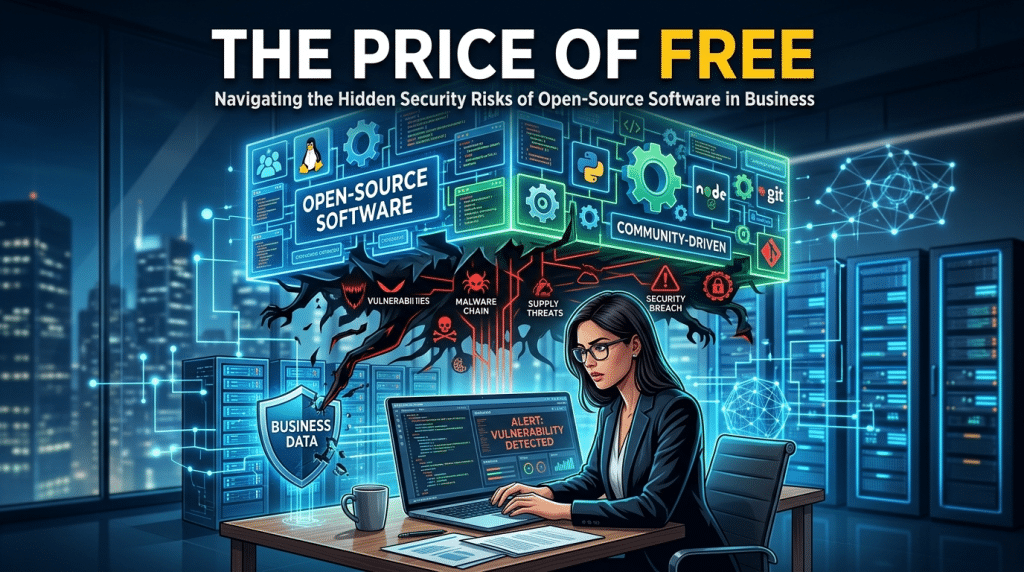
The Price of Free: Navigating the Hidden Security Risks of Open-Source Software in Business
When corporate procurement managers and software development leads look for mechanisms to accelerate digital transformation while minimizing overhead, open-source software (OSS) appears to be an unmatched operational asset. The baseline financial appeal is obvious: there are zero licensing fees, no aggressive vendor lock-in contracts, and no multi-year subscription spikes. Your software engineering teams can simply pull ready-made code libraries, database frameworks, and content modules straight from repositories like GitHub to build proprietary applications or run business workflows in a fraction of the time.
As we navigate the enterprise landscape, treating open-source assets as entirely cost-free utilities is a critical operational blind spot.
Open-source code forms the hidden infrastructure of the modern digital economy, powering over ninety percent of all enterprise application stacks. But because this code is written and maintained by global networks of independent volunteers rather than centralized, highly accountable commercial entities, it introduces an unmanaged security perimeter directly into your environment.
Relying blindly on open-source packages without rigorous organizational oversight creates an invisible tax measured in code vulnerabilities, supply chain exploits, and compliance liabilities. To preserve your corporate capital and protect your data availability, business leadership must understand the hidden technical risks behind “free” software.
The Vectors of Open-Source Vulnerability
To appreciate the necessity of an active open-source defense, business leaders must look past the consumer interface and analyze how code vulnerabilities enter the software supply chain.
1. The Proliferation of Abandonware
Unlike enterprise software companies that are contractually bound by Service Level Agreements (SLAs) to continuously maintain and patch their products, open-source projects have no such obligations. A highly popular code library that handles complex mathematical functions or data sorting might be maintained by a single, uncompensated developer in their spare time. If that developer burns out, changes careers, or loses interest, the project quietly transforms into abandonware. When cybercriminals inevitably discover severe security flaws within that unmaintained code, no one is writing a patch to seal the leak, leaving your dependent corporate systems wide open to automated exploitation.
2. Malicious Repository Poisoning and Typosquatting
Because public code repositories are accessible to anyone, highly sophisticated threat syndicates actively execute supply chain poisoning campaigns. In a common tactic known as typosquatting, hackers publish malicious code libraries with names that are nearly identical to popular, trusted packages—varying by just a single, easily mistyped letter. If a hurried software developer accidentally inputs the misspelled name into an application build script, your business unknowingly compiles a Trojan horse straight into your internal network, giving hackers a functional backdoor to deploy ransomware or siphon intellectual property.
3. Deep Dependency Blindness
Modern application development is modular. When your technical team integrates a single open-source package to handle a basic task, that package natively pulls in dozens of additional sub-libraries, known as transitive dependencies. This creates a cascading architecture where a single proprietary company tool can easily rely on hundreds of unvetted, third-party code fragments. If a critical software vulnerability is buried five layers deep inside an obscure, nested library that your internal developers do not even realize exists, your local network monitors remain completely blind to the threat until an actual exploit occurs.
Systemizing a Hardened Open-Source Perimeter
Mitigating the risks of open-source software does not mean executing a rigid corporate ban that forces your team to write every line of code from scratch, paralyzing your operational speed. True organizational resilience relies on deploying automated, zero-trust engineering guardrails that screen and validate your technical footprint continuously in the background.
At Krypto IT, we help growth-minded companies safely leverage the efficiency of open-source ecosystems by building an automated, audit-ready software perimeter:
- Deploying Continuous Software Bill of Materials (SBOM) Tracking: We eliminate dependency blindness by deploying automated composition scanners across your digital environment. Our platforms instantly index every open-source module, library, and nested dependency running inside your infrastructure, building a transparent, real-time inventory of your entire code supply chain.
- Automating Vulnerability Screening Pipelines: We integrate intelligent gatekeepers directly into your software deployment tracks. If an infrastructure script or application package attempts to pull an open-source library featuring a known, unpatched software vulnerability (CVE), our security tools automatically block the integration, alert your engineering team, and recommend a verified, secure alternative.
- Enforcing Frictionless Zero-Trust Identity: We wrap your core development environments and database repos in a strict identity shield. We connect code promotion access points with rapid biometric single sign-on tools (such as Windows Hello and Touch ID). This ensures that while your development speed remains high and agile, no unvetted technical user can push code modifications or adjust deployment pipelines without sub-second hardware verification, keeping your infrastructure safe, compliant, and under your absolute control.
Conclusion: Guard Your Supply Chain
In the modern digital economy, operational velocity is a supreme competitive requirement, but it cannot come at the expense of structural data visibility. Open-source software provides incredible leverage to build tools quickly, but it shifts the absolute burden of security maintenance completely onto your shoulders. Treating public code as a hands-off, zero-risk asset is an outdated approach that invites severe system compromise. By actively auditing your code dependencies, enforcing automated screening guardrails, and protecting your network edge with smart access controls, you convert a massive supply chain liability into a safe engine of corporate growth.
Are unvetted open-source code libraries quietly creating hidden vulnerabilities within your corporate networks? Contact Krypto IT today for a comprehensive “Software Supply Chain and Open-Source Risk Assessment” and let’s secure your digital boundary.