The True ROI of Cyber-Awareness Training: Human Shields
June 26, 2026
The Hidden Security Risks of Free Open-Source Software
June 29, 2026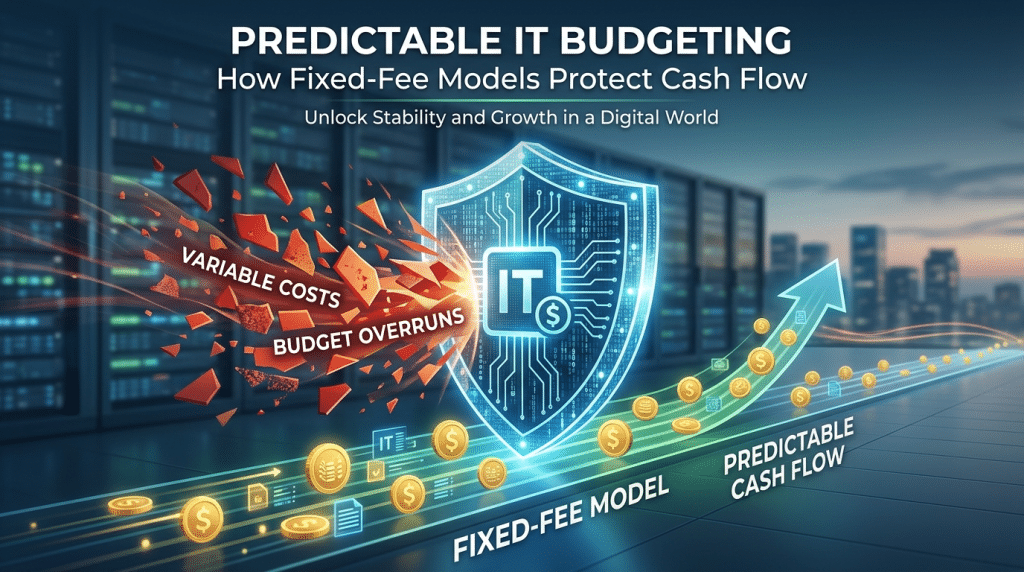
Flat-Rate Security: How Fixed-Fee IT Models Protect Your Monthly Cash Flow from Unpredictable Tech Spikes
When a business owner or chief financial officer sits down to project their quarterly operating margins, they rely on predictability. They look at fixed lease payments, structured payroll structures, and steady utility overhead to build a reliable baseline for their cash flow. Because these numbers are constant, leadership can confidently allocate funds toward market expansion, product development, inventory procurement, and corporate capital reserves.
However, when it comes to technology infrastructure, many small to mid-sized organizations operate under an outdated, volatile financial model known as the break-fix approach.
Under a break-fix arrangement, a business pays zero dollars for IT support when everything is running smoothly. But the moment a local network server crashes, an automated backup routine fails, or a critical database corrupts, the firm must pay high, unmanaged hourly consulting rates to emergency engineers to patch the infrastructure. This approach turns your technology line item into a volatile roller coaster that breaks financial forecasts.
To maintain operational stability and protect your monthly treasury, your business must move away from reactive technical bills and transition to a proactive, fixed-fee IT partnership. Here is how flat-rate managed IT services eliminate hidden tech spikes and bring absolute predictability to your balance sheet.
The Hidden Cost of the Break-Fix Illusion
The primary appeal of the legacy break-fix model is psychological. Management believes they are saving cash by only paying for IT assistance when a clear hardware or software failure occurs.
This is a profound financial illusion. The break-fix model contains an inherent misalignment of incentives between your business and your technology provider. In a break-fix scenario, your IT vendor only generates revenue when your business is actively suffering from technical failure, system downtime, or a network emergency. They have zero commercial incentive to engineer a self-healing, bulletproof environment that prevents glitches in the first place.
This friction introduces three major financial drains to your daily cash flow:
First, it creates unpredictable budget spikes. A single complex network intrusion or an unexpected hardware lifecycle breakdown can easily result in an emergency technical invoice totaling thousands of dollars in unbudgeted hourly fees.
Second, it hits your business with a steep productivity tax. While you wait for a break-fix technician to arrive at your office, diagnose a system failure, and bill you by the hour to repair it, your workforce is left completely paralyzed. If a department of twenty employees faces an all-day network blackout, you are cutting check sizes for hours of zero operational output.
Third, it leaves your perimeter wide open to automated threats. Because break-fix providers do not perform continuous patch management or proactive vulnerability monitoring, your outdated applications and unmanaged network ports sit exposed to global cybercriminals who use automated scanning bots to deploy ransomware.
How Fixed-Fee Models Stabilize Your Balance Sheet
A flat-rate Managed Service Provider (MSP) model completely reverses this dynamic. Under a fixed-fee agreement, your organization pays a single, predictable monthly fee that covers your entire digital footprint: continuous endpoint monitoring, cloud backup protection, user helpdesk ticketing, and data compliance perimeters.
This flat-rate structure completely realigns operational incentives. Because the provider receives a fixed monthly amount regardless of how many technical issues occur, their entire objective shifts from reactive firefighting to aggressive, proactive prevention. The provider maximizes their own efficiency by building an incredibly stable, zero-trust infrastructure that keeps your business live, fast, and completely secure.
Transitioning to a fixed-fee infrastructure protects your cash flow across three core pillars:
- Absolute Capital Predictability: Your IT infrastructure cost is hardcoded into your budget. There are no surprise consulting invoices, no hidden surcharges for out-of-hours ticket remediation, and no unexpected support billing spikes, allowing your finance team to project exact profit margins.
- Continuous Vulnerability Hardening: Instead of waiting for a network breach to occur, a proactive partner performs continuous automated software updates, firewall configurations, and edge security mapping as part of your baseline agreement.
- Frictionless Workforce Velocity: Employees gain instantaneous access to helpdesk resolution without management needing to authorize an hourly expense for every support ticket. Your staff logs in safely using rapid biometric single sign-on (such as Windows Hello and Touch ID), keeping their daily focus entirely on hitting corporate production deadlines.
Conclusion: Trade Volatility for Velocity
In the modern marketplace, capital efficiency and financial predictability are essential requirements for sustained enterprise growth. Relying on an unpredictable break-fix model to maintain your corporate network is an operational gamble that invites daylight downtime, unbudgeted capital drains, and severe cyber liabilities. By embracing a proactive, fixed-fee managed IT model, you transform your technology stack from an erratic cost center into a smooth, self-healing foundation—ensuring your capital, your data, and your monthly cash flow remain under your absolute control.
Are unpredictable IT repair bills and sudden system failures continually disrupting your monthly cash flow projections? Contact Krypto IT today for a comprehensive Technical Infrastructure and Predictable Budgeting Review, and let’s stabilize your digital baseline.