Why Your Culture Is Your Strongest Firewall
May 25, 2026
Leading Your Clients Through a Cyber Crisis
May 27, 2026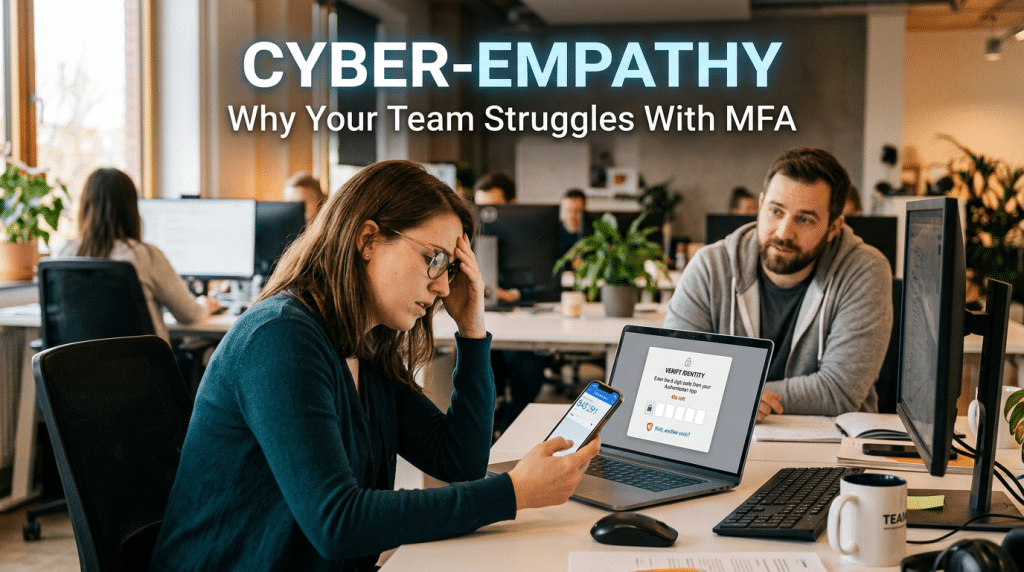
Beyond Frustration: Embracing Cyber-Empathy to Solve the MFA Adoption Crisis
Multi-Factor Authentication (MFA) is one of the most effective security controls an organization can implement. By requiring a second layer of verification—such as an app notification, a text message, or a physical token—MFA stops the vast majority of identity-based cyberattacks in their tracks. It transforms a simple compromised password from an enterprise-wide catastrophe into a minor, contained incident.
Yet, if you look at the daily operations of most small and mid-sized businesses, MFA is often met with widespread internal resistance.
To a business owner or security administrator, the rule is simple: “Just tap the button on your phone to log in.” But to an employee trying to manage a heavy workload, handle incoming client requests, and hit tight deadlines, the reality looks very different. When security measures fail to account for human workflow, fatigue, and psychology, employees do not become more secure—they become burnt out.
To bridge this gap and build a resilient workforce, leadership must adopt a posture of cyber-empathy. This means looking past raw compliance statistics and truly understanding the daily friction your team faces, so you can engineer security that works with human nature rather than against it.
The Anatomy of MFA Fatigue
To build an empathetic security strategy, management must first diagnose exactly why employees struggle with traditional multi-factor authentication loops. It is rarely a matter of lazy staff or deliberate insubordination; instead, it is driven by measurable physical and psychological friction:
1. The Interruption Tax on Productivity
Deep focus is a fragile state. When an employee is analyzing a complex spreadsheet, drafting a technical proposal, or corresponding with an important client, they are in a high-value productive rhythm. If an aggressive security policy logs them out of their database every 60 minutes, that rhythm is shattered. The employee must stop what they are doing, hunt for their personal smartphone, unlock it, open an authenticator app, find a six-digit code, and type it in before the timer expires. This continuous contextual switching causes a cognitive drain that lowers overall output and heightens workplace frustration.
2. The Boundary Blur of Personal Devices
In many modern organizations, staff are required to download corporate authenticator apps onto their personal cell phones. While this saves the company the cost of purchasing dedicated corporate hardware, it introduces a subtle but real boundary violation. Employees may feel uncomfortable installing mandatory workplace monitoring software on a device that holds their personal photos, bank accounts, and private conversations. If a security prompt wakes them up on a weekend or during dinner, it breeds a quiet resentment toward the company’s entire security infrastructure.
3. The Threat of “MFA Fatigue” Attacks
When security friction becomes too intense, it actually creates a severe technical vulnerability. Cybercriminals now exploit user frustration through “MFA Fatigue” or “Prompt Bombing” attacks. A hacker who has stolen an employee’s password will trigger dozens of push notifications to the user’s phone in rapid succession at 3:00 AM. A user who is exhausted by endless, daily security prompts may tap “Approve” simply to make the notifications stop and go back to sleep, inadvertently granting the intruder complete access to the corporate network.
Engineering an Empathetic Security Framework
Cyber-empathy does not mean lowering your defenses or disabling multi-factor authentication. It means using intelligent, modern technology to deliver the same high-level protection while actively eliminating user exhaustion.
At Krypto IT, we help organizations transition away from high-friction enforcement and toward an intuitive, human-centric security model:
- Contextual and Conditional Access: Stop treating every login attempt identical to the last. By deploying conditional access profiling, your network can evaluate the risk of a login in the background. If an employee is sitting at their familiar desk, using a company-managed laptop, on the office’s secure network, the system recognizes the safe environment and minimizes unnecessary prompts. MFA is saved for true anomalies—such as a login attempt from a new device, a public Wi-Fi network, or an unusual geographic location.
- Biometric Windows Hello and Touch ID Integration: Eliminate the stress of text codes and app digging by moving to identity-first biometrics. Allowing an employee to clear a security check with a single glance at their webcam or a quick touch of a fingerprint scanner keeps authentication under one second and feels entirely natural to the modern digital user.
- Single Sign-On (SSO) Consolidation: Instead of forcing staff to authenticate separately into their email, their CRM, their project management boards, and their accounting tools throughout the morning, use a secure SSO portal. The employee performs one robust, biometrically validated login at the start of their day, granting them smooth, secure entry into every tool they need to excel.
Conclusion: Security Designed for People
In the modern digital landscape, human endurance is a finite resource. If your IT strategy treats your employees like machines that can handle endless programmatic friction, your culture will eventually fracture, leading to dangerous workarounds and hidden vulnerabilities. By leading with cyber-empathy and deploying smart, non-intrusive identity guardrails, you build an organization that is both exceptionally secure and profoundly productive.
Is your security stack causing user burnout and hidden risks? Contact Krypto IT today for a comprehensive “MFA Friction and Security Usability Audit” and let’s design a defensive strategy your team will actually embrace.