Rethinking Passwords: Why the 90-Day Rule Fails
April 8, 2026
The SASE Revolution: Why the VPN is Dead
April 10, 2026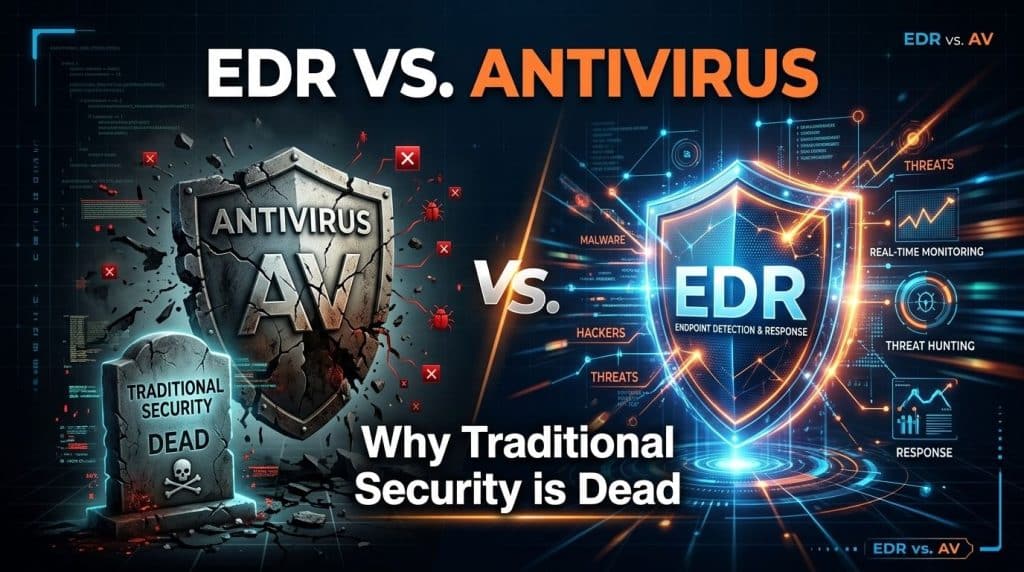
Stop Buying Yesterday’s Protection: Why the ‘Next Gen’ Label is No Longer Marketing Fluff
The Contrarian’s Security Playbook by Krypto IT | Challenging Outdated IT Dogma in Houston
If you walk into any office in the Energy Corridor or a logistics hub near the Port of Houston and ask the business owner if they are protected, they will almost certainly point to a small icon in their taskbar. “I’ve got an antivirus,” they’ll say with a sense of finality. “It’s got a green checkmark. I’m good.”
At Krypto IT, we have to be the bearer of some uncomfortable news: In 2026, relying solely on traditional antivirus (AV) is like trying to protect a modern bank with a wooden door and a list of known shoplifters. It’s not just “old school”—it’s functionally useless against the current wave of polymorphic, AI-driven attacks hitting Texas businesses.
It is time to stop thinking about “Antivirus” and start talking about Endpoint Detection and Response (EDR). The “Next Gen” label isn’t just marketing—it’s the difference between a minor incident and an extinction-level event for your firm.
The Signature Trap: Why Your AV is Blind
Traditional antivirus works on a “Blacklist” model. It has a library of “signatures”—essentially digital fingerprints of known viruses. When a file lands on your computer, the AV checks its fingerprint against the library. If it matches a known criminal, it blocks it. If it doesn’t, it lets it in.
The problem? Modern hackers don’t use the same “fingerprint” twice. In 2026, malware is polymorphic. Using AI, hackers can slightly alter the code of a virus every few seconds. By the time a signature is created and downloaded to your traditional AV, the hacker has already moved on to version 2.0, 3.0, and 4.0.
By relying on traditional AV, you are effectively tellling your security guard: “Only stop the people whose faces are on these ten-year-old posters.” Meanwhile, the hackers are walking through the front door wearing a new mask every single time.
Behavior is the New Signature: The EDR Revolution
This is where the “Next Gen” label actually earns its keep. EDR doesn’t care what a file looks like; it cares what the file does.
Imagine a person walks into your Houston office. They aren’t on any “banned” list. They look like a normal visitor. But instead of going to the front desk, they immediately start trying to open every locked drawer and looking for the safe. A traditional AV would ignore them because they aren’t a “known criminal.”
An EDR system is like a high-tech surveillance network with AI-behavioral analysis. It notices that the visitor is acting suspiciously. It sees them trying to access sensitive areas. It doesn’t need to know who they are to know that their actions are malicious. In the digital world, EDR watches for “fileless” attacks, credential harvesting, and unauthorized encryption—the hallmarks of modern ransomware that traditional AV misses entirely.
The “Response” in EDR: More Than Just Deleting a File
The biggest flaw in the “Antivirus” mindset is that it is purely a “delete” tool. If an AV finds a virus, it deletes it. Case closed.
But in 2026, a virus is rarely a lone wolf; it’s a scout. If a piece of malware hits one laptop in your Woodlands home office, you need to know: Where did it come from? What other machines did it touch? Did it exfiltrate any data before it was caught?
Traditional AV can’t answer those questions. EDR provides the “Response.” When a threat is detected, EDR can:
- Isolate the Device: Automatically kick the infected laptop off the network so the threat can’t spread to your server.
- Roll Back the Clock: In some cases, EDR can actually reverse the changes made by ransomware, restoring your files to their state just seconds before the attack.
- Perform Forensic Analysis: It shows us the “kill chain”—the exact path the hacker took—so we can close the hole for good.
Why Houston SMBs Are the Biggest Winners
There is a myth that EDR is “Enterprise only”—too expensive and too complex for a 20-person law firm or a local construction company.
At Krypto IT, we argue the opposite. Small businesses have the most to lose from a breach. A major corporation in Downtown Houston has a massive IT team to handle a cleanup; you have a business to run. By implementing EDR, you are essentially hiring a 24/7 Security Operations Center (SOC) to watch over your network.
The “Next Gen” label means you are no longer playing a game of “Whack-a-Mole” with old viruses. You are building a sentinel that understands the intent of an attacker, stopping them before they can even get their foot in the door.
Conclusion: Don’t Settle for a Green Checkmark
In the 2026 Trust Economy, your clients aren’t just asking if you have an antivirus; they are asking if their data is safe from the next generation of threats. If you are still relying on a 2015 security model, you are a target of opportunity.
Is your “Next Gen” security actually just an old suit with a new label? Contact Krypto IT today for a “Behavioral Defense Audit” and let’s upgrade your shield.