Cloud Outage Playbook: Keep Operations Running
August 28, 2026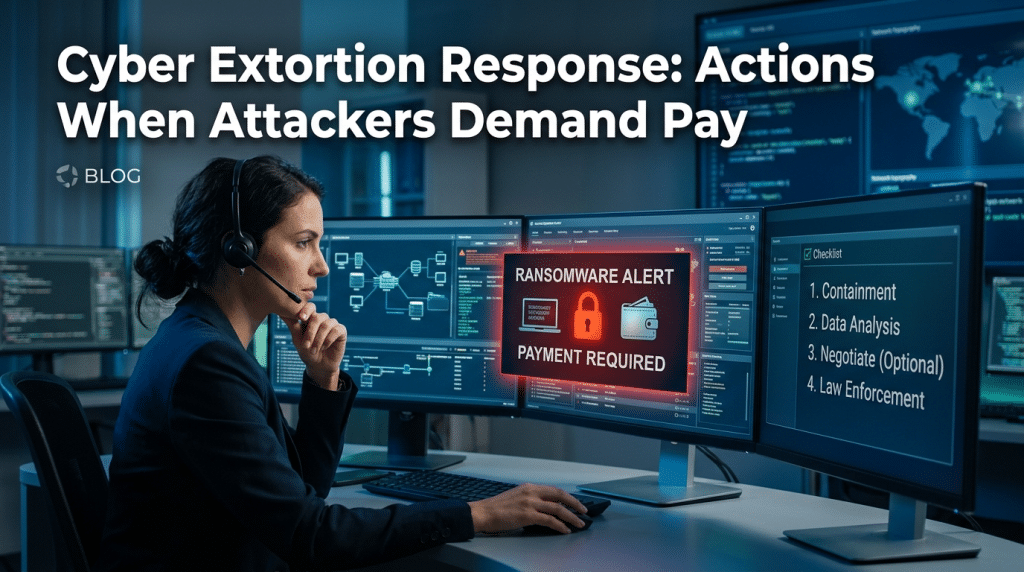
Cyber Extortion Response: Step-by-Step Actions When Attackers Demand Payment
Finding a ransom note on your server or receiving an extortion email from a cybercriminal group is one of the most stressful events an organization can face. Attackers often deploy multi-extortion tactics: not only encrypting core systems to halt operations, but also stealing sensitive customer records, financial reports, or proprietary source code and threatening public disclosure on leak sites.
Under extreme pressure, leadership teams frequently panic. Some rush to wipe systems, while others contemplate immediate ransom payments in hopes of making the crisis disappear.
Both impulsive reactions can lead to catastrophic consequences. Paying a ransom does not guarantee data recovery, fails to prevent secondary extortion attempts, and may violate federal regulatory sanctions. A structured, methodical cyber extortion response plan is essential to protecting your business, preserving digital evidence, and navigating extortion demands safely.
Step 1: Isolate Affected Systems Without Powering Down
The immediate priority during an active extortion event is containment, but it must be handled carefully to avoid destroying vital digital forensics.
- Disconnect Network Connectivity: Physically unplug Ethernet cables and disable Wi-Fi adapters on affected endpoints, servers, and hypervisors. Isolate virtual machines using hypervisor network segmentation.
- Do Not Power Off Machines: Avoid hard resets or powering down infected machines. Volatile memory (RAM) contains active encryption keys, running malware processes, and network connection artifacts that digital forensic investigators need to identify the threat actor.
- Segment Backup Repositories: Immediately sever network links between your live environment and backup storage pools to prevent attackers from executing wipe scripts against immutable or secondary cloud backups.
Step 2: Establish Secure Out-of-Band Communications
Assume that primary internal communication channels—including corporate email, unified messaging platforms, and internal VoIP—are monitored or compromised by the intruder.
- Move to Encrypted Alternate Channels: Transition incident response leadership, executive decision-makers, and technical responders to dedicated out-of-band communication tools such as Signal, encrypted external conference lines, or secondary offline mobile channels.
- Protect Incident Documentation: Keep all incident notes, breach assessments, and remediation plans off the primary corporate network to prevent attackers from tracking your response strategy in real time.
Step 3: Activate Your Incident Response and Legal Ecosystem
Cyber extortion is not merely an IT emergency; it is a complex legal, financial, and regulatory event requiring specialized external expertise.
- Notify Cyber Insurance Immediately: Contact your cyber insurance provider’s 24/7 claims hotline. Most policies mandate prompt notification and require the deployment of pre-approved breach counsel and digital forensics and incident response (DFIR) retainers.
- Engage Legal Breach Counsel: Retaining specialized cybersecurity attorneys ensures that forensic investigations, threat actor communications, and system assessments remain protected under attorney-client privilege.
- Engage Certified Ransomware Negotiators: Never allow internal staff or untrained personnel to communicate directly with extortionists. Professional negotiators understand threat actor psychology, know how to stall for time, verify data possession, and validate decryption keys without escalating demands.
Step 4: Assess Threat Actor Claims and Data Exfiltration
Extortionists frequently make exaggerated claims to accelerate payment. Before making strategic decisions, forensic teams must validate the actual scope of compromise.
- Demand Proof of Possession: If attackers claim to possess stolen databases or proprietary files, specialized negotiators require proof of life—such as specific file directory samples or non-sensitive sample records—to confirm actual exfiltration.
- Identify Threat Actor TTPs: Forensic investigators analyze attacker tactics, techniques, and procedures (TTPs) alongside ransom note identifiers to attribute the attack to known ransomware-as-a-service (RaaS) groups, clarifying their historical reliability regarding decryption tools.
- Determine Sanctions Compliance: Under guidelines from agencies like the U.S. Department of the Treasury’s Office of Foreign Assets Control (OFAC), paying ransoms to sanctioned entities or state-sponsored cyber syndicates carries severe legal penalties. Legal counsel must perform mandatory sanctions checks.
Step 5: Execute Clean Restoration and System Hardening
The ultimate goal of extortion response is restoring operations cleanly without relying on attacker promises.
- Verify Clean Recovery Points: Before initiating data restoration, scan and audit backup images in an isolated sandbox environment to confirm that malware persistence mechanisms and dormant backdoors are absent.
- Rebuild from Clean Baselines: Rebuild operating systems and active directories from scratch or verified golden images rather than simply restoring potentially compromised host states.
- Close Entry Vectors and Rotate All Secrets: Identify the initial point of entry—whether an unpatched edge vulnerability, stolen remote access credential, or phishing hook. Patch the flaw, enforce hardware-backed Multi-Factor Authentication (MFA), and force enterprise-wide password and API key rotations.
Protect Your Organization from Cyber Extortion with Krypto IT
Surviving a cyber extortion attempt requires proactive architectural defense, verified recovery systems, and a rapid, battle-tested response strategy.
At Krypto IT, we help Houston businesses deploy robust Zero-Trust protections, automated immutable backup architectures, and comprehensive incident response plans that neutralize extortion threats and keep your critical operations running.
Are your systems and incident response protocols prepared to handle an extortion demand? Contact Krypto IT today to schedule a comprehensive threat assessment and incident preparedness review.