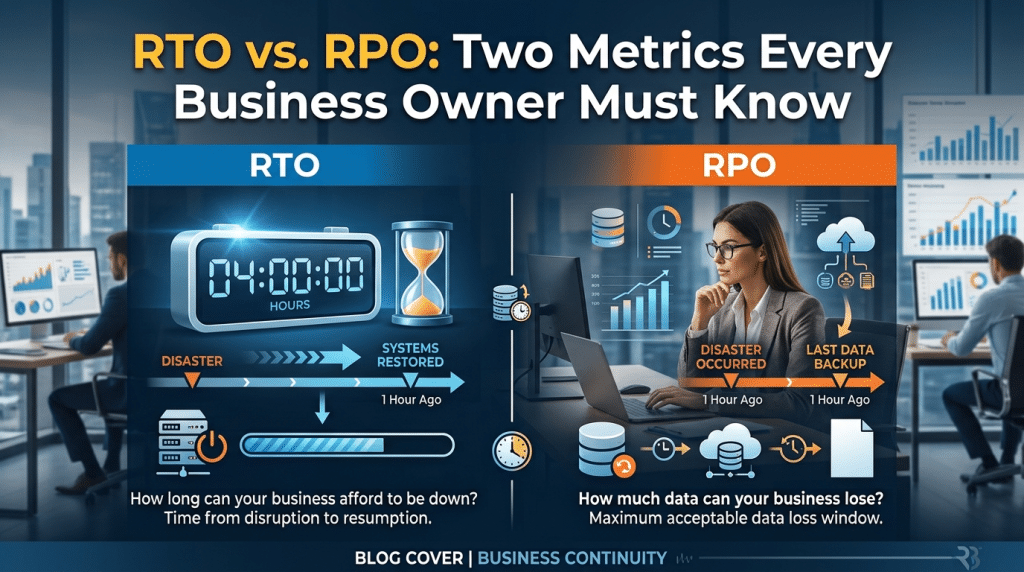
RTO vs. RPO: Two Metrics Every Business Owner Must Know
August 25, 2026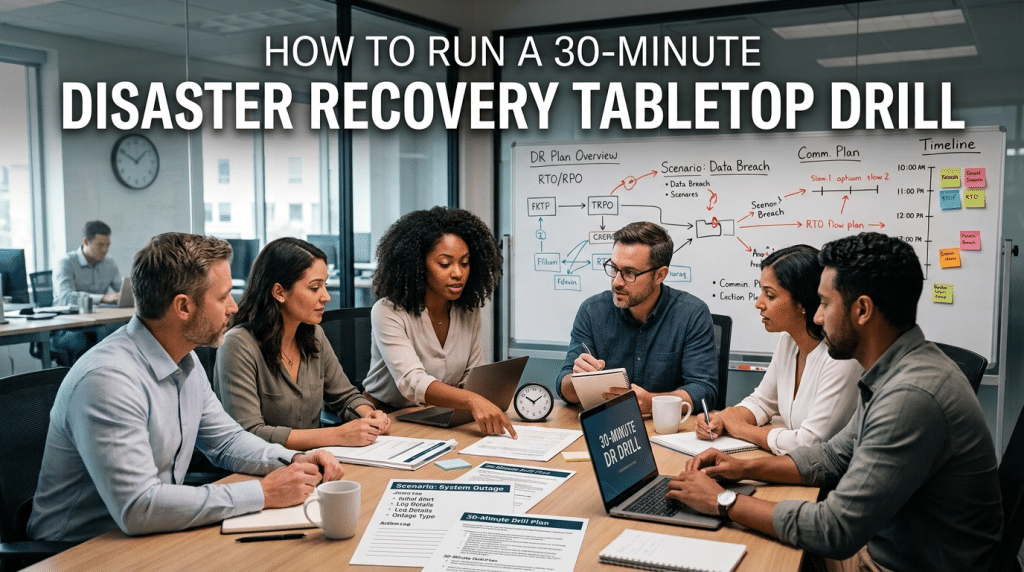
How to Run a 30-Minute Disaster Recovery Tabletop Drill with Your Core Team
When a severe crisis hits—whether it is a widespread ransomware deployment, a blown server power supply, or a major regional power outage—the worst time to discover gaps in your disaster recovery plan is during the active emergency. Under intense pressure, confusion over roles, missing contact details, and unverified assumptions can turn an otherwise manageable IT incident into days of crippling downtime.
Many business leaders believe that testing business continuity requires days of planning, complicated simulations, and massive operational disruption. As a result, incident response testing gets pushed off indefinitely.
In reality, an effective exercise does not need to consume an entire workday. A focused, structured 30-minute tabletop drill is one of the most efficient ways to pressure-test your emergency response, clarify leadership roles, and uncover critical vulnerabilities before a real outage strikes.
Here is a practical, step-by-step framework to run an impactful disaster recovery tabletop drill with your key leadership team in just half an hour.
What Is a Tabletop Drill?
A disaster recovery tabletop drill is a discussion-based walkthrough where key stakeholders gather around a table (or on a video call) to respond to a realistic emergency scenario.
No actual systems are taken offline, no production code is altered, and no employees are interrupted. Instead, your team talks through the exact operational, technical, legal, and communication steps they would take as the scenario unfolds in real time.
Preparation: Setting Up the 30-Minute Drill
To keep the exercise efficient and actionable, prep these foundational elements in advance:
- Select Key Participants: Include decision-makers across primary business functions—the business owner or CEO, operations lead, head of finance, human resources manager, and your Managed Service Provider (MSP) or IT director.
- Establish Ground Rules: Emphasize that this is a no-blame learning environment designed to uncover system and process weaknesses, not critique individual performance.
- Choose a Realistic Scenario: Pick one specific, high-impact disruption. Common options include a ransomware attack encrypting the main database server, a lost executive laptop holding unencrypted customer records, or an office-wide internet outage during payroll processing.
The 30-Minute Drill Breakdown
Structure the meeting into four strict, time-boxed blocks to maintain momentum and focus:
Minutes 0–5: The Incident Briefing
The drill facilitator presents the opening scenario with specific, realistic operational details.
Example scenario: “It is 8:30 AM on a Tuesday. Several staff members report that their desktop files have turned into unreadable extensions, and a text file demands a Bitcoin ransom. Our main file server and shared cloud drive are completely locked.”
Minutes 5–15: Initial Response and Containment
The team discusses the immediate operational triage steps:
- Technical Isolation: Who has the authority and access to immediately disconnect affected machines and isolate the network from cloud backups?
- Escalation and Notification: Who alerts our IT partner or cybersecurity team? What alternate communication channel do we use if company email and internal chat are compromised?
- Customer and Legal Protocols: Does our cyber insurance policy require us to contact their designated incident response team before taking remediation steps?
Minutes 15–23: Continuity and Business Operations
The team evaluates how daily operations continue while systems are down:
- Alternate Workflows: How do customer service and sales staff operate without access to the central CRM or ERP database?
- RTO and RPO Validation: Can our backup systems restore operations within our target Recovery Time Objective (RTO)? When was the last verified immutable snapshot taken?
- Internal and External Communications: Who is authorized to speak with clients, stakeholders, and the public? What draft messaging is ready to explain service delays?
Minutes 23–30: The Action-Item Debrief
Spend the final seven minutes capturing clear takeaways and assigning ownership to close identified gaps:
- Did we discover missing emergency phone numbers or outdated contact lists?
- Were roles and decision-making authorities clear, or did people hesitate?
- Are cyber insurance policy details and claim phone numbers stored offline where they can be accessed if corporate email is down?
Turning Drill Findings into Real-World Resilience
A tabletop drill is only valuable if it leads to meaningful improvements. Document every bottleneck uncovered during the session, whether it is creating an offline emergency contact sheet, drafting pre-approved client notification templates, or configuring rapid cloud server virtualization with your IT team.
Schedule tabletop drills semi-annually, rotating through different disruption scenarios to build organizational muscle memory.
Strengthen Your Business Continuity with Krypto IT
Disaster preparedness requires proven recovery systems paired with an aligned, confident team.
At Krypto IT, we help Houston businesses build robust Business Continuity and Disaster Recovery (BCDR) architectures, facilitate realistic incident response drills, and implement rapid-recovery failovers that keep your business resilient in any crisis.
Is your team prepared to respond effectively if an IT disaster strikes tomorrow? Contact Krypto IT today to schedule a comprehensive business continuity and disaster recovery review.