Cyber Extortion Response: Actions When Attackers Demand Pay
August 31, 2026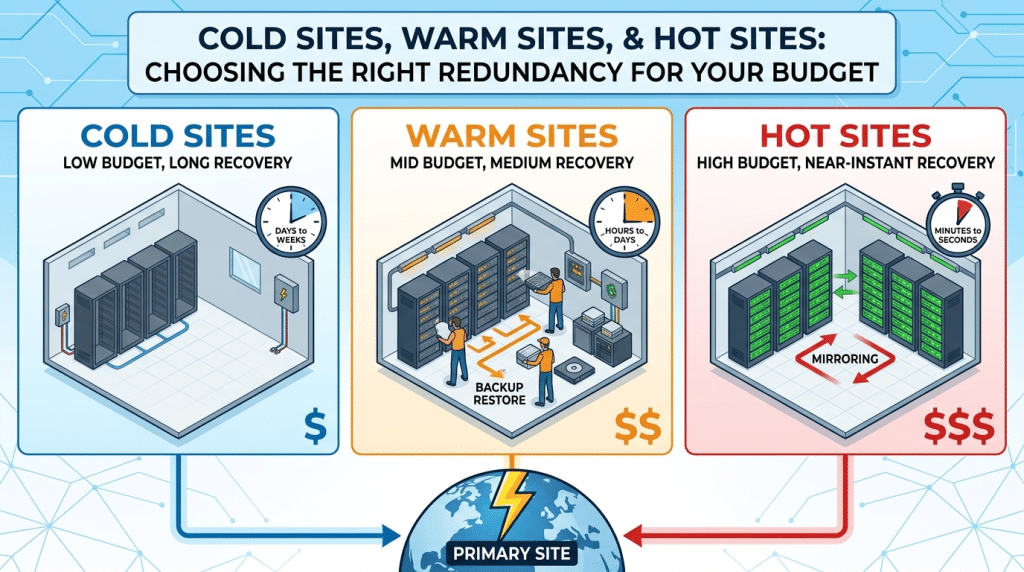
Cold Sites, Warm Sites, and Hot Sites: Choosing the Right Redundancy for Your Budget
When developing a comprehensive disaster recovery and business continuity strategy, one of the most critical decisions leadership must make is where and how operations will resume if a primary facility or data center is rendered completely unusable.
Whether an outage is caused by a catastrophic hardware failure, a localized natural disaster, a protracted power blackout, or an aggressive ransomware attack, your organization needs an alternate location—either physical, virtual, or cloud-hosted—to restore systems and resume work.
In disaster recovery planning, secondary recovery environments are traditionally classified into three operational models: Cold Sites, Warm Sites, and Hot Sites.
Each tier represents a specific balance between recovery speed and financial cost. Selecting the appropriate model requires evaluating your organization’s Recovery Time Objective (RTO), Recovery Point Objective (RPO), and operational budget.
1. Cold Sites: The Low-Cost Baseline
A cold site is a secondary facility that provides basic physical and technical infrastructure—such as space, power connections, cooling, and basic network cabling—but contains no pre-installed computer hardware, active servers, or pre-loaded company data.
- How It Works: In the event of a disaster, your organization must purchase or transport replacement server hardware, configure the operating environment from scratch, establish internet circuits, download backup archives from offsite storage, and verify application functionality before employees can resume work.
- Recovery Timeline (RTO & RPO): Recovery times for cold sites are measured in days to weeks. RPO depends on the age of the offsite backup media available for restoration.
- Cost Profile: Cold sites are the most economical recovery option. They carry minimal ongoing maintenance overhead and lower subscription or lease fees because no expensive computing assets or continuous software licenses sit idle.
- Best For: Non-critical operations, organizations with flexible delivery timelines, or budget-conscious businesses with systems that can remain offline for several days without fatal financial or legal consequences.
2. Warm Sites: The Balanced Middle Ground
A warm site provides a compromise between cost efficiency and recovery speed. It is a secondary location equipped with hardware, networking infrastructure, and pre-installed operating systems, but it does not maintain a live, real-time mirror of your primary production data.
- How It Works: Server racks, storage arrays, and network switches are already installed and configured at the warm site. Backups are delivered periodically (such as daily or weekly increments) either over high-speed network tunnels or via cloud replication. When a disaster occurs, administrators do not need to build hardware; they simply restore the latest available data snapshots onto the waiting systems.
- Recovery Timeline (RTO & RPO): Recovery times for warm sites typically range from a few hours to a couple of days. RPO corresponds to the frequency of your periodic data replication schedule (often 12 to 24 hours).
- Cost Profile: Moderate. Warm sites require ongoing capital investment for secondary hardware, routine system maintenance, power consumption, and periodic software licensing, but avoid the high expense of continuous real-time synchronization.
- Best For: Mid-market businesses, core business applications, and standard commercial operations that can tolerate brief, planned downtime while requiring recovery within the same or next business day.
3. Hot Sites: Maximum Resilience and Instant Failover
A hot site is a fully replicated, continuously synchronized clone of your primary production environment. It runs identical hardware, software configurations, database instances, and network connections in parallel with your primary site.
- How It Works: Production data is continuously replicated to the hot site in near real time using synchronous or asynchronous database replication. If the primary site goes dark, automated or single-click failover mechanisms redirect traffic and workloads to the hot site almost instantaneously, often without users noticing an interruption.
- Recovery Timeline (RTO & RPO): Recovery times for hot sites are measured in minutes to seconds (near-zero RTO), with virtually zero data loss (near-zero RPO).
- Cost Profile: High. Hot sites are the most expensive disaster recovery tier, requiring complete hardware duplication, redundant enterprise bandwidth, duplicate software licensing, and active management overhead.
- Best For: Financial institutions, healthcare providers, mission-critical e-commerce platforms, and 24/7 enterprise services where even an hour of downtime results in devastating financial losses or regulatory penalties.
The Modern Shift: Cloud-Based Disaster Recovery (DRaaS)
Historically, building warm or hot sites required leasing physical real estate and purchasing duplicate physical hardware racks. Today, modern cloud infrastructure and Disaster Recovery as a Service (DRaaS) have changed the economics of redundancy.
By utilizing hyperscale cloud platforms, organizations can maintain a “warm standby” or automated hot failover environment without the heavy capital expense of physical data centers. Cloud virtualization allows servers to remain in an encrypted, dormant snapshot state at low storage costs, only spinning into active, billable compute nodes when a failover drill or actual emergency occurs.
How to Choose the Right Model for Your Business
To select the right redundancy tier for your organization, follow this decision framework:
- Calculate the True Cost of Downtime: Determine your hourly financial burn rate during an outage. If losing systems for 24 hours costs $100,000, investing in a warm or hot cloud failover delivers immediate return on investment.
- Tier Your Workloads: You do not need a uniform model across your entire IT estate. Deploy a hot failover for customer-facing web applications and primary databases, a warm failover for internal file shares and accounting systems, and a cold recovery plan for legacy archive servers.
- Test Regularly: Regardless of whether you deploy a cold, warm, or hot strategy, schedule semi-annual failover drills to ensure staff know the exact activation procedures.
Build Resilient Redundancy with Krypto IT
Disaster recovery should match your exact operational requirements, compliance mandates, and budgetary constraints.
At Krypto IT, we help Houston businesses design and manage hybrid and cloud-based disaster recovery architectures—delivering rapid RTOs and minimal data loss without unnecessary infrastructure costs.
Are you unsure which recovery redundancy model fits your business operations and budget? Contact Krypto IT today to schedule a comprehensive business continuity assessment.