Phishing Simulation Twist: Testing Client Staff
August 13, 2026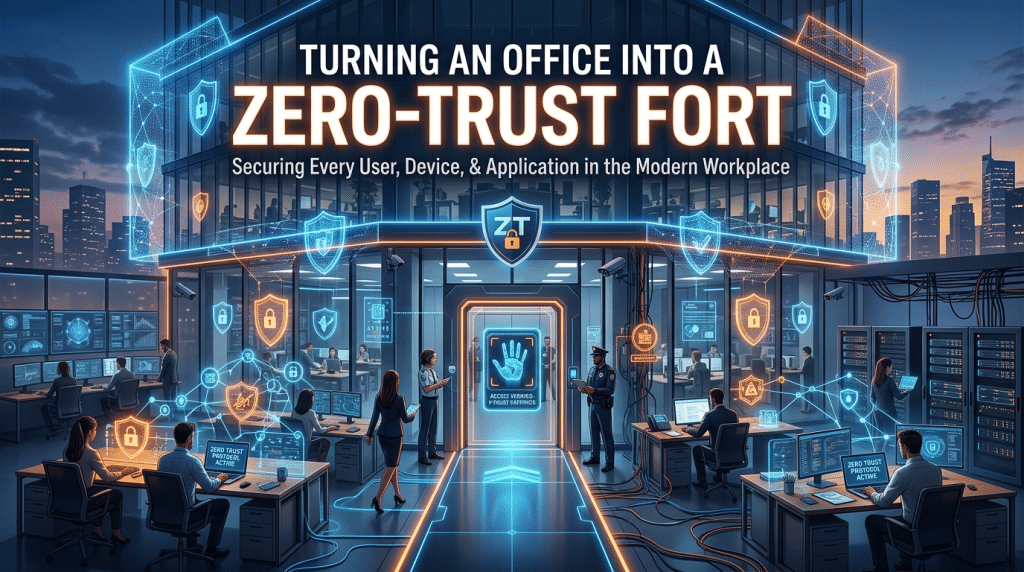
Before and After: Turning a Vulnerable Office Into a Zero-Trust Fort
For decades, corporate network security operated on a “castle-and-moat” philosophy: once a user or device made it past the outer perimeter (the firewall), they were granted unfettered trust inside the network. If an employee was in the office or connected via VPN, the system assumed they had legitimate reasons to access local shared drives, databases, and internal servers.
In a modern business landscape shaped by hybrid work, software-as-a-service platforms, and sophisticated credential phishing, the castle-and-moat model has failed. If an attacker breaches the perimeter or compromises a single set of login credentials, they can move laterally across the entire network with zero friction.
The modern antidote to this vulnerability is Zero Trust: a security framework built on the core principle of “never trust, always verify.”
Here is the before-and-after story of how Krypto IT transformed a vulnerable, open-door business office into an agile, highly secure Zero-Trust fort.
The “Before”: A Wide-Open Castle with a Fragile Moat
When we first evaluated the client—a mid-sized Houston engineering firm with 45 on-site and remote employees—their network suffered from classic architectural vulnerabilities:
- Flat Internal Network: Workstations, network printers, VoIP desk phones, guest Wi-Fi devices, and accounting servers all resided on the same single subnet. If a smart TV or guest phone were infected, a threat actor had direct network visibility into the accounting server.
- Static Passwords and Fragmented Logins: Staff used distinct, unsynced passwords across different business applications. Multi-factor authentication was only partially adopted, leaving remote email access exposed to credential-stuffing attacks.
- Broad Access Privileges: Every employee had full access to the primary network file share. Marketing staff could browse technical engineering drawings, and administrative staff had access to historical financial records.
- Unmanaged Remote Devices: Remote employees regularly accessed corporate files from personal home computers with unknown security patch levels and no centralized antivirus monitoring.
The company felt secure because they had an enterprise firewall in their server closet, but an internal compromise of any single workstation would have allowed ransomware to spread across the entire business within minutes.
The Transformation: Building the Zero-Trust Fort
Transitioning to a Zero-Trust architecture does not happen overnight, but applying structured controls across identities, devices, and networks yields immediate defense gains.
Phase 1: Securing Identity with Contextual Verification
In Zero Trust, identity is the new security perimeter. We consolidated all employee accounts into a central identity provider and enforced mandatory multi-factor authentication (MFA) across every cloud and local application.
Furthermore, we introduced Conditional Access Policies. Rather than just checking if a password and MFA token are correct, the identity engine continuously evaluates context:
- Where is the login coming from? (Geographic anomalies are blocked automatically.)
- What device is being used? (Only company-enrolled, encrypted devices can access core file systems.)
- What is the user’s risk score? (Unusual access times or abnormal behavior trigger immediate re-authentication challenges.)
Phase 2: Micro-Segmentation and Least Privilege
Next, we dismantled the flat network structure. We divided the physical and wireless networks into isolated Virtual Local Area Networks (VLANs).
Guest Wi-Fi, IoT office devices, user laptops, and sensitive servers were segregated into distinct zones with zero lateral communication permitted between them. We applied strict Role-Based Access Control (RBAC) across cloud drives and databases—ensuring employees only have access to the specific resources required to execute their daily jobs.
Phase 3: Continuous Endpoint Inspection
We deployed continuous Endpoint Detection and Response (EDR) agents to all corporate laptops and workstations. Under Zero Trust, an endpoint is never permanently trusted simply because it logged in successfully this morning. The EDR system continuously monitors running processes, file changes, and outbound network traffic in real time, automatically isolating any machine that displays abnormal or suspicious behavior.
The “After”: Resilience, Speed, and Compliance
Following the rollout, the client achieved a security posture capable of resisting modern cyber threats:
- Contained Blast Radius: If an employee clicks a phishing link today, the threat is completely confined to that single isolated device, with zero ability to move laterally to file repositories or servers.
- Seamless Remote Productivity: Employees work safely from anywhere without relying on sluggish legacy VPNs, as access policies verify security posture continuously in the cloud.
- Audit-Ready Compliance: The business now easily satisfies third-party client security assessments and cyber insurance underwriting requirements.
Build Your Zero-Trust Defense with Krypto IT
Zero Trust is not a single product you buy off the shelf; it is an ongoing architectural strategy that protects your critical data, employees, and operations from modern cyber attacks.
At Krypto IT, we help Houston businesses replace fragile perimeters with resilient Zero-Trust frameworks tailored to their exact workflows.
Ready to eliminate digital blind spots and secure your business? Contact Krypto IT today to schedule your Zero-Trust infrastructure assessment.