Moving Beyond the “IT Guy”: Why Dedicated Security Wins
August 11, 2026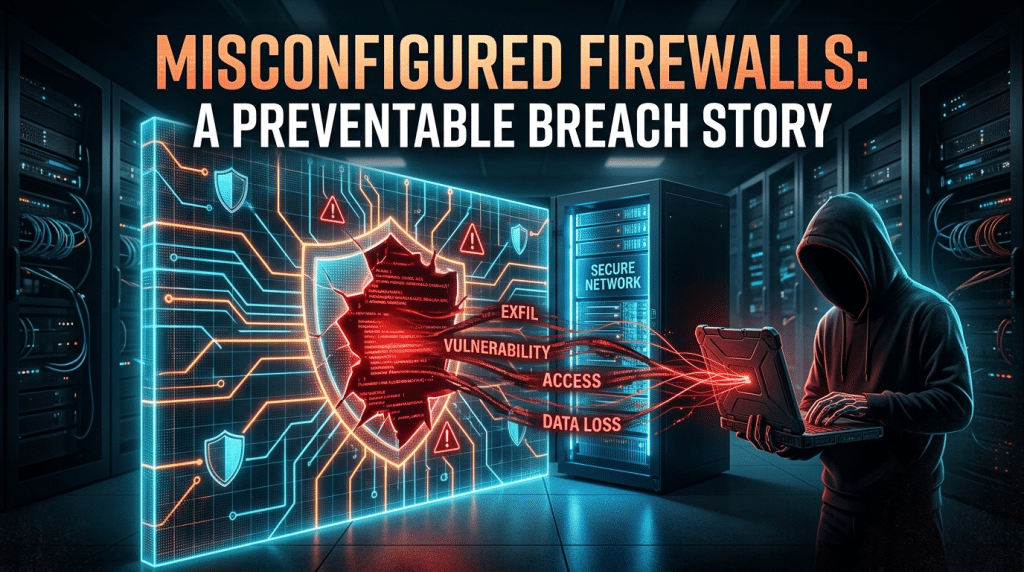
Misconfigured Firewalls: The True Story of a Breach That Should Have Been Stopped
When organizations invest in enterprise-grade firewalls, leadership often assumes they have erected an impenetrable digital perimeter. They purchase top-tier hardware, place the device at the edge of the network, and check the “network security” box on their compliance checklists.
However, a firewall is only as effective as the rules and policies programmed into it. In the world of cybersecurity, a top-of-the-line firewall with bad configuration rules is the digital equivalent of installing a high-tech steel door but leaving it propped open with a brick.
This is the true story of how a single misconfigured firewall rule led to a severe network compromise—and how proper firewall management and regular audits could have stopped the attack before it ever began.
The Setup: An “Any-Any” Rule Left Forgotten
The target was a growing mid-sized business operating in a busy office park. A year prior to the breach, the company contracted a temporary software vendor to deploy a new cloud-connected database module.
During the initial installation, the vendor encountered connectivity issues while attempting to sync data across ports. To speed up troubleshooting, a technician created a temporary inbound firewall rule: allowing all traffic from any source IP to any destination port inside the local network (commonly referred to in network administration as an “Any-Any” rule).
The temporary rule solved the connection glitch, and the database setup was completed successfully. However, the vendor never removed the rule, and the internal IT contact never performed a post-implementation review. The open rule sat silently in the firewall’s configuration file for over eleven months—completely invisible to end-users, but actively broadcasting an open door to automated external scanners.
The Attack: Automated Scanners Find the Hole
Cybercriminals do not sit at keyboards manually typing IP addresses one by one. Instead, they deploy automated botnets that continuously sweep the entire public IPv4 spectrum, searching specifically for exposed management ports, open Remote Desktop Protocol (RDP) channels, and permissive firewall rules.
Eventually, an automated botnet scanned the company’s public IP address and discovered the unrestricted inbound rule. Realizing that RDP port 3389 was wide open to the public internet, the botnet immediately initiated a targeted brute-force password spray attack against the domain controller.
Because the firewall was configured to pass all incoming traffic without filtering or rate-limiting, the attackers flooded the network with thousands of automated login attempts per minute. Within three hours, the script successfully guessed a weak administrative password on an dormant user account.
The Breach: Unchecked Lateral Movement
Once inside the network, the attacker discovered a second critical configuration flaw: a total lack of internal network segmentation.
Because the firewall was not configured to isolate distinct network zones, there were no internal barriers separating standard office workstations, guest Wi-Fi networks, accounting databases, and primary backup appliances. The attacker moved laterally across the network completely unimpeded:
- Reconnaissance: The attacker mapped active network shares and located unencrypted database backups.
- Disabling Safeguards: Using the compromised administrative account, the attacker disabled local antivirus software and deleted local shadow copies.
- Payload Execution: Ransomware was simultaneously deployed across twenty-five workstations and three primary storage servers.
By the time employees arrived at the office the following morning, every file server was encrypted, display screens showed ransom demands, and daily business operations were completely frozen.
The Cost of a Preventable Error
The business spent the next week dealing with massive operational disruption. Beyond the immediate financial losses stemming from employee downtime and emergency incident response services, the company suffered significant reputational damage with long-time clients.
The most frustrating aspect of the entire incident? The firewall hardware itself never failed. It performed exactly as programmed. The breach occurred solely because of human error during configuration and a total absence of routine firewall management.
Lessons Learned: Firewall Configuration Best Practices
Protecting your business from misconfiguration breaches requires shifting from a “set-it-and-forget-it” mindset to active perimeter governance.
1. Enforce the Principle of Least Privilege
Firewalls should operate on an explicit default-deny posture. All incoming and outgoing traffic should be blocked unless explicitly required for legitimate business functions. Never use blanket “Any-Any” rules, even for temporary troubleshooting.
2. Implement Strict Change Control Procedures
Require formal documentation and approval for every firewall rule modification. Temporary rules created for vendor access or troubleshooting must carry strict expiration dates and mandatory removal reminders.
3. Segment Internal Networks (VLANs)
Use your firewall and managed switches to divide your internal network into isolated Virtual Local Area Networks (VLANs). Separate sensitive payment terminals, accounting servers, and general staff workstations so that if one endpoint is compromised, the threat cannot move laterally across the entire business.
4. Schedule Regular Firewall Rule Audits
Perform routine security audits of your firewall rule sets. Partnering with a Managed Service Provider ensures that stale, redundant, or overly permissive rules are identified and purged before attackers can exploit them.
Secure Your Network Perimeter with Krypto IT
Your firewall is your first line of defense, but only if it is configured correctly and monitored continuously. At Krypto IT, we help businesses audit, optimize, and manage their network security infrastructure to ensure no hidden misconfigurations put your operations at risk.
When was the last time your firewall rules were audited? Contact Krypto IT today to schedule a comprehensive network perimeter security assessment.