Legacy Macro Risks: Excel Files as Security Nightmares
July 25, 2026
Firmware Security: The Hidden Small Business Risk
July 27, 2026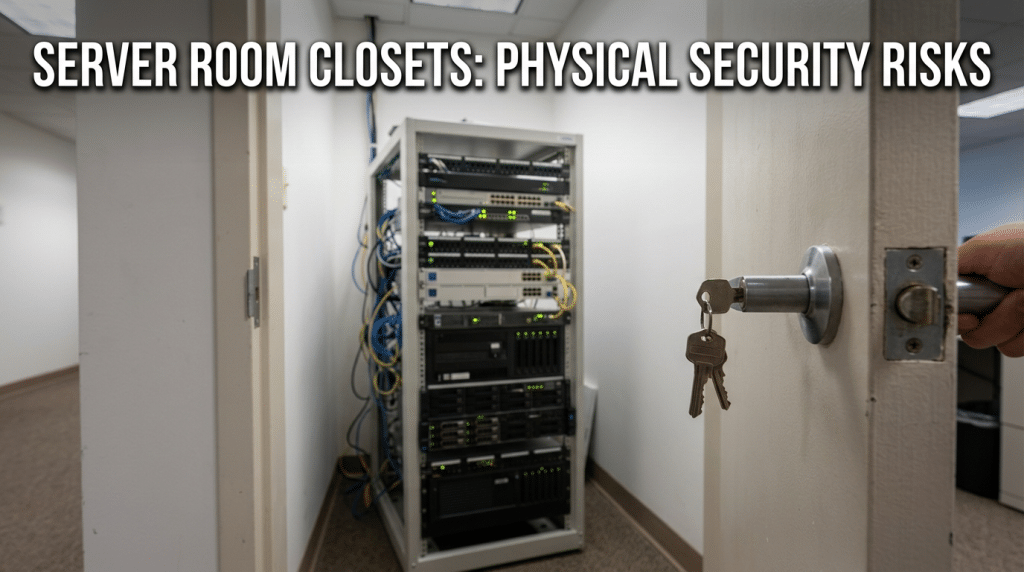
The Server Room Closet: Why Temperature and Physical Access Matter for Security
When business leaders think about cybersecurity, their minds usually jump to software: firewalls, complex passwords, multi-factor authentication, and sophisticated anti-phishing training. However, some of the most critical security vulnerabilities inside a business aren’t virtual at all—they are physical.
In many small and mid-sized businesses, the heart of the entire IT infrastructure lives inside a modified utility closet, a janitorial room, or an unused corner office. Known colloquially as “the server room closet,” these repurposed spaces house the essential hardware—servers, network switches, routers, and back-up power supplies—that keeps the company connected and operational.
While tucking hardware away in a spare closet seems like an efficient use of office space, unmanaged server closets present massive risks. Specifically, two physical factors are routinely overlooked: environmental temperature control and physical access management. Neglecting either can lead to catastrophic hardware failure, permanent data loss, or severe security breaches.
The Hidden Threat of Unmonitored Temperature and Humidity
IT equipment generates a tremendous amount of heat. Modern servers and network gear rely on continuous, high-volume airflow to draw cool air across sensitive microprocessors and push hot exhaust away. When servers are crammed into a small closet without dedicated, active cooling, the temperature inside the room can spike dangerously high within minutes.
What Happens When Servers Overheat?
High ambient temperatures degrade physical hardware rapidly, causing several major security and operational issues:
- Thermal Throttling and Unexpected Outages: Modern CPUs automatically slow down (thermal throttle) when temperatures reach dangerous levels to prevent permanent damage. If temperatures continue to rise, hardware triggers emergency shut-offs. An unannounced system crash during core business hours can corrupt open databases, interrupt active data backups, and disrupt critical business applications.
- Accelerated Hardware Failure: Constant exposure to high heat drastically shortens the lifespan of hard drives, solid-state drives, and motherboard components. Silent hardware failure on a primary server or backup drive leaves your business exposed to permanent data loss.
- Humidity and Static Risks: It isn’t just heat that poses a threat—humidity levels matter too. High humidity causes condensation, leading to short circuits and corrosion on sensitive circuit boards. Low humidity, on the other hand, creates an environment ripe for static electricity, where a simple electrostatic discharge can fry vital network components instantly.
Proper IT infrastructure requires targeted climate control, dedicated air circulation, and automated environmental sensors that alert your IT team before a minor cooling drop turns into a total network shutdown.
Physical Access: The Forgotten Cybersecurity Vulnerability
You can invest thousands of dollars in high-end cybersecurity software, but if an unauthorized individual can walk up to your physical server stack, your digital defenses can be bypassed in seconds.
Many server closets double as storage for office supplies, cleaning equipment, or extra furniture. This means janitorial staff, vendors, contractors, and visiting guests often have easy access to the exact room holding your company’s most sensitive data.
The Security Risks of Unrestricted Physical Access
Physical access to hardware gives a malicious actor—or even an untrained employee—direct control over your IT environment:
- Direct Hardware Attacks: If an attacker gets physical access to a server, they can bypass OS-level passwords by booting from a rogue USB drive, extract unencrypted hard drives directly from the chassis, or install physical keyloggers and network taps.
- Accidental Infrastructure Damage: When a server closet is used to store mop buckets, ladders, or extra paper towels, accidental damage is bound to happen. An employee reaching for a box of copy paper can easily snag a loose Ethernet cable, knock out a power cord, or accidentally press the power switch on a core firewall.
- Lack of Audit Trails: A standard key lock on a closet door provides zero visibility into who entered the room, when they entered, or how long they stayed inside. Without electronic access logging or video surveillance, investigating a physical security incident or hardware tampering becomes virtually impossible.
Securing Your Server Closet: Essential Best Practices
Securing your physical IT infrastructure doesn’t necessarily require building a multi-million-dollar data center. By implementing a few structured controls, you can turn a standard server closet into a secure, reliable environment.
At Krypto IT, we recommend starting with these essential physical security baselines:
- Install Dedicated Environmental Monitoring: Deploy smart sensors that track temperature, humidity, and liquid leaks in real time. Configure automated alerts to notify your IT management team the moment parameters exceed safe operating thresholds.
- Enforce Strict Physical Access Control: Remove all non-IT storage from the room immediately. Upgrade standard door locks to electronic keycards, smart locks, or biometric scanners so you can maintain a clear audit log of everyone who enters the space.
- Implement Visual Monitoring: Install an internal security camera aimed at the server rack to monitor physical activity and deter unauthorized entry or physical tampering.
- Maintain Clean Cable Management and Airflow: Elevate hardware off the floor, organize cabling cleanly to avoid trip hazards or accidental disconnects, and ensure intake and exhaust paths on equipment racks remain completely unobstructed.
Protect Your Hardware Before It Fails
Physical security and digital security are two sides of the same coin. Leaving your server room closet open to rising temperatures or uncontrolled physical access undermines every cybersecurity tool you have in place.
Is your physical server setup exposing your business to unexpected downtime or security risks? Contact Krypto IT today to schedule a comprehensive Physical IT Infrastructure and Security Assessment.