Vendor Impersonation: How Hackers Mimic Trusted Partners
July 8, 2026
Timing the Attack: Why Hackers Target Your Weekend
July 10, 2026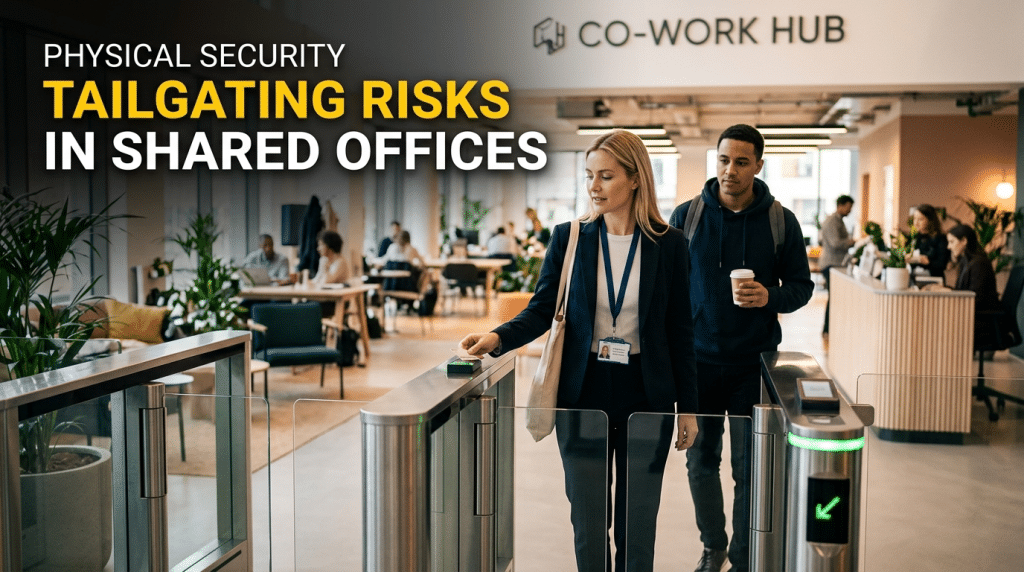
Beyond the Firewall: Neutralizing Tailgating and Physical Security Risks in Shared Spaces
When modern business leadership evaluates their operational risk matrix, the overwhelming majority of attention, training hours, and technical capital is dedicated to securing the digital perimeter. Organizations implement advanced corporate firewalls, enforce conditional access policies, and mandate continuous phishing awareness tracks to keep external threat actors out of their cloud repositories. The common assumption is that if the digital gateway is locked down, the business is safe.
However, a massive and highly dangerous operational blind spot exists right at your office door: tailgating and physical social engineering.
As the modern business landscape has embraced flexible work models, a significant portion of growing companies now operate out of coworking environments, multi-tenant corporate centers, or shared office buildings. While these spaces offer excellent administrative flexibility and cost efficiency, they drastically expand your physical attack surface. Cybercriminals are fully aware that your digital technology stack is incredibly difficult to pierce from the outside. Because cloud perimeters are heavily guarded, threat actors frequently choose to simply walk past your digital lines by physically stepping right into your workspace. To protect your corporate capital, secure your client data rooms, and safeguard your staff, leadership must understand the mechanics of physical intrusion.
The Anatomy of a Physical Tailgating Intrusion
Tailgating—the act of an unauthorized individual following a credentialed employee through a secure doorway before the portal closes—is rarely executed using aggressive force. Instead, physical social engineering relies on a fundamental human vulnerability: the deep-seated cultural desire to be polite, helpful, and avoid awkward interpersonal friction.
In a shared office environment, a threat actor does not look like a Hollywood catburglar dressed in black. Instead, they seamlessly blend into the daily professional background. An intruder will typically utilize one of three common physical scripts to exploit human courtesy:
First, the attacker might dress in a clean uniform or delivery attire, carrying a large, heavy box of catering supplies, paperwork, or equipment. As a hurried employee swipes their keycard to enter your private suite or a restricted floor, the attacker approaches with their hands visibly full, letting out a subtle sigh of exhaustion. Driven by natural empathy and politeness, the employee instinctively holds the door open, bypassing the building’s physical access rules without giving it a second thought.
Second, threat actors exploit the high-volume, transient nature of multi-tenant environments. An intruder will dress in standard business casual clothing, hold a phone to their ear, and walk briskly right behind an authorized staff member who has just unlocked an access point. The employee assumes the person behind them is simply a worker from another department, a vendor, or a neighboring tenant, allowing the stranger to gain unrestricted access to your office footprint.
Once past the door, the intruder has a direct line to your physical assets. Within minutes, an unchecked individual can spot passwords written on desks, snap photos of sensitive client files left on a printer, or quietly plug a small, macro-enabled USB rubber ducky device into an unattended workstation, establishing a permanent, un-filterable backdoor straight into your local server arrays.
The Multi-Tenant Vulnerability Factor
Operating a business within a shared or multi-tenant building introduces unique security friction that traditional standalone facilities do not face:
- The Diffusion of Accountability: When an office building houses dozens of independent companies, the collective sense of ownership over physical security erodes. Employees become accustomed to seeing unfamiliar faces in hallways, breakrooms, and elevators daily, making it incredibly easy for an unauthorized outsider to wander the premises undetected.
- Complacency at the Perimeter: Many shared spaces rely on a centralized lobby receptionist or building security guard to vet entrants. This creates a false sense of security for individual tenants. Staff members assume that if someone is inside the building, they must have been properly vetted at the front desk, leading them to drop their defensive guard at their own suite doors.
Systemizing an Uncompromising Physical-First Boundary
Mitigating the threat of physical social engineering does not require turning your office environment into a hostile, low-trust bunker or introducing bureaucratic delays that frustrate your team. True resilience relies on implementing automated, identity-first infrastructure guardrails that calmly protect your business assets even when human courtesy creates an opening.
At Krypto IT, we help growth-minded companies eliminate these physical supply chain blind spots by deploying continuous, human-first defensive perimeters:
- Enforcing Rigid Endpoint and Environment Hardening Rules: We neutralize the impact of an physical breach at the hardware layer. Through advanced automated group policies, we configure your corporate workstations to instantly lock their screens after a brief period of inactivity and enforce comprehensive device restrictions that block unauthorized external hardware, ensuring an inserted USB drive cannot compromise your data rooms.
- Hardcoding Out-of-Band Data and Physical Security Protocols: We replace baseline interpersonal trust with clear operational boundaries. We train your personnel to recognize that security and politeness are not mutually exclusive, establishing non-negotiable operational rules that require every individual—including executives, clients, and maintenance staff—to scan their own credentials at every single entry point without exception.
- Anchoring Systems in Frictionless Biometric Identity: We secure your administrative channels from physical insider threats. We connect all network entry points with rapid biometric single sign-on tools (such as Windows Hello and Touch ID). This ensures that even if a physical intruder gains access to an employee’s desk, they cannot open sensitive systems, modify transaction paths, or view restricted client repositories without hardware-validated biometric verification, keeping your infrastructure secure, compliant, and under your absolute control.
Conclusion: Security is a Seamless Standard
In the modern decentralized economy, relying entirely on digital software parameters to secure your enterprise while leaving your physical workspace unmanaged is an unsustainable approach to corporate risk management. Threat actors are highly opportunistic; they will always take the path of least resistance, and an open office door is infinitely easier to exploit than an enterprise firewall. True resilience demands absolute visibility across both your digital and physical footprints. By hardcoding workstation lockouts, establishing clear badge-in workflows, and anchoring your core data portals in robust biometric validation, you eliminate the physical tracking tax and keep your business entirely under your absolute control.
Are your employees’ shared office habits quietly exposing your internal digital networks to physical intrusion and data theft? Contact Krypto IT today for a comprehensive Physical Security and Technical Infrastructure Readiness Review, and let’s harden your human perimeter.