Smishing Defense: Why Employees Click Text Scams
July 7, 2026
Physical Security: Tailgating Risks in Shared Offices
July 9, 2026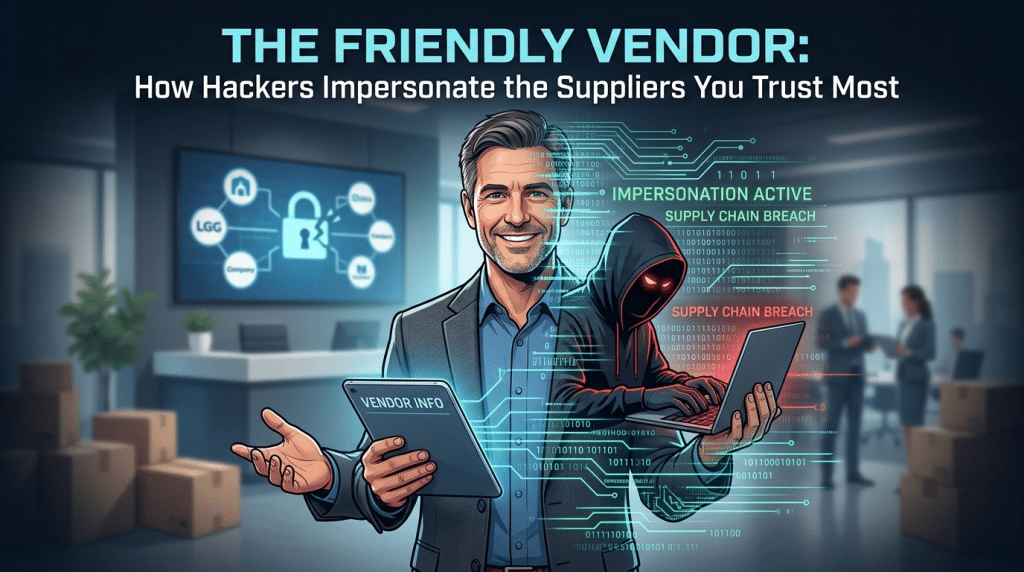
The Friendly Vendor: How Hackers Impersonate the Suppliers You Trust Most
When business leaders map out their network defenses, they generally focus on securing the immediate perimeter. Organizations deploy enterprise-grade firewalls, mandate complex administrative passwords, and closely monitor internal network access points. The operating assumption is that threats originate from unverified external actors attempting to breach a secure boundary from the outside.
However, modern cybercriminal syndicates frequently bypass these direct technological defenses by exploiting an asset that sits entirely outside your firewalls: the trust you place in your third-party vendor ecosystem.
This highly effective methodology is known as vendor impersonation or supply chain business email compromise (BEC). Instead of creating a glaringly obvious malicious script or a blind phishing blast, threat actors quietly insert themselves into the established B2B relationships your operational teams rely on daily. By mimicking the exact invoicing habits, conversational tones, and documentation styles of the suppliers you know best, hackers transform an essential business relationship into a catastrophic security breach. To protect your company capital, preserve your operational workflows, and secure your supply chain, leadership must look past the internal technology stack and understand the hidden mechanics of vendor fraud.
The Anatomy of a Supply Chain Hijack
To understand why traditional email filters and cautious employees frequently fail to intercept vendor impersonation campaigns, you must analyze how modern threat actors systematically compromise these trusted relationships.
The process begins long before a fraudulent message ever arrives in your accountant’s inbox. Cybercriminals conduct highly organized, multi-layered reconnaissance phases targeting your weaker, third-party supplier networks. They identify the smaller logistics firms, material suppliers, specialized consultants, or janitorial providers that have open payment pipelines with your company.
Once a target supplier is identified, the attacker launches a silent intrusion against that specific vendor’s network. Rather than deploying disruptive ransomware that would sound immediate alarms, the hacker quietly establishes persistence inside the supplier’s email server. They deploy automated email harvesting scripts to map out active client lists, review historical contract parameters, study valid transaction templates, and analyze the natural conversational tone of the vendor’s billing personnel.
When a high-value invoice milestone approaches, the threat actor strikes across one of two primary execution paths:
1. The Intercepted Thread Hijack
Using the vendor’s actual, compromised email account, the attacker slips into an ongoing invoice discussion. They send a completely native email to your accounting department containing a real, expected invoice, but with one critical structural alteration: the bank routing numbers and wire destination details have been changed to point directly to an untraceable corporate account controlled by the criminal syndicate. Because the email originates from the supplier’s legitimate server and references accurate contract milestones, it sails right past standard technical filters and human scrutiny.
2. The Lookalike Domain Blueprint
If direct server persistence is lost, the hacker registers a lookalike domain name that is visually indistinguishable from the real vendor’s web address at a rapid glance (such as replacing an “m” with “rn” or using an alternate top-level domain). They forge the billing employee’s digital signature, attach a flawless duplicate of the standard monthly invoice, and insert a high-pressure narrative explaining that a routine internal corporate audit requires all immediate payments to be sent to a new regional banking facility.
By the time the actual vendor reaches out to follow up on a missed payment a few weeks later, your operational capital has already been drained, moved through multiple banking layers, and converted into unrecoverable digital assets.
Systemizing a Rigid, Multi-Layered Supply Chain Shield
Defending your operational capital against vendor impersonation does not require introducing massive structural delays that paralyze your purchasing speed or alienate your trusted business partners. True organizational resilience relies on replacing baseline interpersonal trust with automated, zero-trust validation guardrails that treat every external modification as an unverified risk vector.
At Krypto IT, we help growth-minded businesses securely eliminate supply chain blind spots by deploying continuous, human-first defensive perimeters:
- Hardcoding Dual-Authorization Verification Policies: We eliminate single points of failure within your accounting loop. Our security frameworks dictate that any external request to alter vendor banking information, modify routing numbers, or execute a transaction crossing a specific financial threshold must be independently verified through a separate, authenticated out-of-band communication channel (such as a direct, pre-established voice call or a face-to-face confirmation), entirely removing the ability for a single spoofed email to drain your treasury.
- Deploying Prominent External Tagging and Domain Auditing Tools: We strip away the visual illusions used by threat actors. We configure your enterprise mail networks to automatically append distinct visual warning flags to any incoming email originating outside your internal corporate architecture. Furthermore, we deploy advanced inbound protection engines that scan for newly registered lookalike domains, immediately isolating suspicious external correspondence before it ever hits an employee’s inbox.
- Anchoring Internal Environments in Robust Biometric Identity: We isolate your core administrative and payment processing systems from external manipulation. We connect all network entry points with rapid biometric single sign-on controls (such as Windows Hello and Touch ID). This ensures that even if an attacker tricks a worker into interacting with a lookalike vendor portal, the threat actor cannot compromise your actual backend databases without sub-second hardware-validated biometric verification, keeping your infrastructure safe, compliant, and under your absolute control.
Conclusion: Verification Protects Margin
In the modern digital economy, expecting traditional security parameters alone to protect your firm while leaving your third-party communication channels unmanaged is an unsustainable approach to corporate risk management. Cybercriminals actively weaponize the professional trust networks you have built over years to execute highly targeted, silent thefts. True operational resilience demands absolute, zero-trust visibility into every external transactional modification. By hardcoding strict dual-authorization parameters, deploying proactive lookalike domain blocking, and anchoring your perimeter in robust biometric identity, you clear the invisible vendor impersonation tax and keep your corporate capital entirely under your absolute control.
Are your accounting teams currently relying on simple email threads to verify high-value vendor transaction updates? Contact Krypto IT today for a comprehensive Technical Infrastructure and B2B Perimeter Vulnerability Review, and let’s harden your digital boundary.