Baiting and Watering Holes: Tracked Online Habits
July 6, 2026
Vendor Impersonation: How Hackers Mimic Trusted Partners
July 8, 2026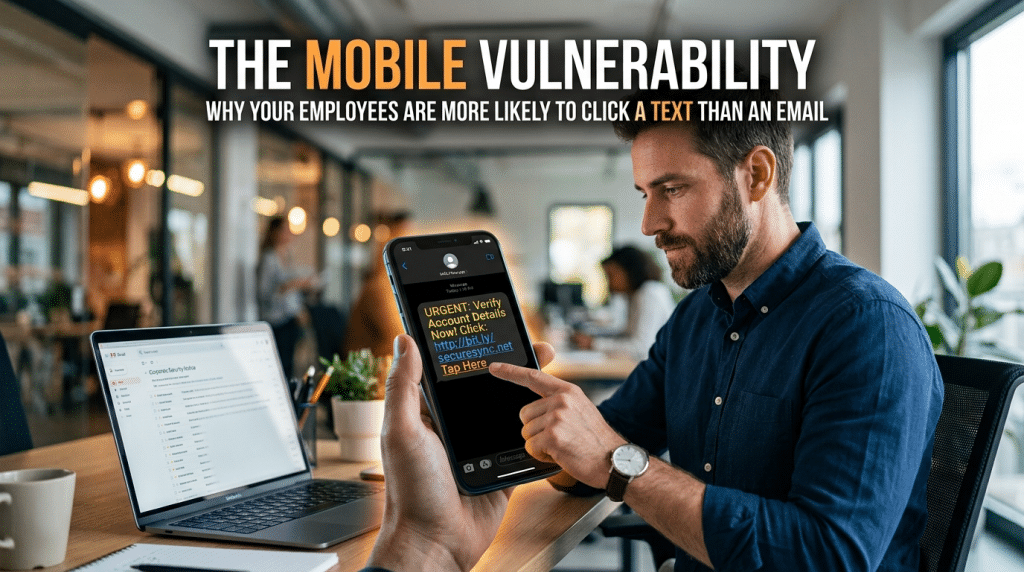
The Mobile Vulnerability: Why Your Employees Are More Likely to Click a Text Than an Email
When corporate leadership reviews their operational security roadmap, the vast majority of resources, training hours, and software capital are poured into protecting the traditional desktop environment. Organizations deploy advanced enterprise firewalls, secure email gateways, automated inbox filters, and continuous training tracks designed to help workers spot malicious email phishing hooks.
However, as workforce dynamics have decentralized, a major and highly dangerous behavioral blind spot has emerged right in the palm of your team’s hands: Smishing (SMS Phishing).
While an administrative employee might exercise high caution when reviewing an unexpected message in their corporate email inbox, that same worker’s analytical defenses drop drastically when a notification pops up on their personal or corporate mobile device.
In the modern enterprise landscape, threat actors are rapidly migrating away from email channels to execute text-based security breaches. To protect your corporate treasury, preserve your client data repositories, and build a truly resilient workforce, business leadership must understand the deep psychological and structural reasons why employees are far more likely to click a malicious link inside a text message than a standard email.
1. The Psychological Illusion of the Mobile Device
The primary reason smishing campaigns achieve devastating success rates relies on a deep-seated psychological conditioning. For over two decades, the mobile phone has existed as an intensely personal communication hub. While a corporate email inbox is viewed as a public, high-volume environment flooded with spam, marketing promotions, and cold outreach, text messaging channels are historically reserved for high-trust, real-time interactions with family, close friends, and direct co-workers.
Because of this deeply ingrained behavioral conditioning, individuals naturally interact with text messages on a subconscious level of high trust. When an SMS alert sounds, the immediate human reflex is to read and respond almost instantly. Studies in mobile engagement reveal that text messages feature an astronomical open rate of nearly ninety-eight percent, with the vast majority of those messages being read within three minutes of delivery.
By exploiting this rapid compliance reflex, a cybercriminal can drop a malicious verification link straight into an employee’s daily workflow, completely bypassing the cognitive analytical filters that would normally prompt the worker to pause and investigate.
2. The Structural Deficiencies of Mobile Interfaces
Beyond the psychological advantage, text-based attacks leverage severe technical and visual limitations inherent to modern smartphone operating systems. The desktop ecosystem provides workers with a robust toolkit to evaluate message legitimacy: users can hover their cursor over a hyperlinked text string to inspect the true underlying URL, easily review full, unedited sender email headers, and reference integrated corporate warning banners.
On a compact mobile screen, these critical defensive inspection habits are structurally throttled:
- Hidden URL Infrastructure: Mobile web browsers and SMS applications inherently truncate long text strings and compress web links. Threat actors heavily utilize URL shorteners or register lookalike domains that appear legitimate on a small interface, making it incredibly difficult for a hurried employee to visually distinguish a real corporate portal from a fraudulent replica.
- Lack of Header Transparency: Unlike email clients, which display detailed sender routing info, an SMS application displays only a generic, unverified phone number or an easily spoofed alphanumeric contact name. Attackers can seamlessly mask their identity to appear as a major logistics carrier, a primary commercial bank, or even your internal HR department.
- The Merging of Professional and Personal Data Streams: On a mobile device, a single application handle updates from the local pharmacy, a favorite lunch spot, a personal credit card issuer, and corporate notification engines. This continuous consolidation of data streams completely desensitizes the user, making a fraudulent text message claiming to be an “urgent IT password update” look entirely native to their daily routine.
3. The Anatomy of Modern Smishing Scripts
Modern cybercriminal syndicates deploy highly tailored, high-pressure text scripts engineered to trigger immediate operational compliance:
The Urgent Executive Proxy Command
An entry-level worker or field representative receives an SMS displaying the exact name of their company’s chief executive: “Travis here. I’m stuck in an emergency supplier review and my corporate login is locked. Click this link to approve the verification token for me right now so we don’t lose the contract.” Rushed by the perceived authority of the CEO, the employee taps the link, immediately redirecting them to a credential harvesting site.
The Missing Multi-Factor Authentication (MFA) Bypass
The employee receives an automated-looking text alert claiming that an unauthorized login attempt from an external IP address was detected on their corporate account. The text insists that to prevent immediate, permanent profile suspension, the worker must click an attached link to re-verify their identity, which silently siphons their active session tokens to a waiting hacker.
Systemizing an Advanced, Mobile-First Perimeter
Securing your organization against smishing does not require implementing restrictive mobile bans or creating cumbersome administrative barriers that slow down your field personnel. True operational resilience relies on deploying automated, identity-first infrastructure guardrails that keep your corporate assets safe even when a text-based lure succeeds.
At Krypto IT, we help growth-minded companies safely eliminate mobile supply chain blind spots by systemizing proactive network defense:
- Deploying Enterprise Mobility Management (EMM): We extend your secure perimeter directly to your mobile fleet. We implement advanced endpoint defense tools that filter text-based web requests in real-time, instantly blocking access to malicious lookalike domains before a browser can load the page.
- Enforcing Strict Out-of-Band Validation Rules: We remove single points of failure from your operational loop. Our frameworks dictate that any high-risk task requested via text message—such as processing an emergency wire transfer or exposing a sensitive data repository—must be independently verified through a separate, authenticated voice channel.
- Anchoring Assets in Robust Biometric Identity: We isolate your administration pathways from stolen credentials. We connect all system entry points with rapid biometric single sign-on tools (such as Windows Hello and Touch ID). This ensures that even if an attacker tricks an employee into surrendering a text-string password or copying an MFA code, the hacker cannot step into your network rooms without sub-second hardware-validated biometric verification, keeping your infrastructure safe, compliant, and under your absolute control.
Conclusion: Protect the Edge in the Palm of Their Hand
In the modern decentralized economy, your corporate network perimeter is no longer anchored to a physical brick-and-mortar office building; it is distributed across every mobile device carried by your workforce. Relying entirely on traditional desktop email filters while leaving mobile channels unmanaged is an unsustainable approach to corporate risk management. Cybercriminals actively exploit the high-trust, high-speed psychology of SMS messaging to execute silent, catastrophic network intrusions. By hardcoding device hardening rules, implementing real-time web filtering, and locking down data rooms with robust biometric identity perimeters, you clear the mobile vulnerability tax and ensure your corporate treasury, data, and continuity remain entirely secure.
Are your remote employees’ mobile texting habits quietly exposing your internal corporate infrastructure to devastating credential theft? Contact Krypto IT today for a comprehensive Mobile Infrastructure and Network Vulnerability Assessment, and let’s harden your digital boundary.