The True Cost of Being Offline: Audit Your Downtime
June 30, 2026
Authority Bias: Why Employees Instantly Obey Fake CEO Emails
July 3, 2026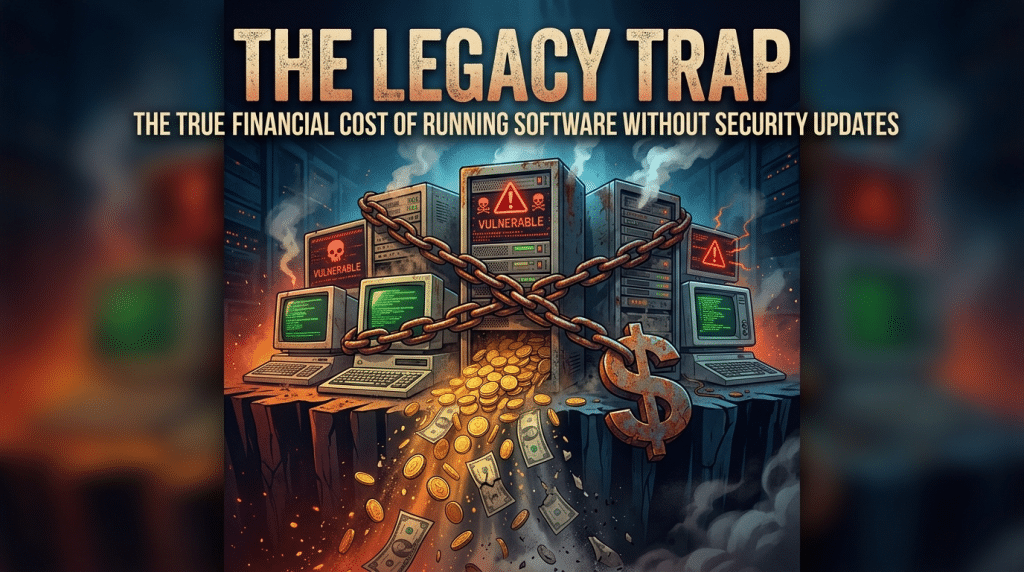
The Legacy Trap: The True Financial Cost of Running Software Without Security Updates
When a business owner or financial officer reviews their corporate software roadmap, legacy platforms are frequently viewed through a lens of static economy. It is easy to look at a core accounting database, an on-premise inventory tracking tool, or an aging workstation operating system that has been running for a decade and conclude that keeping it alive is a smart way to preserve capital. The logic feels sound on the surface: the software is fully paid for, the staff already knows how to use it, and executing a modernization project would require a direct investment of capital and training hours.
As we navigate the highly connected corporate landscape, keeping software running past its expiration date is one of the most dangerous and expensive financial gambles a small to mid-sized business can make.
When a software vendor announces an End-of-Life (EOL) milestone, they are not just trying to force an unnecessary upgrade. They are establishing a hard boundary. Crossing that boundary means your business is operating entirely on its own, running software that will never receive another security patch, compatibility update, or stability fix.
Stretching the lifespan of unsupported legacy systems does not save operational capital. Instead, it trades a predictable deployment cost for an invisible, compounding financial liability that leaves your network exposed to catastrophic failure. To protect your corporate margins and maintain real operational resilience, leadership must look past the initial cost savings of old code and understand the true financial risks of running unsupported software.
1. The Direct Capital Exposure of Automated Exploits
The most severe and immediate financial risk of running EOL software is the threat of an automated network intrusion. Modern cybercriminals do not waste time manually probing your network defenses; they deploy automated scanning bots that continuously crawl the public web, searching for known, unpatched vulnerabilities inside specific software builds.
When software is actively supported, developers race to write and push emergency security patches the moment a flaw is exposed. Once a product reaches its hard End-of-Life date, that defensive loop stops completely.
If a major vulnerability is discovered in an old operating system or database engine tomorrow, the manufacturer will never release a patch. The flaw remains permanently open, acting as a broad, un-closeable front door for threat actors. If an employee account on that legacy machine is compromised, attackers can slip straight past your perimeter filters, move laterally into your primary data rooms, and deploy network-wide ransomware.
The immediate financial impact of a ransomware event begins with extortion demands that routinely cross thousands of dollars, but the true fiscal penalty includes emergency forensic cleanup fees, potential legal liability for client data exposure, and severe brand erosion that permanently drives clients to your modern competitors.
2. The Invisible Productivity Tax of System Fragmentation
Even if your legacy software manages to avoid a major security breach, it quietly drains your cash flow every single day through a compounding interest rate known as technical debt.
Modern business relies on deep software integration. Your cloud communication tools, customer relationship management portals, and financial processors must constantly share data to keep your business moving fast. Legacy software is fundamentally incapable of communicating with modern cloud-native architectures.
To bridge this technical gap, your workforce is forced to develop slow, manual workarounds. Employees waste valuable hours every week manually copying data from one system to another, fighting constant application crashes, and managing formatting errors caused by incompatible software generations. Studies in workplace efficiency reveal that staff operating on obsolete software platforms lose a staggering amount of productive hours every year just dealing with preventable technology friction. You are paying modern, competitive wages for heavily throttled operational output.
3. The Escalation Loop of Crisis Maintenance Costs
When you run your business infrastructure on borrowed time, your IT maintenance costs shift from a flat, predictable baseline to a chaotic loop of expensive emergency firefighting.
Unsupported software naturally becomes highly unstable as the underlying hardware or adjacent applications evolve. When an obsolete platform glitches or a legacy database corrupts, your internal team cannot submit a standard helpdesk ticket to the vendor for a quick resolution.
Instead, your business is forced to hire specialized, high-cost legacy consulting engineers to perform custom code patching or manual data recovery. These emergency interventions are incredibly expensive, and because the platform itself is dead, every temporary fix merely buys a few weeks of time before the system breaks somewhere else. You end up spending more capital keeping a dying application on life support than you would have spent migrating to a modern, fully supported solution.
Systemizing a Modern, Guarded Perimeter
Transitioning away from a legacy platform does not require disrupting your daily operations or causing internal organizational chaos. True business maturity relies on implementing a structured, proactive technology lifecycle that protects your cash flow and accelerates your growth.
At Krypto IT, we help growth-minded companies eliminate the hidden liabilities of old software by systemizing infrastructure modernization:
- Continuous Asset Inventory Audits: We deploy automated scanning tools that map your entire digital footprint, indexing every application build and operating system version to flag upcoming EOL milestones long before they cause a crisis.
- Frictionless Cloud Migration Pipelines: We dismantle the burden of maintaining legacy on-premise databases by shifting your critical workflows to secure, high-availability cloud environments that update automatically.
- Identity-First Access Shielding: We protect your modern environment by wrapping it in rapid biometric single sign-on tools (such as Windows Hello and Touch ID), ensuring that while your data remains safe, your team experiences zero daily login friction, keeping them entirely focused on hitting their deadlines.
Conclusion: Invest in Your Velocity
In the modern digital economy, operational speed and data security are your core competitive requirements. Expecting your workforce to secure client data and out-pace market competitors while relying on unsupported, un-patched legacy systems is an unsustainable operational strategy. Software modernization is not a luxury luxury expense; it is a direct investment in your firm’s long-term cash flow protection. By actively auditing your infrastructure, retiring legacy applications before they fail, and maintaining a modern digital perimeter, you clear the invisible legacy tax and keep your business entirely under your absolute control.
Are unsupported legacy systems or unpatched applications quietly exposing your business to hidden financial risks? Contact Krypto IT today for a comprehensive Software Lifecycle and Network Vulnerability Assessment, and let’s secure your digital boundary.