How an MSP Cuts Internal HR Costs When Hiring Tech Talent
June 25, 2026
Predictable IT Budgeting: How Fixed-Fee Models Protect Cash Flow
June 27, 2026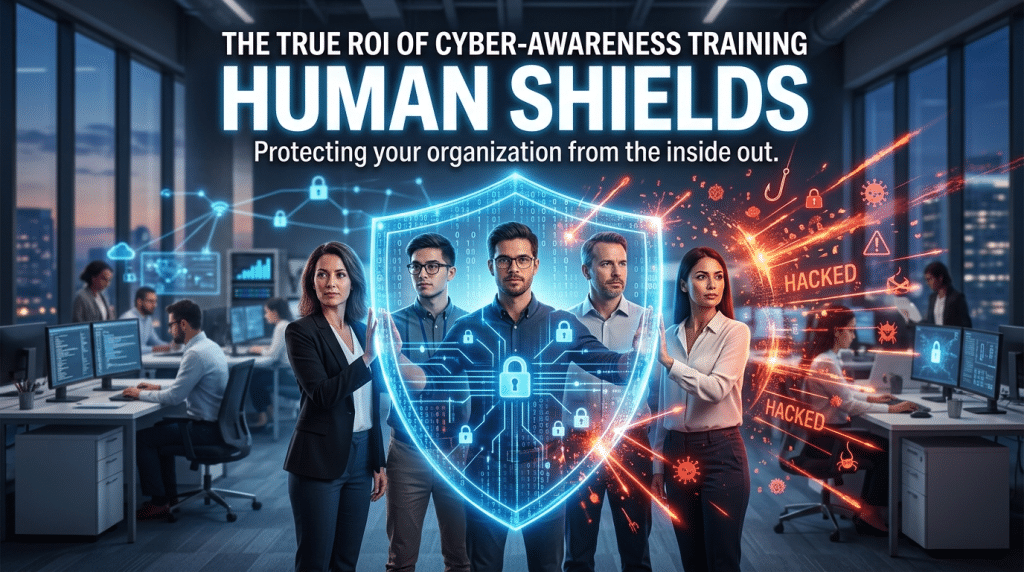
The $10 Guard: How Cyber-Awareness Training Prevents a $10,000 Ransom Catastrophe
When corporate leadership teams sit down to evaluate their annual technology line items, cybersecurity expenses are frequently viewed through the lens of pure cost center management. Executives authorize budgets for enterprise firewalls, cloud-native endpoint encryption, and automated patch monitoring tools because these platforms produce visible technical barriers. They are tangible software products designed to keep hackers out of internal networks.
However, when an IT department requests funding for continuous employee cyber-awareness training, the purchasing decision often stalls. Management looks at a per-user seat cost and wonders if sending staff through short, interactive security modules delivers a measurable return on investment. It feels like an academic exercise rather than a hard security control.
Relying on software alone while neglecting your workforce is a massive operational blind spot.
The reality of modern network defense is that over ninety percent of all successful corporate data breaches are initiated by human error. Cybercriminals do not spend weeks trying to crack an enterprise firewall from the outside; they simply bypass it entirely by tricking an employee into clicking a single link, downloading a macro-enabled invoice, or entering credentials into a fraudulent portal. To protect your corporate capital and maintain real business continuity, your workforce must be transformed into your primary defensive asset.
The Economics of a Human-Engineered Breach
To understand the true return on investment of security awareness, you must analyze the sheer financial asymmetry between proactive training and reactive incident recovery.
Consider a typical small-to-mid-sized enterprise operating with fifty employees. Implementing a continuous, automated cyber-awareness training platform costs approximately ten dollars per user seat per month. For this organization, the total annual investment scales to exactly six thousand dollars.
Now, consider the financial trajectory of a single unmanaged human error. An employee in the accounting department receives a highly targeted, AI-phished email that appears to originate from a known software supplier. Because the employee has never been trained to spot modern phishing markers, such as lookalike domain indicators or mismatched sender signatures, they click the embedded link to review a fake pending statement.
The moment that link is clicked, a silent, automated ransomware script triggers in the background. It maps the local device, moves laterally across your local server arrays, locates your connected data repositories, and encrypts your active operational files.
The recovery costs for a minor, localized ransomware incident like this start at a baseline of ten thousand dollars in direct extortion demands alone. However, the true financial damage extends far beyond the ransom note:
- Daylight Operational Blackouts: Your staff cannot access client files, process transactions, or hit delivery deadlines, costing an average of five thousand dollars per day in lost workforce velocity.
- Emergency Engineering Intervention: You must pay premium, short-notice forensic consulting fees to isolate infected hardware, clean your registry systems, and verify data integrity.
- Irreversible Brand Attrition: If client data is exposed during the breach, your business faces potential regulatory non-compliance fines, legal liabilities, and severe damage to your market reputation.
By allowing a ten-dollar training seat to remain vacant, your organization is essentially playing high-stakes roulette with your corporate treasury.
Building a Predictive, Human-Agent Firewall
Defending your organization through human engineering does not mean launching boring, hour-long classroom lectures that disrupt your team’s weekly focus. True operational resilience relies on deploying short, continuous, and highly targeted training loops that adapt to real-world threats.
At Krypto IT, we turn your workforce into a self-healing defensive network by systemizing continuous awareness education right inside their daily workflows:
First, we replace outdated, once-a-year compliance checks with bite-sized training campaigns. Employees engage with brief, interactive simulations that take less than five minutes a month, keeping critical security concepts top-of-mind without causing cognitive fatigue or slowing down their ability to hit business deadlines.
Second, we launch controlled, unannounced phishing simulations modeled directly on active, real-world exploits identified by global threat intelligence. If an employee misclicks a simulated link, the system does not punish them. Instead, it instantly delivers a brief, inline educational micro-module explaining exactly what indicator they missed, turning a potential network crisis into a routine learning experience.
Finally, we pair this human conditioning with rapid, identity-first access controls. We connect your workforce portals with frictionless biometrics like Windows Hello and Touch ID. This ensures that even if a worker is tricked into revealing a text-string password, a hacker cannot gain access to your core data rooms without physical, biometric verification, shrinking your attack surface to zero.
Conclusion: Security Is a Cultural Standard
In the modern digital landscape, expecting an automated software subscription alone to absorb every targeted, human-engineered threat is an unsustainable approach to risk management. Your technology stack can block thousands of automated background scans, but it only takes one successful click by an untrained worker to paralyze your entire enterprise footprint. Security awareness training is not a passive luxury item; it is a core mechanism of cash flow protection. By investing in the digital literacy of your team, you transform your single largest vulnerability into your strongest defensive line, ensuring your data, your capital, and your continuity remain entirely under your absolute control.
Are your employees currently equipped to spot an AI-generated phishing campaign? Contact Krypto IT today for a comprehensive Workforce Vulnerability and Cyber-Awareness Readiness Review, and let’s harden your human perimeter.