Hardware Lifecycles: The Real Cost of a 6-Year-Old PC
June 23, 2026
The True ROI of Cyber-Awareness Training: Human Shields
June 26, 2026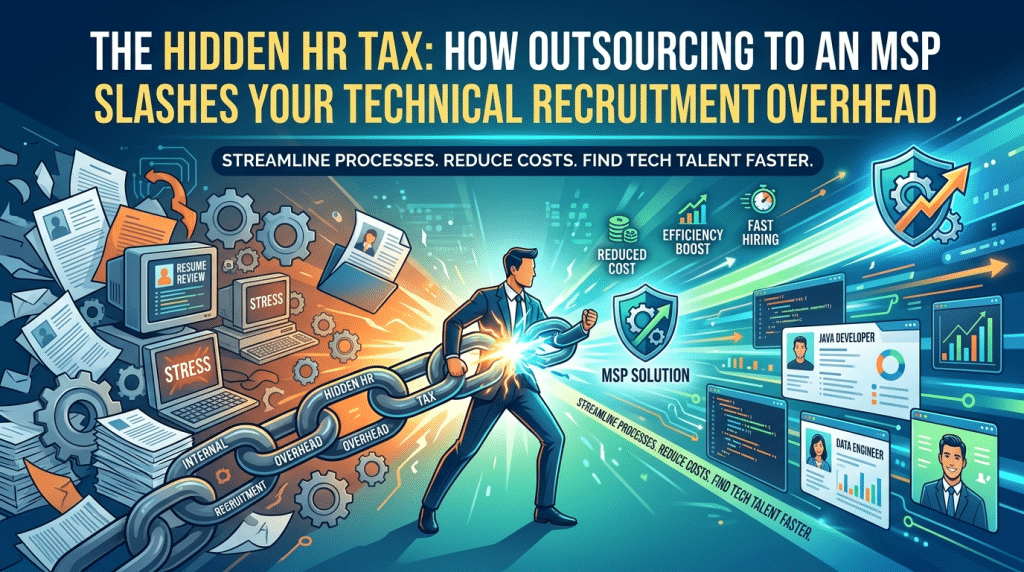
The Hidden HR Tax: How Outsourcing to an MSP Slashes Your Technical Recruitment Overhead
When small to mid-sized business owners plan their organizational growth, the conversation eventually turns to technology infrastructure. As operations expand, so does the volume of helpdesk tickets, cloud management needs, and cybersecurity alerts. The traditional playbook suggests that it is time to open a headcount requisition, hand the file to the Human Resources department, and look for an internal IT generalist or systems administrator.
To the untrained eye, adding an internal IT body seems like a straightforward personnel decision.
However, in the highly specialized labor market of 2026, tech recruiting has turned into a massive financial bottleneck. Data from the Society for Human Resource Management (SHRM) and recent recruitment indicators reveal that the average time-to-fill for a technical role has stretched to between 30 and 48 days, while specialized engineering positions can take upwards of two months to close.
For an internal HR team that is already balancing payroll, benefits administration, employee relations, and general compliance, managing a technical search is an incredibly expensive distraction.
Partnering with a Managed Service Provider (MSP) does not just solve your technical headaches; it fundamentally alters your corporate balance sheet by stripping away the hidden, compounding HR costs of acquiring and retaining tech talent. Here is how an MSP eliminates your internal hiring overhead and protects your corporate capital.
1. Wiping Out Direct Sourcing and Agency Fees
The literal cost of placing a job advertisement on premium networks is only the baseline entry fee. Because specialized technical talent is rarely hunting on generic job boards, internal HR teams frequently find themselves forced to rely on external tech recruiting agencies to source viable resumes.
The math behind technical agency placements is punishing to a growing firm’s bottom line. Recruitment agencies typically charge between 18% and 30% of a new hire’s first-year base salary. For a competent systems administrator commanding a market salary of $85,000, that translates to an immediate, upfront cash layout of $15,000 to $25,000 paid to a headhunter—before the employee has completed a single hour of productive work.
When you partner with an MSP, this entire procurement expense evaporates. Personnel acquisition, background screening, technical validation, and salary overhead are entirely embedded within a predictable, flat monthly managed service fee. The MSP handles the entire burden of talent sourcing internally, allowing your company to bypass recruitment fees completely.
2. Eliminating the Invisible “Time-to-Fill” Productivity Drain
When a network engineering or security role remains vacant, your company pays a silent daily tax. Deloitte’s recruitment efficiency research reveals that an unfilled corporate role costs an organization an average of $500 per day in lost operational productivity and deferred technical optimization.
Furthermore, technical interviewing requires massive chunks of executive time. Because a standard HR generalist does not possess the technical depth to vet an applicant’s knowledge of advanced firewall routing, cloud container security, or automated backup configurations, your highest-paid technical leaders or operational managers must step away from revenue-generating projects to conduct multi-stage technical assessments and panel interviews.
An MSP stops this internal resource drain by providing instantaneous operational capability. There are no position approvals, no resume screening rounds, and no weeks of lost productivity while waiting for an offer letter to clear. The minute your contract goes live, you gain access to an established, highly coordinated team of certified engineers, architects, and helpdesk technicians who integrate with your business workflows in days, rather than months.
3. Erasing Ongoing Training, Tooling, and Benefit Sprawl
The financial commitment of an internal tech hire extends far past their baseline salary. According to data from the Bureau of Labor Statistics, employee benefits, payroll taxes, health insurance, and 401(k) matching add an extra 30% on top of cash wages.
Additionally, to keep an internal employee effective in a rapidly changing threat landscape, your firm must fund continuous professional development. Annual tech certifications, specialized cybersecurity bootcamps, and platform training can cost between $3,000 and $8,000 per staff member every single year.
Worse yet, that internal tech person still requires enterprise-grade software to do their job. Your business must purchase retail licenses for Remote Monitoring and Management (RMM) platforms, centralized ticketing networks, and advanced endpoint security tools, stacking up an extra $5,000 to $15,000 in software overhead per year.
An MSP spreads these massive operational expenses across its entire enterprise client base. The costs of high-tier software tools, advanced compliance systems, and continuous engineer certifications are entirely absorbed by the provider. Your business leverages volume-discounted infrastructure and top-tier expertise at a fraction of retail pricing.
4. Bypassing the Sudden Chaos of Technical Turnover
The most significant operational risk of relying on a tiny, in-house IT team is the Single Point of Failure (SPOF) vulnerability. If your business depends on one or two internal generalists, your entire digital continuity is tied to their personal career trajectories.
When an internal IT person resigns, takes a medical leave, or goes on vacation, your company faces immediate exposure:
- The Institutional Knowledge Void: Critical administrator passwords, network maps, and custom application workarounds walk out the door with them.
- The Double HR Cycle: Your HR team must immediately restart the expensive, high-friction 45-day recruiting process all over again, doubling your total acquisition costs.
- Elevated Security Risks: Gaps between technical employees create unmonitored windows where missed software patches or unreviewed alerts can pave the way for automated ransomware execution.
An MSP completely modernizes this staffing equation. Because an MSP operates as an institutional partner with a deep bench of redundant talent, individual employee turnover never affects your daily business continuity. Your network documentation is hardcoded into secure, centralized repositories, and your 24/7/365 network coverage stays entirely uninterrupted.
Conclusion: Let HR Focus on Your Core Mission
In the modern marketplace, capital efficiency and operational agility are your primary competitive requirements. Forcing your internal HR department to pivot into a specialized, high-cost technical staffing agency is an administrative drain that introduces unnecessary financial risk into your enterprise.
By outsourcing your technology needs to a managed IT infrastructure, you transform unpredictable talent liabilities into a smooth, scalable, and secure operational asset. Your internal teams stay focused on human capital, your technical perimeter remains completely secure, and your corporate capital stays directed toward real revenue growth.
Are technical hiring costs and constant helpdesk turnover quietly draining your internal HR resources? Contact Krypto IT today for a comprehensive “IT Staffing Cost and Managed Services Readiness Audit” and let’s optimize your operational budget.