The Magic of Immutable Backups: Un-deletable Data
June 13, 2026
Coffee Shop Connection Risks: Work From Anywhere Safely
June 15, 2026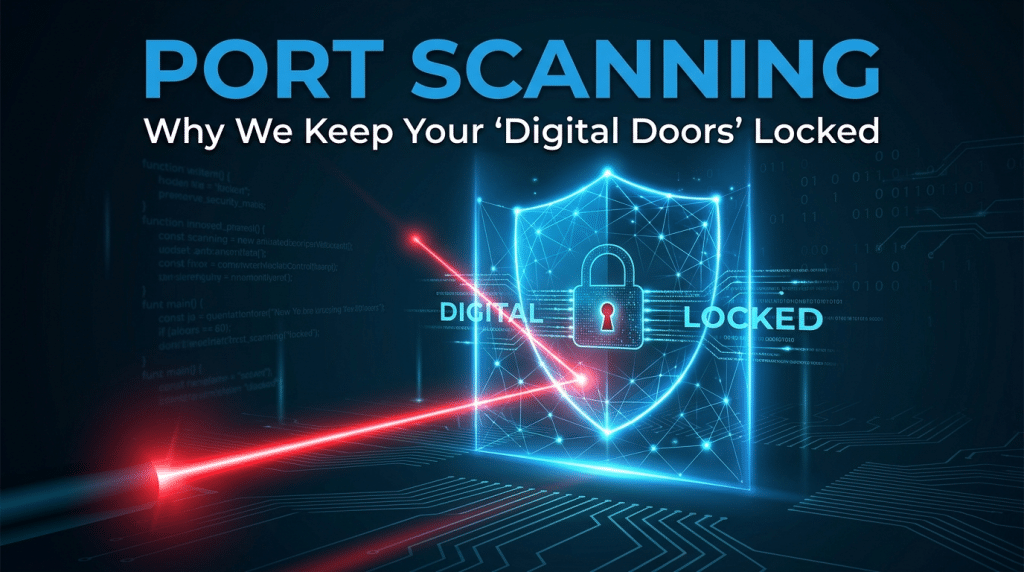
Locking the Digital Grid: How Port Scanning Defense Neutralizes Inbound Cyber Reconnaissance
When business leaders envision a cyberattack, they often imagine a highly cinematic event: a hacker actively writing code to smash through an encrypted network barrier, or a sudden, loud ransomware message flashing across every employee’s screen simultaneously.
In the actual landscape of enterprise security, intrusions are rarely that abrupt. Before a malicious actor can deploy a single byte of malware or execute an extortion script, they must find an open entryway into your infrastructure.
Cybercriminals do not blindly attack a business; they perform systematic digital reconnaissance. The primary tool behind this reconnaissance is an automated technique known as Port Scanning.
Think of a port scan as a thief walking quietly down the dark alleyway behind your office building, testing every door handle, window latch, and loading dock gate to see what has been left unlocked. If your infrastructure leaves unnecessary network doors swinging wide open to the public internet, you are providing threat actors with a map straight to your corporate data. To protect your operations and preserve your capital, your defense must keep your digital perimeter entirely invisible.
The Architecture of the Digital Perimeter
To understand how a port scan operates, you must first understand what a network port actually is. Your company’s primary internet connection functions like a massive multi-tenant office building. The building has a single physical street address (your network’s public IP address), but inside, there are exactly 65,535 individual offices—or ports—engineered to route specific types of data traffic.
Standard internet protocols dictate which ports handle which workflows:
- Port 80 and 443: Reserved for standard, encrypted web browsing traffic.
- Port 25: Used exclusively for routing outbound business emails.
- Port 3389: The Remote Desktop Protocol (RDP) gateway, frequently used by remote staff to access office workstations.
When an automated port scanner (such as an AI-driven script or an Nmap engine) targets your business IP address, it sends rapid, continuous electronic pings to hundreds of these ports in a matter of seconds. The scanner evaluates the precise network response it receives to classify each door into one of three distinct categories:
[Inbound Ping] ──> Open (Vulnerable App) ──> Attack Focus
──> Closed (Active Reject) ──> Information Gain
──> Filtered (Stealth Drop)──> Total Dead End
If a port comes back as **Open**, the scanner doesn’t just stop there. It interrogates the open port to extract the exact software version running behind it, looking for unpatched vulnerabilities (or CVEs) that allow them to bypass your authentication entirely.
——————————————————-
The Dangerous Entryways: What Attackers Look For
While some ports must remain accessible to keep your website live or your email flowing, hackers specifically search for administrative or legacy ports that have been exposed to the public web due to human error or lazy configurations:
1. Remote Access Exposed (Port 3389 – RDP)
Leaving your Remote Desktop Protocol port completely open to the internet is the digital equivalent of leaving your master office keys hanging on a hook next to the front door. Cybercriminals use automated credential-stuffing tools to pump thousands of stolen password combinations into open RDP ports every single hour until they gain administrative access.
2. The Legacy File Backdoor (Port 445 – SMB)
The Server Message Block (SMB) port is engineered for rapid file sharing across a local office network. When an unmanaged router or firewall accidentally exposes Port 445 to the outside world, a hacker can execute sophisticated network exploits to move laterally across your server arrays, harvesting files and preparing a devastating ransomware deployment.
3. Unencrypted Management (Port 23 – Telnet / Port 21 – FTP)
Legacy protocols like Telnet and basic FTP handle data transmissions in clear text. If an automated scan locates an open Telnet port on your router, a malicious actor can passively intercept your local network traffic, harvesting administrative credentials and passwords right out of thin air.
——————————————————-
Engineering an Invisible Defensive Shield
Defending your business against port scanning reconnaissance does not mean creating a rigid, frustrating tech environment that locks out your legitimate remote employees. True operational resilience relies on deploying smart, non-intrusive edge perimeters that protect your infrastructure quietly in the background.
At Krypto IT, we secure our clients’ digital perimeters by building a proactive, human-friendly environment through three structural hardening layers:
* Enforcing the “Stealth Mode” (Filtered Ports): We configure your enterprise firewalls to completely drop unsolicited inbound pings rather than responding with an error message. To an automated hacker scan, your entire network behaves like a blank, solid brick wall with zero doors to probe.
* Transitioning to SASE and Cloud Proxies: We eliminate the need to expose ports like RDP (3389) directly to the web. Instead, we route your remote workforce through a Secure Access Service Edge (SASE) architecture. Remote staff validate their identity instantly via frictionless biometrics (such as Windows Hello and Touch ID), keeping your internal ports hidden from public scanners.
* Proactive Vulnerability Auditing: We don’t wait for threat actors to map out your architecture. Our automated systems perform continuous, internal and external port scans across your entire digital environment, instantly identifying and sealing any shadow IT applications or misconfigured ports before an initial access broker can find them.
——————————————————-
Conclusion: You Can’t Attack What You Can’t See
In the modern digital economy, data availability and business continuity are the lifeblood of your company’s brand and survival. Leaving your network ports unmonitored and exposed to constant internet probing is an open invitation to global cybercrime syndicates. By implementing a proactive, zero-trust perimeter that keeps your digital doors locked and completely hidden from public view, you ensure your capital, your data, and your reputation remain under your absolute control.
Are your company’s digital doors currently unlocked and visible to global scanners? Contact Krypto IT today for a comprehensive “Perimeter Hardening and External Port Vulnerability Review” and let’s make your network invisible to threat actors.