IT Roadmaps: Stop the Surprise Spending
April 21, 2026
The End of Prevention: Cyber-Resilience 2026
April 23, 2026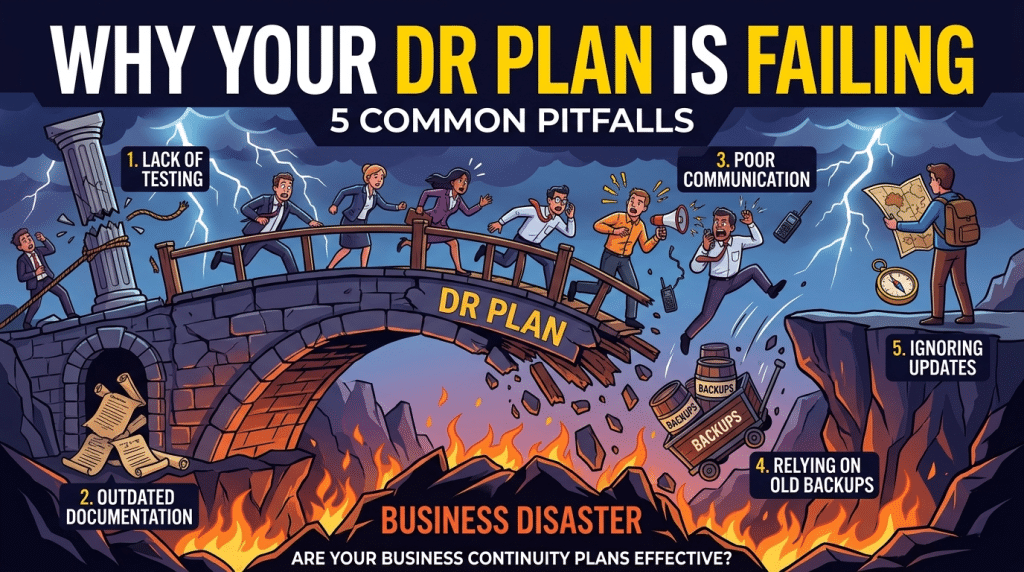
The Disaster Recovery Delusion: Why Most Houston Firms Fail the “Real-World” Test
The Contrarian’s Security Playbook by Krypto IT | Challenging Outdated IT Dogma in Houston
If you own a business in Houston—whether it’s a medical practice in the Texas Medical Center or an industrial firm in Deer Park—you likely have a “Disaster Recovery (DR) Plan” sitting in a binder or a digital folder. You’ve probably spent thousands on the software, the cloud storage, and the consultant who helped you write it. You feel prepared.
At Krypto IT, we’re here to tell you that “having a plan” is not the same as “being ready.” In 2026, we see a massive gap between what businesses think will happen in a disaster and what actually happens. Most DR plans are built for a laboratory environment, not the chaotic, high-pressure reality of a ransomware attack or a Gulf Coast power surge.
It is time to stop trusting the paper and start looking at the gaps. Here are the five common pitfalls that turn a Disaster Recovery plan into a Disaster itself.
1. The “Schrödinger’s Backup” (Lack of Testing)
The biggest myth in IT is that a backup is “successful” because the software sent you a green checkmark email.
The Contrarian Reality: A backup does not exist until it has been successfully restored. We frequently encounter Houston firms that have been “backing up” for years, only to find that when they actually need to pull the data, the files are corrupted, the encryption keys are missing, or the data was never actually being captured in the first place. If you aren’t performing a “Live Restore Drill” at least once a quarter, your DR plan isn’t a plan—it’s a wish.
2. The Connectivity Blind Spot
In 2026, almost everyone relies on the cloud for their recovery. But many Houston business owners forget one critical variable: The Pipe. Imagine your server room in Katy is flooded and you need to restore 5 Terabytes of data from the cloud. If your office internet is down because of the same storm, or if you are trying to pull that much data over a standard business connection, it could take days to get your systems back online. Your DR plan might say you’ll be up in four hours, but the math of your internet speed says you’ll be down for a week. Without a plan for “Local Recovery” or “Offline Data Injection,” your cloud recovery is a bottleneck.
3. The RTO/RPO Expectation Gap
There is a fundamental disconnect between the “Business Reality” and the “Tech Reality.”
- RPO (Recovery Point Objective): How much data can you afford to lose? (The last hour? The last day?)
- RTO (Recovery Time Objective): How long can you afford to be down?
The Contrarian Problem: Most business owners tell us their RTO is “zero”—they want to be back up instantly. However, their budget and their current technology are set for a 24-hour recovery. This “Expectation Gap” is where reputations are destroyed. If your board expects the lights to be on in two hours but your tech takes twelve, the DR plan has failed before it even started.
4. The “Key Person” Dependency (The Bus Factor)
Who actually runs the recovery? In many Houston firms, the entire DR plan exists in the head of one IT person.
The Professional View: If your lead tech is on vacation in Galveston, or worse, if they are the one who is unavailable during a city-wide crisis, can anyone else execute the plan? A true Disaster Recovery plan must be “Persona-Agnostic.” It should be written so clearly that a secondary technician—or even a trained office manager—can follow the steps. If your plan requires a “Hero” to save the day, your architecture is broken.
5. The Ransomware “Sync” Trap
Traditional DR plans were built for hardware failure—a server dying or a building burning down. They were not built for the “Patient Poisoning” of a ransomware attack.
If your DR plan involves “Real-Time Syncing” to the cloud, the ransomware will simply “sync” its encryption to your recovery site. By the time you realize you’ve been hit, your recovery data is just as encrypted as your production data. A modern DR plan must include Immutable Backups and Logical Air-Gapping to ensure that the “fire” in your network doesn’t spread to your safety net.
How Krypto IT Architectures Real Resilience
We don’t just “back up your files”; we ensure your survival. Krypto IT builds the “Sentinel Standard” of recovery:
- Quarterly Integrity Drills: We don’t just check the logs; we actually spin up your servers in a sandbox environment to prove they work.
- Hybrid Recovery Models: We combine the speed of local recovery with the resilience of the cloud to eliminate the “Connectivity Bottleneck.”
- SLA Alignment: We work with your leadership to ensure your RTO/RPO expectations match your technical reality and your budget.
- Living Documentation: Our DR plans are constantly updated and accessible to multiple team members, ensuring no “Single Point of Failure.”
Conclusion: Fireproofing vs. Insurance
Insurance pays you after the house burns down. Fireproofing prevents the house from burning in the first place. A Disaster Recovery plan should be your fireproofing. If it’s just a “checked box” for your insurance company, it won’t save your business when the heat is on.
Is your DR plan ready for a real-world test? Contact Krypto IT today for a “Live Recovery Audit” and let’s find the gaps before the hackers do.