Physical Security: Tailgating Risks in Shared Offices
July 9, 2026
LinkedIn Data Phishing: How Hackers Tailor Scams
July 12, 2026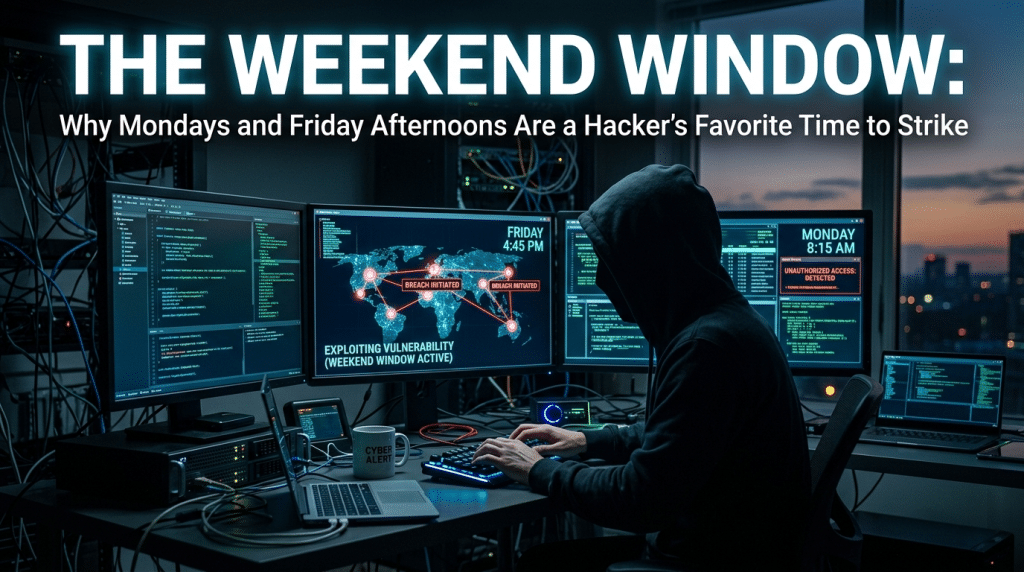
The Weekend Window: Why Mondays and Friday Afternoons Are a Hacker’s Favorite Time to Strike
When business leaders map out their enterprise cybersecurity strategies, they typically focus on the what and the how of an attack. They invest heavily in sophisticated firewalls, configure advanced endpoint encryption, and debate the merits of various email filtering algorithms. The operational assumption is that cybercriminals are automated, faceless entities launching strikes around the clock with absolute indifference to the calendar.
However, experienced threat actors do not just analyze your software vulnerabilities; they carefully study your corporate calendar. They look closely at your operational rhythms, your human exhaustion cycles, and your staffing bottlenecks.
In the modern enterprise landscape, cybercriminals heavily favor two specific operational timeframes: Monday mornings and Friday afternoons. By alignment of their malicious payloads with the natural fatigue and distraction patterns of the standard workweek, hackers drastically increase their success rates. To secure your corporate capital, eliminate security gaps, and build a truly resilient workforce, business leadership must understand the deep psychological mechanics of the weekend window.
The Friday Afternoon Drop: Exploiting the Rush to Exit
The period between 1:00 PM and 5:00 PM on a Friday is arguably the most vulnerable timeframe for any corporate network. At this point in the week, your employees’ cognitive processing filters are heavily degraded by sustained operational fatigue. Staff members are focused entirely on wrapping up lingering tasks, clearing out their remaining task backlogs, and transitioning into weekend mode.
Cybercriminals actively weaponize this desire for a fast exit by deploying highly targeted, high-pressure phishing scripts:
- The Urgent Weekend Processing Request: An accountant receives an email appearing to originate from a primary supplier or your internal HR department, claiming that an “immediate payroll discrepancy” or an “unsettled invoice balance” must be resolved before the close of business. The message warns that if the attached verification form isn’t filled out within the next sixty minutes, vendor deliveries will be canceled or employee paychecks will be delayed over the weekend. Rushed by the impending clock, the exhausted worker bypasses standard verification rules.
- The Strategic Timing of the Exploitation: Hackers don’t just drop the bait on Friday to catch tired workers; they do it to exploit your IT department’s weekend scheduling. When a ransomware payload or a data exfiltration loop is triggered late Friday afternoon, the threat actor knows your core security personnel are likely operating on skeleton weekend shifts or are entirely offline. This gives the attack a massive, unchecked head start to map your internal network topology, corrupt your automated local backups, and encrypt your databases before anyone even notices an anomaly on Monday morning.
The Monday Morning Flood: Exploiting Cognitive Overload
If Friday afternoon is defined by exhaustion and a rush to leave, Monday morning between 8:00 AM and 11:00 AM is defined by severe cognitive overload. When your employees boot up their workstations at the start of the week, they are met with a digital avalanche: dozens of unread emails, urgent internal chat notifications, calendar sync alerts, and immediate task reminders.
In this state of high distraction and mental friction, human analytical defenses drop significantly. Workers shift into a rapid-fire processing state, attempting to clear out their inboxes as fast as humanly possible.
Threat actors seamlessly blend their malicious hooks right into this morning clutter. An employee might see an email that looks identical to a routine system notification, a file-share alert from a collaborative portal, or a shipping delivery update. Because the worker is rushing to reduce their inbox count from fifty down to zero, they instinctively click lookalike links, input multi-factor authentication (MFA) tokens into fraudulent replicas, or open macro-enabled attachments without pausing to inspect the sender’s full email address domain.
Hardening the Perimeter Against the Clock
Mitigating the threat of time-targeted exploits does not mean restricting your workforce’s operational velocity or introducing complex administrative bottlenecks that paralyze daily productivity. True organizational resilience relies on deploying automated, zero-trust infrastructure guardrails that calmly protect your network edge when human fatigue and distraction peak.
At Krypto IT, we turn your team into an active human firewall by systemizing continuous, automated behavioral protections:
- Deploying Enterprise-Grade Secure Web Gateways (SWG): We eliminate browser-driven and email-driven vulnerabilities by implementing advanced DNS-layer filtering and cloud URL isolation pipelines. Our security tools analyze web requests in real-time, instantly isolating suspicious link executions in secure sandboxes before they touch your local endpoints, keeping your network safe regardless of when an employee clicks.
- Enforcing Strict Device and Port Hardening Policies: We neutralize lateral infection loops at the system layer. Through advanced endpoint management, we configure your corporate workstations to instantly enforce automatic screen lockouts after inactivity and apply strict policies that block unauthorized external hardware, ensuring your network cannot be compromised over a quiet weekend.
- Anchoring Assets in Robust Biometric Identity: We isolate your core administrative channels from credential harvesting. We connect all system entry points with rapid biometric single sign-on tools (such as Windows Hello and Touch ID). This ensures that even if an attacker uses extreme psychological timing to trick a rushed employee into revealing a text-string password or copying an MFA code, the threat actor cannot gain access to your critical data rooms without sub-second hardware-validated biometric verification, keeping your infrastructure safe and under your absolute control.
Conclusion: Security Never Punches Out
In the modern digital economy, relying entirely on human vigilance to protect your business assets across a fluctuating workweek is an unsustainable approach to corporate risk management. Software parameters do not get tired, but your workforce does. Cybercriminals will always take the path of least resistance, and an exhausted brain on a Friday afternoon or a distracted mind on a Monday morning is infinitely easier to exploit than an enterprise firewall. True resilience demands absolute, time-independent visibility. By hardcoding hardware access restrictions, deploying proactive web filtering, and anchoring your perimeter in robust biometric validation, you clear the invisible timing tax and ensure your corporate capital remains entirely secure.
Are your employees’ weekend transition habits quietly exposing your internal digital infrastructure to devastating cyber threat vectors? Contact Krypto IT today for a comprehensive Technical Infrastructure and Operational Readiness Review, and let’s harden your digital boundary.