Beyond Backups: Protecting Your Houston Business from Ransomware 3.0
January 8, 2026
Quishing 101: How Scammers Use QR Codes to Bypass Your Houston Business Security
January 11, 2026
By the Team at Krypto IT | Cybersecurity Experts Serving Houston SMBs
When most Houston business owners think of a “cyberattack,” they imagine a loud, catastrophic event. They picture a screen locked by a ransomware message, a website defaced with political slogans, or a bank account suddenly drained of funds. In our minds, a breach is a “bang.”
However, the reality of modern cybercrime is often much quieter. In fact, the most dangerous threats in 2026 aren’t the ones that demand your attention; they are the ones that work tirelessly to avoid it.
Welcome to the era of the “Quiet Breach.” This is the domain of Infostealer Malware—sophisticated code designed to sit inside your system for months, silently harvesting your data while you go about your business. At Krypto IT, we call this the “Invisible Threat,” and it is currently the leading cause of corporate identity theft in the Houston SMB sector.
What is an Infostealer?
Unlike ransomware, which wants you to know it’s there so you can pay a ransom, an Infostealer’s primary goal is stealth. It is a lightweight piece of malware that typically enters a system through a malicious browser extension, a spear-phishing email, or an “infected” software update.
Once inside, it doesn’t encrypt your files. It doesn’t slow down your computer. Instead, it begins a systematic “sweep” of your digital life. It targets:
- Saved Browser Passwords: The “Vault” in Chrome or Edge that holds your logins.
- Session Cookies: This is the most dangerous target. By stealing your active “session cookies,” hackers can bypass Multi-Factor Authentication (MFA) entirely and log into your accounts as “you.”
- Autofill Data: Credit card numbers, addresses, and personal identification.
- Crypto Wallets: Any digital currency stored locally.
- Clipboard Data: Anything you “Copy and Paste” during your workday.
The Danger of “Dwell Time”
In the cybersecurity world, we measure the time between an initial infection and its discovery as “Dwell Time.” For Infostealers, the average dwell time is currently over 200 days.
Imagine a spy sitting in your office for seven months. They read every email, see every invoice, and know the credentials for every one of your cloud applications. By the time you realize they are there, the damage isn’t just a “loss”; it’s a complete compromise of your business’s integrity.
In Houston’s thriving professional services, legal, and engineering sectors, this data is gold. Hackers don’t just use it to steal money; they sell these “Logs” on the Dark Web to other criminals who use them for corporate espionage, tax fraud, or launching a much larger Ransomware 3.0 attack later down the line.
How the “Quiet” Breach Bypasses Traditional Security
If you are relying on basic, “free” antivirus or the default security settings that came with your computers, you are likely invisible to these threats. Infostealers use Polymorphic Code—meaning the malware changes its “signature” every time it is deployed. Traditional antivirus software looks for known “bad” signatures. If the signature is new, the antivirus ignores it.
Furthermore, because Infostealers don’t use much CPU power and don’t modify system files, they don’t trigger the “slowness” that usually alerts a user that something is wrong.
How Krypto IT Flips the Lights On
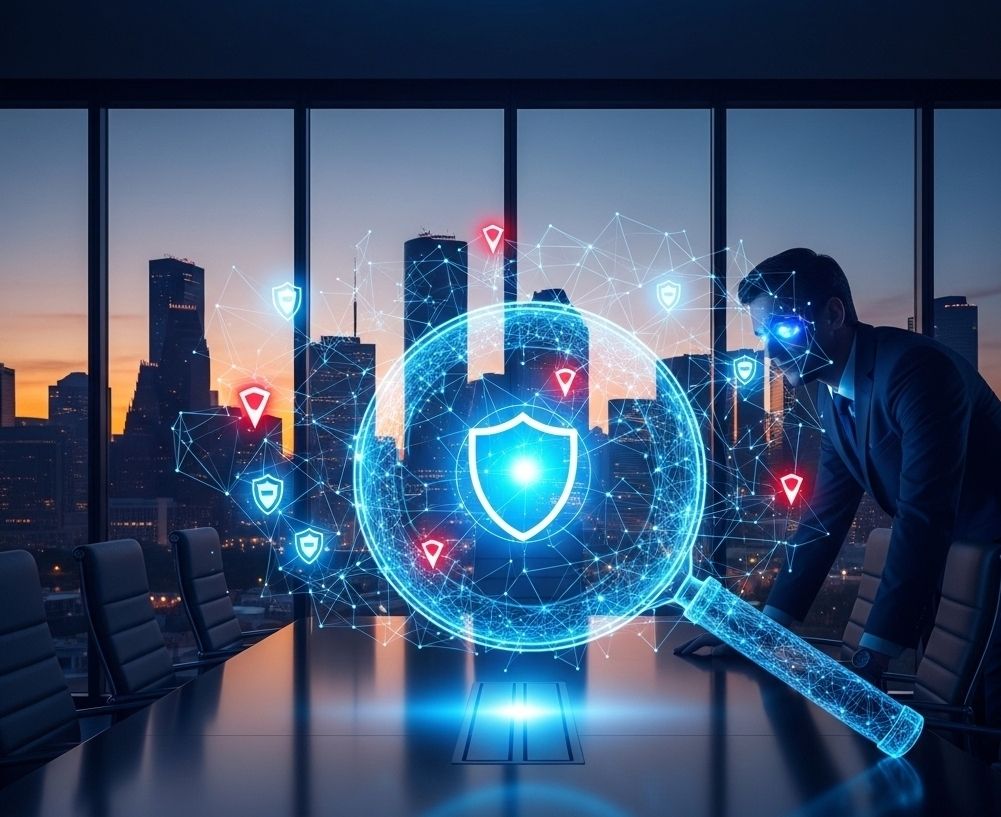
At Krypto IT, we don’t look for signatures; we look for Behavior. We assume that the “Quiet Breach” is already attempting to find a home in your network, and we build our defenses accordingly:
1. Managed EDR (Endpoint Detection and Response)
We use AI-driven tools that monitor for suspicious actions. If a browser process suddenly tries to extract a password database, our system detects the intent and kills the process instantly, even if it has never seen that specific malware before.
2. DNS Filtering and “Invisible Traffic Cop”
Infostealers must “phone home” to send your data back to the hacker’s server. Our DNS filtering acts as an invisible wall, blocking any outgoing communication to known malicious command-and-control servers.
3. Session Security and Cookie Management
We help your team implement “Conditional Access” policies. Even if a hacker steals a session cookie, they won’t be able to use it because our systems recognize they are trying to log in from an unauthorized location or an unrecognized device.
4. Continuous Credential Monitoring
We monitor the Dark Web in real-time. If an Infostealer does manage to grab a credential from an unmanaged device (like an employee’s home computer), we get an alert the moment that credential is put up for sale, allowing us to reset your passwords before the hacker can act.
Conclusion: Awareness is the Best Defense
The “Quiet Breach” relies on your complacency. It thrives in environments where technology is treated as a “set it and forget it” utility.
By partnering with Krypto IT, you are ensuring that your Houston business isn’t a silent host for cybercriminals. We provide the 24/7 visibility and proactive hunting needed to keep your network truly clean.
Is there a “silent partner” sitting in your network right now? Contact Krypto IT today for a comprehensive “Quiet Breach” Audit and let’s find out what’s hiding in the shadows.