LinkedIn Data Phishing: How Hackers Tailor Scams
July 12, 2026
Active Defense: Catching Cyber Intruders with Decoys
July 14, 2026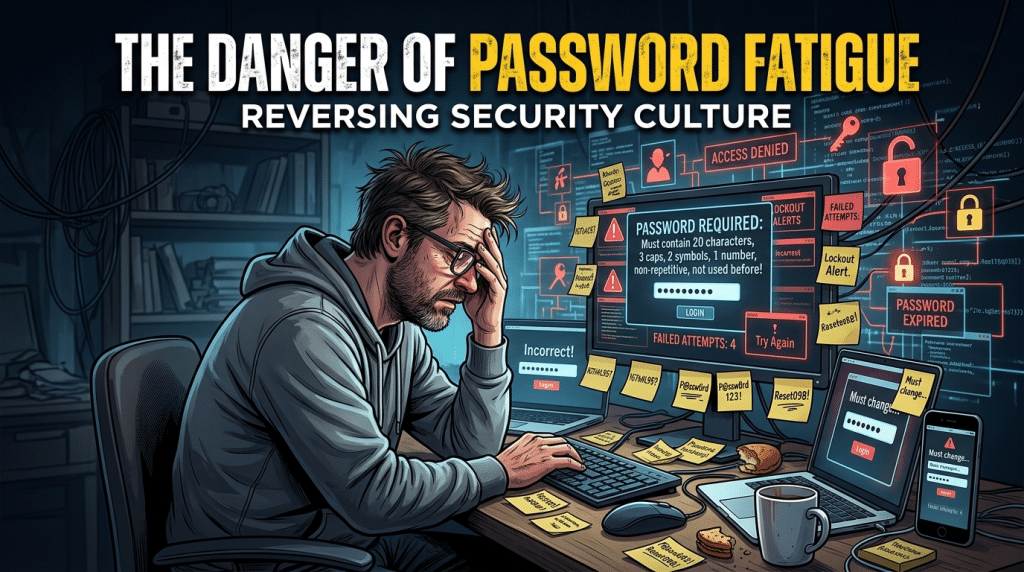
The Password Paradox: Why Complex Rules Often Lead to Weaker Security Culture
When modern business leaders design their internal cybersecurity frameworks, they almost always begin with a rigid set of password requirements. Corporate policies regularly dictate that every employee must create a credential containing a precise combination of uppercase letters, lowercase letters, numerical values, and special symbols. Furthermore, these frameworks frequently mandate that all users rotate their entire set of passwords every 60 to 90 days. The operational assumption is that by increasing the complexity of the rules, you naturally increase the strength of your company’s network security perimeter.
However, a dangerous and highly counterproductive psychological friction exists right at the keyboard: password fatigue.
As the modern enterprise relies on an ever-expanding fleet of cloud-based applications, collaborative portals, database environments, and software platforms, the sheer number of credentials an individual must manage has exploded. When businesses attempt to secure these vast software parameters by layering on increasingly complex, human-unfriendly rule sets, the strategy actively backfires. Instead of building a robust and defensive corporate environment, arbitrary constraints crush employee morale and force staff members to bypass the rules altogether. To protect your corporate capital, eliminate active data gaps, and secure your long-term operational workflows, leadership must understand the hidden mechanics of password exhaustion.
The Human Psychology of Security Workarounds
To understand why traditional password enforcement mechanisms frequently result in weaker network perimeters, you must analyze how human beings respond to systemic friction. When an individual is forced to memorize multiple long, complex, and rapidly changing character strings, their cognitive processing capacity hits a wall. Employees are hired to execute specific operational goals—whether that involves sales pipeline management, customer relations, or engineering development. They view complex security rules as obstacles standing between them and their actual jobs.
Driven by a natural desire for efficiency and convenience, the workforce systematically develops dangerous shortcuts to circumvent administrative constraints:
1. The Predictable Pattern Shift
When a corporate policy forces a user to change an already complex password every few months, the employee rarely invents a brand-new, distinct string of text. Instead, they apply predictable, low-effort modifications to their existing credential. For example, a password like Summer2026! simply becomes Autumn2026! or Winter2026!. Cybercriminals are fully aware of this behavior. If a threat actor harvests a single old credential via a data breach or a phishing landing page, they can easily predict the next iteration using automated script variations, rendering the forced rotation policy completely useless.
2. The Physical Paper Trail
When passwords become too complex to remember, humans stop trying to remember them. Instead, they write them down. In multi-tenant offices and shared workspaces, it is remarkably common to find sticky notes tucked under keyboards, handwritten spreadsheets hidden beneath desk pads, or unencrypted text documents saved directly to a computer desktop labeled “Passwords.” This introduces a massive physical security vulnerability, allowing an unvetted vendor, a visitor, or a physical tailgater to gain instant administrative entry into your digital network.
3. Systematic Credential Stuffing
Managing dozens of unique, rule-abiding passwords creates severe mental friction. Consequently, employees routinely reuse the exact same complex password across multiple external platforms, including personal social media accounts, third-party shopping sites, and critical corporate databases. If a low-security external website suffers a public data breach, the hacker harvests that reused complex password and immediately inputs it into your main corporate access panels using automated credential stuffing attacks, walking straight past your firewalls.
Eliminating Friction by Replacing Passwords with Identity
Mitigating the threat of password fatigue does not require introducing complex administrative bottlenecks that paralyze your team’s purchasing power or lower your baseline defensive metrics. True organizational resilience relies on replacing vulnerable, human-dependent text strings with automated, zero-trust infrastructure guardrails that protect your network edge seamlessly.
At Krypto IT, we help growth-minded companies eliminate password-related operational vulnerabilities by deploying continuous, identity-first defensive perimeters:
- Enforcing Strict Device and Endpoint Hardening Rules: We remove the burden of memorization from the user. We configure and deploy centralized enterprise password management environments that securely generate, encrypt, and automatically input high-entropy, random character strings across all corporate applications. This ensures your workforce never has to remember a single password or write a credential down on a physical note.
- Deploying Prominent Inbound Protection and Gateways: We stop attacks before they test your employees’ credentials. By integrating advanced cloud web gateways and real-time email filtering engines, we block lookalike credential harvesting links and malicious domains before they ever hit an inbox, keeping your team safe even if their password habits are imperfect.
- Anchoring Environments in Frictionless Biometric Identity: We eliminate text-string passwords entirely from the daily user experience. We connect all network entry points with rapid biometric single sign-on controls (such as Windows Hello and Touch ID). By shifting to hardware-validated, cryptographic passkeys and sub-second biometric checks, we allow your employees to access their systems instantly with a glance or a fingerprint, making stolen text passwords completely useless and securing your data rooms permanently.
Conclusion: Convenience Drives Security
In the modern digital economy, assuming that making security protocols harder for humans will make networks safer for data is an unsustainable approach to corporate risk management. Software parameters do not get frustrated, but your workforce does. When security rules conflict with human convenience, convenience always wins, and your organization is left carrying the structural risk. True resilience demands an environment where the most secure path is also the easiest path. By hardcoding hardware access parameters, deploying enterprise password management, and anchoring your perimeter in robust biometric validation, you clear the invisible password fatigue tax and keep your corporate capital entirely secure.
Are your company’s rigid password rules quietly forcing your employees to create dangerous operational security shortcuts? Contact Krypto IT today for a comprehensive Technical Infrastructure and Identity Perimeter Vulnerability Review, and let’s harden your digital boundary.