QuickBooks Security: Protecting Your Business Financial Core
July 17, 2026
Cloud Sync vs. Backup: The Storage Trap
July 20, 2026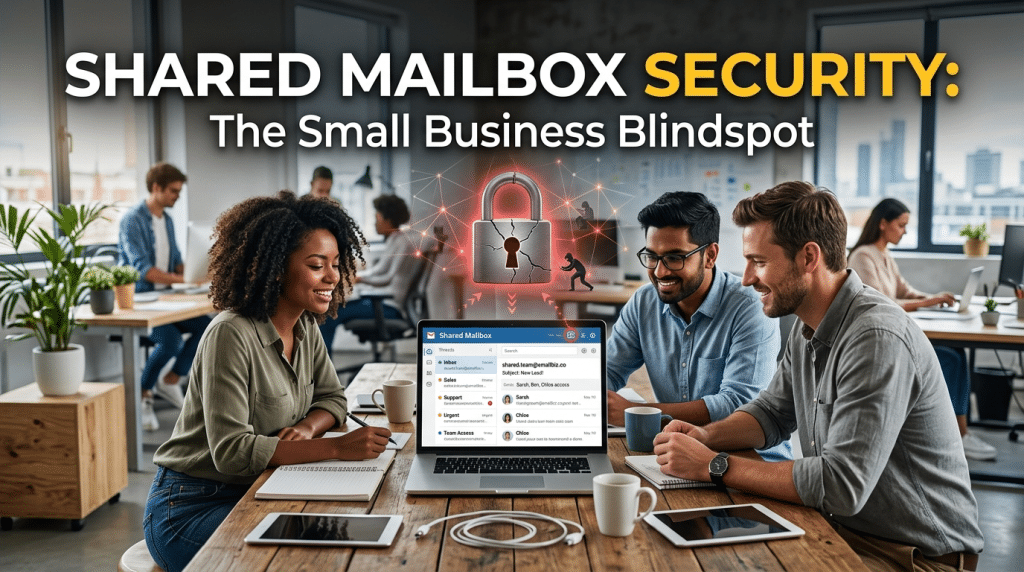
Shared Mailboxes: The Common Security Loophole in Small Business Operations
In the daily sprint of running a small or medium-sized business, efficiency often takes precedence over architecture. When a team needs a collective way to handle incoming sales leads, manage customer service inquiries, or process vendor invoices, the immediate solution is almost always the same: set up a shared mailbox. Whether it is info@, billing@, or support@, these collaborative hubs are fundamental to maintaining smooth external communications.
However, because these mailboxes are designed specifically for friction-free access, they frequently become the single largest, unmonitored security loophole in a company’s cloud ecosystem.
Many business owners treat shared mailboxes as harmless utility tools, assuming they inherit the robust security parameters applied to individual employee accounts. In reality, their collaborative nature creates unique structural vulnerabilities. If left unmanaged, these mailboxes offer cybercriminals an invisible, highly privileged staging ground to launch devastating internal attacks.
Why Shared Mailboxes Are a Premier Target for Hackers
To secure your digital boundaries, you must first recognize why threat actors actively scan for and exploit collaborative email accounts. The danger stems from a combination of missing access visibility, architectural defaults, and the human element of shared responsibility.
1. The Absence of Direct Multi-Factor Authentication
In standard cloud configurations—such as Microsoft 365 or Google Workspace—shared mailboxes are structurally designed as identity-less accounts. They are intended to be accessed by licensed users who have been granted explicit delegate permissions.
However, many IT setups or outsourced administrators provision these accounts with direct, independent login credentials to save on licensing costs or ease the setup process across multiple devices. When a shared mailbox has its own username and password, it often circumvents the organization’s global Multi-Factor Authentication (MFA) mandates. A hacker who harvests these specific credentials can log directly into the account from anywhere in the world, meeting zero verification resistance.
2. The Diffusion of Responsibility
Human psychology plays a massive role in shared mailbox vulnerability. When an email arrives in an individual worker’s inbox, they feel a personal responsibility to vet the sender, analyze links, and double-check requests.
When that exact same email lands in a shared repository viewed by five or six different people, that sense of individual vigilance erodes. Employees assume a colleague has already verified the message, or they rush through processing it to clear the shared queue. Threat actors capitalize on this collective distraction, injecting highly targeted phishing links or fraudulent invoices into the shared space, knowing someone on the team is bound to click out of habit.
3. Lateral Movement and Internal Trust
The true value of a shared mailbox to a cybercriminal isn’t just the data it holds; it is the implicit trust the account commands within the corporate network. If an external attacker compromises info@ or sales@, they don’t just send spam outward. They use that trusted internal address to email the CEO, the CFO, or the human resources department.
Because the email originates from inside the company’s verified domain, standard email security filters rarely flag the message as suspicious. The attacker can then easily request wire transfers, distribute malware, or harvest the credentials of high-level executives from a position of absolute trust.
Hardening the Shared Perimeter: A Zero-Trust Approach
Closing the shared mailbox loophole requires moving away from casual access habits and adopting a strict, zero-trust infrastructure framework. You must verify exactly who is interacting with your shared financial and operational hubs at all times.
At Krypto IT, we help businesses secure these collaborative blindspots by deploying automated access controls and rigid boundary defenses:
- Enforcing Strict Delegate-Only Access: We eliminate independent, standalone login credentials for shared mailboxes. By converting these accounts into true delegate repositories, we ensure they can only be accessed by authenticated users who have already passed your company’s primary biometric or hardware-bound identity checks. If a user cannot log into their personal account, they cannot access the shared environment.
- Implementing Continuous Identity Auditing: Shared mailboxes often suffer from “permission creep,” where former employees, temporary contractors, or reassigned staff retain access long after they leave the team. We establish automated discovery pipelines to continuously audit delegate lists, instantly revoking permissions for inactive users and ensuring the principle of least privilege is maintained.
- Isolating Financial and Sensitive Workflows: Standard shared mailboxes should never be used to handle high-risk financial processes. We work with operations teams to isolate workflows like wire confirmations and vendor routing changes into dedicated, heavily guarded communication channels that utilize advanced inbound threat filtering and mandatory out-of-band verification.
Conclusion: Securing the Collaborative Hub
Shared mailboxes are vital for maintaining agile, responsive operations, but convenience should never dictate your security posture. Leaving a collaborative inbox unprotected with shared passwords or unmonitored delegate access is the digital equivalent of leaving your office backdoor unlocked because it is easier for the staff to use.
By hardening your identity boundaries, eliminating direct credentials, and enforcing strict user accountability, you turn a dangerous structural vulnerability into a secure, highly resilient asset.
Are your shared corporate mailboxes operating without mandatory MFA or clear user tracking? Contact Krypto IT today for a comprehensive Cloud Tenant Security Audit, and let’s close the loopholes threatening your operations.