Hidden API Risks: Is That Third-Party Add-on Stealing Your Data?
July 16, 2026
Shared Mailbox Security: The Small Business Blindspot
July 18, 2026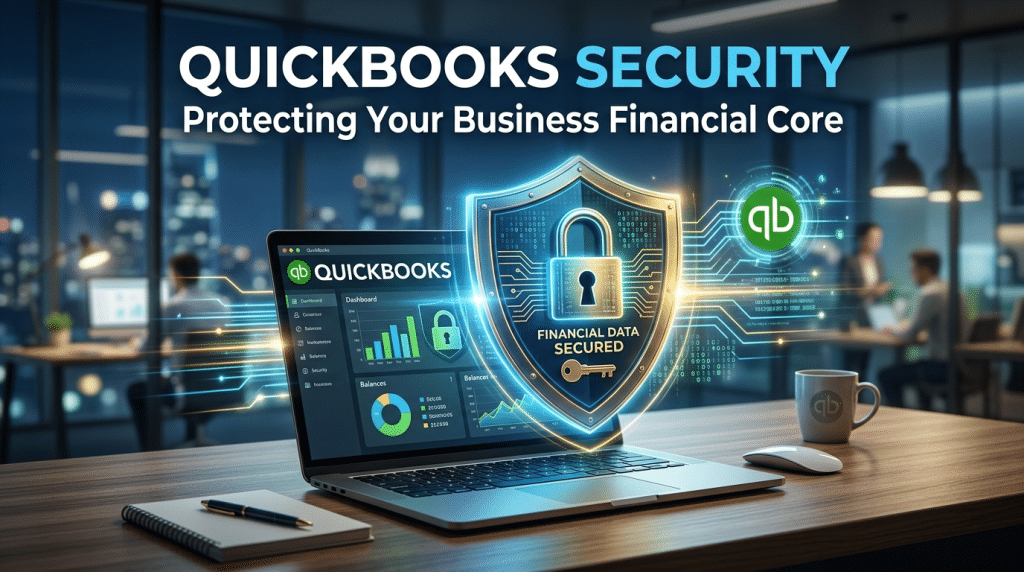
Securing Your QuickBooks: Protecting the Financial Core of Your Business
For small and medium-sized businesses, financial data is the ultimate target for cybercriminals. While intellectual property, client lists, and internal communications are highly valuable, nothing translates into an immediate, devastating payout for an attacker quite like direct access to your accounting infrastructure. At the center of this risk profile sits QuickBooks, the software that handles payroll, bank reconciliations, vendor routing, and tax documentation for millions of expanding companies.
When a malicious actor breaches an accounting platform, the damage is rarely limited to simple data theft. Attackers use this access to execute sophisticated invoice manipulation schemes, redirect automated clearing house (ACH) vendor payments to fraudulent accounts, exfiltrate sensitive employee tax documents for identity theft, or deploy network-wide ransomware.
Because QuickBooks serves as the literal engine of your corporate cash flow, securing it requires moving far beyond basic password hygiene. Protecting your business demands a proactive, multi-layered defensive strategy that hardens your accounting workflows against both external intrusions and internal vulnerabilities.
The Modern Attack Vectors Targeting Financial Software
To build a resilient defense, business leaders must first understand exactly how modern cybercriminals exploit financial accounting ecosystems. Attackers rarely try to crack the core encryption of the software itself; instead, they aggressively target the human operators and perimeter vulnerabilities surrounding the application.
1. Business Email Compromise and Social Engineering
The most common entry point into a financial ecosystem begins with a targeted phishing campaign. Threat actors craft highly convincing emails that mimic urgent communications from Intuit, banking institutions, or key corporate vendors. These messages often claim that a payroll run failed, a software subscription has expired, or a critical security update must be applied immediately.
If an exhausted accounting employee clicks the provided link, they are routed to a lookalike login portal designed to harvest their corporate credentials. Once the attacker captures these details, they can log directly into cloud-hosted financial accounts without raising immediate alarms.
2. Session Hijacking and Session Token Theft
As businesses migrate to cloud-based accounting solutions like QuickBooks Online, hackers have shifted their focus to intercepting active browser sessions. Through specialized malware distributed via malicious downloads or compromised browser extensions, attackers can steal active session cookies directly from an employee’s computer.
By utilizing these stolen tokens, a cybercriminal can replicate the authenticated session on their own machine. This allows them to bypass multi-factor authentication entirely, as the cloud platform assumes the connection is simply a continuation of the legitimate user’s active workday.
3. Compromised Third-Party Financial Integrations
Modern accounting relies heavily on efficiency, leading many organizations to link QuickBooks with external inventory tools, expense management platforms, and automated invoicing applications. However, if any of those secondary applications suffer a backend data breach, the open API tokens connecting them to your ledger can be weaponized. Threat actors use these trusted, automated pipelines to quietly manipulate corporate records, inject fraudulent invoices, or download entire financial histories without ever interacting with the primary login screen.
Implementing Zero-Trust Safeguards for Financial Data
Securing the core of your business requires establishing a strict zero-trust posture across your entire accounting environment. This means operating under the assumption that perimeter defenses can fail, and every access request must be continuously verified and tightly restricted.
At Krypto IT, we help growth-minded companies eliminate accounting vulnerabilities by embedding advanced, automated security controls directly into your financial infrastructure:
- Enforcing Strict Principle of Least Privilege (PoLP): Many organizations make the mistake of granting full administrative access to every member of the accounting or management team. We structure granular user roles within your financial platform, ensuring that employees only possess the exact permissions required to execute their specific daily tasks. A staff member responsible for entering invoices, for example, should never have the architectural rights to modify bank routing details, export entire client databases, or alter payroll schedules.
- Transitioning to Hardware-Bound Biometric Identity: Traditional text-string passwords and SMS-based multi-factor authentication are no longer sufficient to stop sophisticated corporate attacks. We replace vulnerable, shareable credentials with hardware-bound biometric authentication (such as Windows Hello and Touch ID). By tying system access directly to a physical, biometric signature, you ensure that stolen session tokens or harvested passwords are completely useless to an external threat actor.
- Continuous Audit Log Monitoring and Anomalous Behavior Detection: Financial software tracks internal actions through automated audit trails, but these logs are only useful if they are actively analyzed. We implement continuous monitoring protocols that watch for unusual structural behavior—such as mass data exports executed outside of standard business hours, rapid modifications to established vendor bank accounts, or login attempts originating from unexpected geographic locations.
Conclusion: Guarding the Engine of Your Corporate Cash Flow
Your accounting software is the central vault of your enterprise. Allowing it to operate with default configurations, excessive user permissions, or weak authentication protocols invites catastrophic financial and operational risk. True business resilience relies on creating a defensive posture where a single compromised credential cannot compromise your entire cash reserve.
By restricting user roles, mandating hardware-validated identity metrics, and strictly auditing every external application linked to your ledger, you neutralize the modern threat loop and keep your corporate capital entirely secure.
Are your corporate financial records protected by outdated passwords and unmonitored connections? Contact Krypto IT today for a comprehensive Financial Infrastructure and Cloud Access Security Review, and let’s lock down your accounting perimeter.