
60 Minutes to Save Your Business: A Critical Incident Response Guide for Houston SMBs
January 25, 2026
Secure Your Houston Business: A Guide to Choosing the Best Team Password Manager
January 28, 2026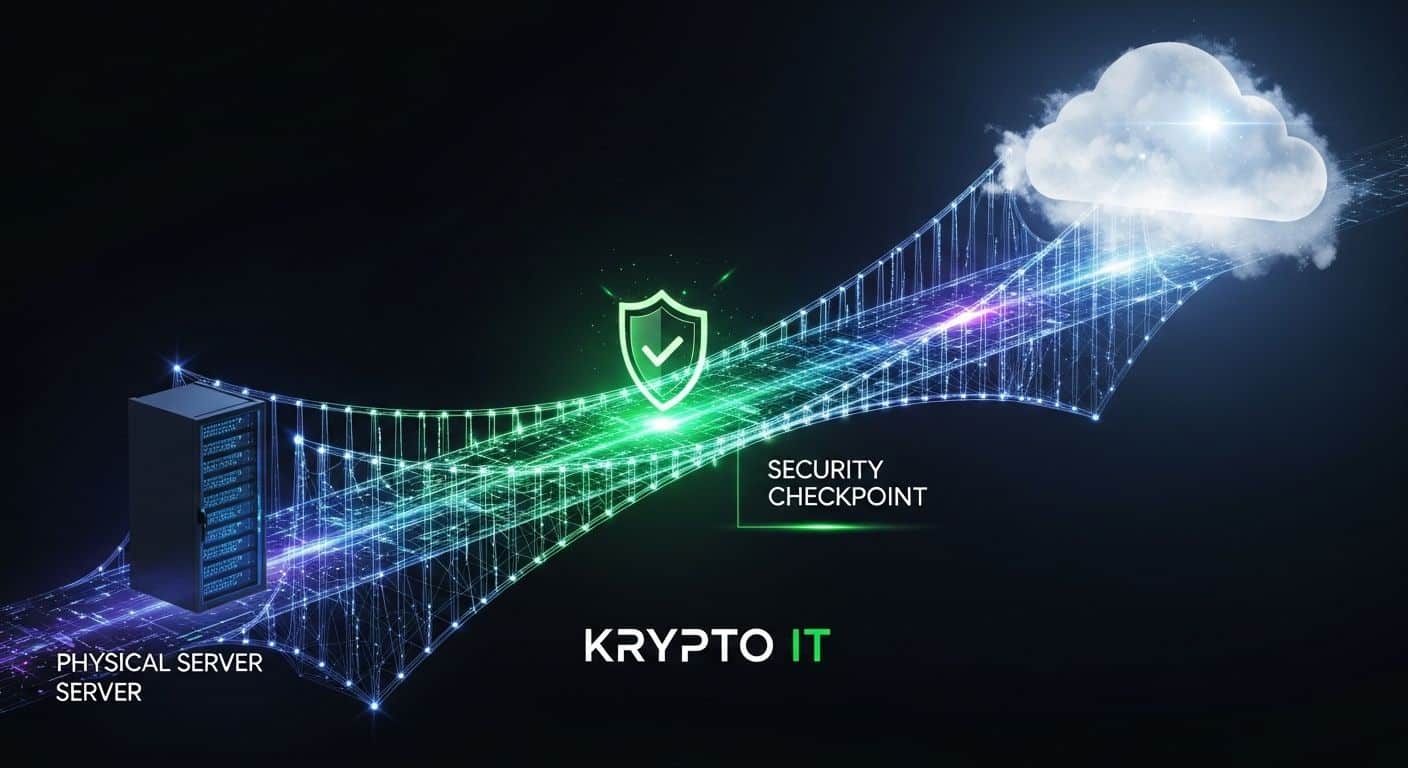
By the Team at Krypto IT | Cybersecurity Experts Serving Houston SMBs
The “Digital Transformation” of Houston’s business landscape is in full swing. From engineering firms in the Energy Corridor to boutique law practices in Downtown, companies are retiring their aging, noisy on-premise servers and moving their operations to the cloud. The allure is undeniable: lower hardware costs, seamless remote work, and better collaboration.
However, many Houston SMBs treat “Cloud Migration” like a simple move across town—they pack the boxes, toss them in a truck, and hope nothing breaks. In the world of cybersecurity, this lack of planning is a recipe for disaster. Moving to the cloud doesn’t automatically make you secure; in fact, if done poorly, it can open new doors for hackers.
At Krypto IT, we’ve guided countless local businesses through this transition. Here is our strategic guide to ensuring your cloud migration is a secure one.
1. Understand the “Shared Responsibility” Model
The biggest misconception about the cloud is that the provider (Microsoft, Google, or AWS) is responsible for everything. This is a dangerous myth.
In cybersecurity, we use the Shared Responsibility Model. Think of it like renting a high-security apartment in a Midtown Houston high-rise. The building management (the cloud provider) is responsible for the lobby security, the elevators, and the structural integrity of the building. However, you (the business) are responsible for who you give your keys to and whether you lock your individual front door.
If an employee uses a weak password and no MFA to access your cloud-based files, Microsoft isn’t “breached”—you are. You must secure your data, your identities, and your configurations.
2. Data Mapping: Don’t Move the “Junk”
One of the most common mistakes we see is the “Lift and Shift” of disorganized data. If your current server is a mess of outdated files and “Copy_of_Final_v2” documents, moving it to the cloud just creates a bigger, more expensive mess.
The Strategy: Perform a data audit before the move. Identify what is:
- Active: Current projects and client data.
- Archive: Data that must be kept for legal reasons but doesn’t need to be in the “Live” environment.
- Trash: Redundant, obsolete, or trivial (ROT) data.
3. Identity is the New Perimeter
When your server sat in a closet in your Houston office, you had a physical perimeter. To get to the data, a hacker usually had to get past your office firewall. In the cloud, the “Perimeter” is the user’s identity.
The Strategy:
- Single Sign-On (SSO): Use one set of secure credentials to access all cloud apps. This makes it easier for employees and easier for you to revoke access if someone leaves.
- Conditional Access: Implement rules that say, “You can only access the HR folder if you are on a managed company laptop and located in the United States.” * Phishing-Resistant MFA: As we move toward 2026, standard text-code MFA is no longer enough. Cloud environments should be secured with biometrics or physical security keys.
4. Encrypt Everything—In Transit and At Rest
In a cloud environment, your data is constantly “in motion” as it travels from the cloud data center to your employees’ homes in Katy or The Woodlands.
The Strategy: Ensure that your cloud provider uses enterprise-grade encryption for data “at rest” (sitting on their drives) and data “in transit” (moving over the internet). Additionally, for highly sensitive Houston industries like medical or legal, we recommend “End-to-End Encryption” where only your business holds the keys to the data, making it unreadable even to the cloud provider itself.
5. Post-Migration Monitoring: The “Set it and Forget it” Trap
The work doesn’t end the day the migration is finished. Cloud environments are “dynamic”—settings can change, new users are added, and third-party apps are integrated.
The Strategy: Implement Cloud Access Security Broker (CASB) tools. These tools act as a “Security Camera” for your cloud environment, alerting you if an employee suddenly tries to download your entire client database or if a login attempt is made from a suspicious location.
How Krypto IT Simplifies Your Move
At Krypto IT, we take the “Fear of the Unknown” out of the cloud. We provide a “White Glove” migration service for Houston SMBs:
- Pre-Migration Audit: We find the holes in your current setup so they don’t follow you to the cloud.
- Secure Configuration: We “harden” your Microsoft 365 or Google Workspace environment, turning off the dangerous default settings hackers love.
- Continuous Compliance: We ensure your cloud setup meets the specific standards of your industry, whether it’s HIPAA, SEC, or NERC CIP.
Conclusion: The Cloud is a Tool, Not a Shield
Moving to the cloud is a brilliant move for Houston businesses looking to scale, but it must be done with a “Security-First” mindset. By understanding your responsibilities and building a strong identity-based perimeter, you can enjoy the benefits of the cloud without the sleepless nights.
Ready to move to the cloud without the risk? Contact Krypto IT today for a “Cloud Readiness Assessment” and let’s plan your secure migration.