Spotting “Silent” Data Corruption Before It’s Too Late
May 19, 2026
Why Cybersecurity Is Now a Boardroom Issue
May 21, 2026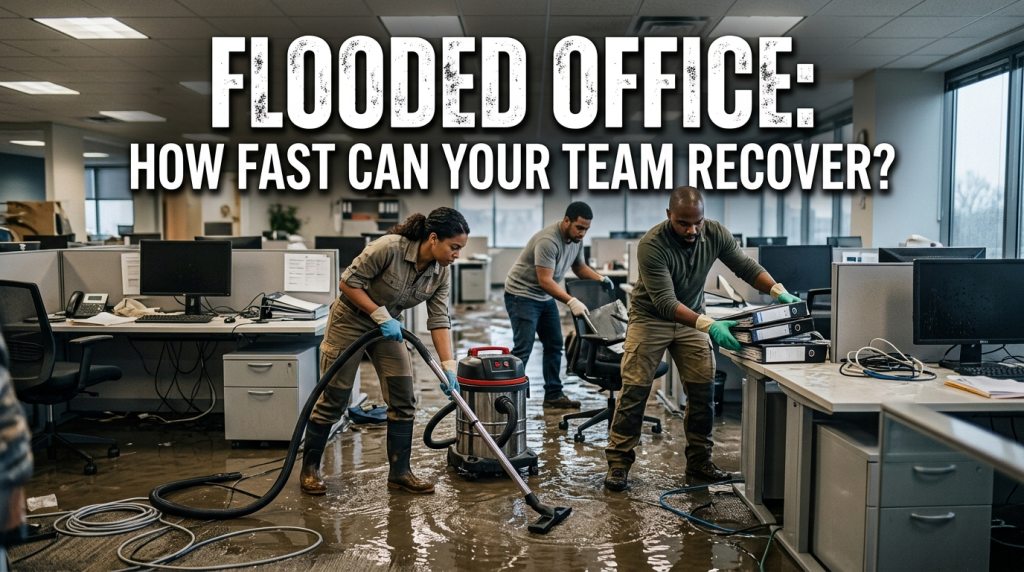
The Waterline and the Bottom Line: A Business Guide to Rapid Recovery After an Office Flood
An office flood is one of the most disruptive physical disasters a business can experience. Whether it is caused by a catastrophic burst pipe over a weekend, a failed commercial water heater, or localized rising water during a severe Gulf Coast storm, water moves fast and destroys completely. Within minutes, drywall is ruined, carpeting is soaked, and your expensive physical technology infrastructure is submerged.
When the water clears, the clock immediately starts ticking against your business survival. The critical question isn’t just “How will we clean this up?” but rather: How soon can our team be back online and serving clients?
For many small to mid-sized organizations, an office flood results in weeks of catastrophic downtime because their operational survival is tied directly to physical hardware sitting on the office floor. True business continuity means building an infrastructure where your office building can be completely inaccessible, yet your team remains fully operational. Here is how to measure your actual recovery speed and build a disaster-proof workflow.
The Reality of Physical Downtime
When a business relies on local, on-site servers and desktop computers, an office flood sets off a chain reaction of operational delays.
First, there is the Safety and Assessment Phase. You cannot safely enter a flooded space or turn on electrical equipment until emergency teams and electricians clear the building. This process alone can take 48 to 72 hours.
Second, there is the Hardware Replacement Cycle. Even if your data is safely backed up to the cloud, you cannot use that data until you have hardware to run it on. If your primary server is ruined, ordering, shipping, configuring, and deploying a replacement enterprise server typically takes 5 to 10 business days. If you are scrambling to buy 20 new employee laptops simultaneously, you are at the mercy of local retail inventory or supply chain shipping windows.
During this entire period, your billable hours drop to zero, your internal communication breaks down, and your clients are met with radio silence.
Measuring RTO and RPO
To understand how fast your business can bounce back, you must define two critical metrics in your disaster recovery plan:
- Recovery Time Objective (RTO): This is the maximum tolerable duration of downtime. If your website, phones, and client portals are down for three days before you can restore operations, your RTO is 72 hours.
- Recovery Point Objective (RPO): This refers to data loss. If your backups only run once a week on Friday night, and your office floods on a Thursday afternoon, you have lost nearly a week’s worth of active client work, data entries, and financial transactions. Your RPO in this scenario is six days.
In a modern business ecosystem, a sustainable recovery target should measure RTO in minutes or hours, not days or weeks.
The Three Pillars of a Flood-Proof Workforce
To minimize your RTO and ensure an office flood is merely a logistical annoyance rather than a business-ending catastrophe, your technology footprint must be intentionally decoupled from your physical real estate.
1. The Virtual Failover Standard
If your local server room goes underwater, your infrastructure should automatically spin up in a secure, cloud-based data center. This is known as Disaster Recovery as a Service (DRaaS). Through continuous replication, a virtual snapshot of your server environment sits waiting in standby mode. If the physical office fails, your IT partner can trigger a “Failover” command, allowing your employees to log into their virtual desktops and access all company files from any internet-connected device within hours.
2. Cloud-Native Communication and SASE
When an office floods, your physical desk phones go dark. A resilient business utilizes cloud-hosted VoIP communication and unified platforms (like Microsoft Teams or Zoom Phone) that seamlessly transition to employee mobile apps. Furthermore, by implementing a SASE (Secure Access Service Edge) framework, your team can securely connect to company resources from their home internet or cellular hotspots without sacrificing cybersecurity protocols.
3. Elevated, Immutable Hardware Policies
For the hardware that must remain on-site, implementation matters. Implement a strict policy requiring all critical network switches, firewalls, and server racks to be mounted at least 48 inches off the ground. Additionally, ensure that your on-site backup appliance is ruggedized and continuously synchronizing with an out-of-region, air-gapped cloud vault.
Conclusion: Resiliency Is an Operational Choice
An office flood is an unpredictable physical event, but your recovery speed is entirely within your control. By migrating away from an office-centric technical model and anchoring your business operations in a high-availability hybrid framework, you ensure that even if your carpets are ruined, your business never misses a beat.
Is your team’s productivity tied to the floorboards? Contact Krypto IT today for a comprehensive “Disaster Recovery and Business Continuity Audit” and let’s secure your operational uptime.