Clean Desk & Screen Policies: Hybrid Office Security
September 8, 2026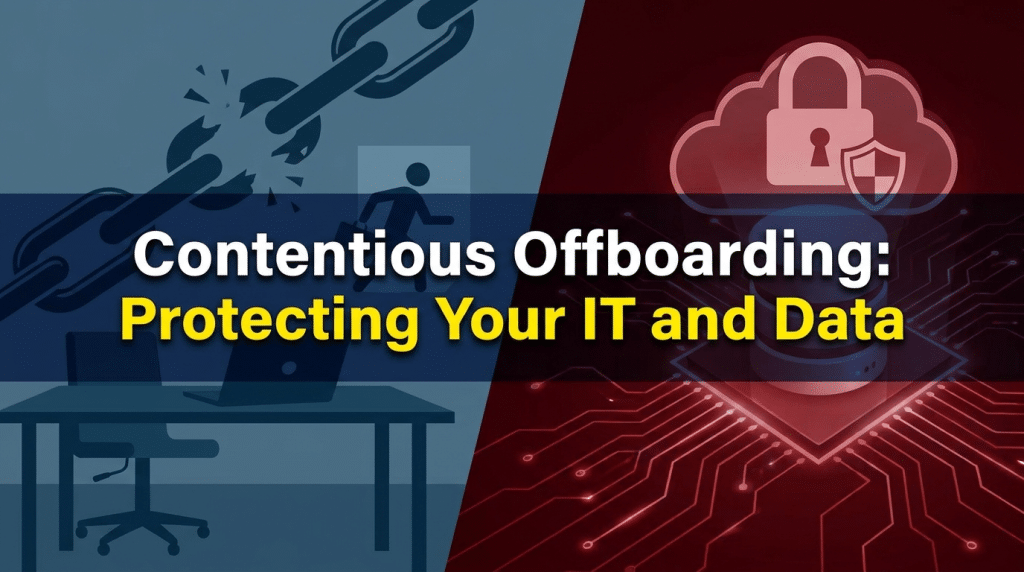
How to Handle Employee Separation When the Departure Is Contentious
Employee offboarding is rarely simple, but when an exit involves conflict, sudden termination, or active grievances, it transforms from a standard human resources process into a high-stakes cybersecurity and legal risk.
A disgruntled departing employee—especially one with administrative privileges, access to client records, or control over critical systems—can inflict catastrophic damage within minutes. Whether driven by revenge, fear, or a desire to gain a competitive head start at a rival firm, contentious separations frequently lead to intellectual property theft, data sabotage, unauthorized credential retention, or intentional infrastructure disruption.
Navigating a hostile departure requires seamless synchronization between Human Resources, executive leadership, legal counsel, and IT security. Without a coordinated, precise offboarding protocol, an organization leaves its most sensitive intellectual assets and network perimeters completely exposed.
Why Contentious Exits Present Extreme Insider Threat Risks
Standard offboarding timelines, where an employee works through a two-week notice period and hands over credentials on their final afternoon, do not apply to hostile departures. During a volatile separation, an organization faces distinct threat vectors:
1. Mass Data Exfiltration
Departing personnel frequently attempt to download proprietary databases, client lists, pricing formulas, or source code repositories to personal cloud drives (such as Dropbox or Google Drive), USB flash devices, or personal email accounts before losing access.
2. Digital Sabotage and Spite Wiping
Angry staff may delete production files, erase project repositories, purge communication archives, or alter core configurations out of frustration, intentionally creating operational chaos for the colleagues left behind.
3. Lingering Persistent Access (Shadow Backdoors)
Technical personnel may generate unauthorized secondary administrative accounts, configure hidden remote desktop utilities, generate long-lived API tokens, or set up external email forwarding rules to maintain covert visibility after departure.
4. Hardware Hostage Scenarios
In remote and hybrid environments, contentious employees may refuse to return corporate laptops, smartphones, or hardware tokens, potentially attempting to wipe devices or extract local data offline.
The Coordinated Protocol for Hostile Separations
Managing a contentious termination requires executing technical and operational controls in lockstep.
Step 1: Pre-Termination Forensic Audit and Quiet Surveillance
Before notifying the employee of their termination, quietly audit their recent activity through Endpoint Detection and Response (EDR), Data Loss Prevention (DLP), and cloud audit logs:
- Review file download and transfer volumes over the past 30 to 60 days for unusual spikes.
- Check for newly created administrative accounts, changed passwords on shared company profiles, or altered multi-factor authentication (MFA) devices.
- Export and preserve these audit logs immediately to establish a clean evidentiary baseline if legal disputes arise.
Step 2: Synchronize Revocation with the Termination Conversation
Access revocation must occur at the exact second the termination meeting begins—not hours before, which tips off the employee, and not hours after, which leaves a window for sabotage.
- Terminate Cloud Identity and Single Sign-On (SSO): Disable their primary identity provider (IDP) account (e.g., Microsoft Entra ID or Okta) and force an immediate global session revocation across all connected SaaS applications.
- Revoke Active Tokens: Do not rely solely on resetting a password; refresh tokens and active OAuth grants must be systematically revoked to sever mobile and desktop app sessions instantly.
- Isolate Managed Devices: Remotely trigger device management policies (via MDM) to lock the corporate laptop, restrict USB read/write access, and initiate an encrypted remote wipe of corporate containers if necessary.
Step 3: Secure Hardware and Physical Access Immediately
For in-office employees, disable building access badges, parking passes, and biometric door credentials concurrently with the meeting. Have a manager or security personnel escort the individual while they collect strictly personal belongings, preventing access to physical server closets, filing cabinets, or colleagues’ workstations.
For remote employees, immediately disable company mobile numbers, re-route inbound calls and emails to an active supervisor, and ship pre-paid, insured return packaging with tracking to recover physical hardware without escalating personal tension.
Step 4: Audit Shared Credentials and Secondary Channels
Disabling a single user account is insufficient if shared departmental passwords exist:
- Rotate passwords and reset API keys for shared administrative portals, social media accounts, vendor management platforms, and domain registrars.
- Inspect corporate email configurations for covertly configured auto-forwarding rules directing copies of inbound messages to personal external addresses.
- Remove the user from external vendor access lists, developer tenants, and GitHub/GitLab organizations.
The Importance of Forensic Preservation
Never immediately wipe, reimage, or reassign a terminated employee’s computer following a contentious departure.
Store the laptop or desktop in an encrypted, physically secured environment for a minimum of 90 to 180 days. If the former employee initiates legal action, files wrongful termination claims, or violates non-solicitation covenants, that machine serves as the primary repository of forensic evidence. Work with an IT security partner to create a verified, bit-stream forensic image with cryptographic hash verification to maintain strict chain of custody.
Safeguard Your Business with Krypto IT
Protecting company assets during employee turnover requires mature identity governance, automated device controls, and disciplined offboarding procedures.
At Krypto IT, we help Houston-area and remote businesses establish comprehensive Identity and Access Management (IAM), Mobile Device Management (MDM), and automated deprovisioning frameworks that neutralize insider risks before damage occurs.
Are your offboarding procedures strong enough to protect critical data during a hostile separation? Contact Krypto IT today to evaluate and harden your offboarding security workflows.