Post-Disaster Retrospectives: Gaining an Edge
September 4, 2026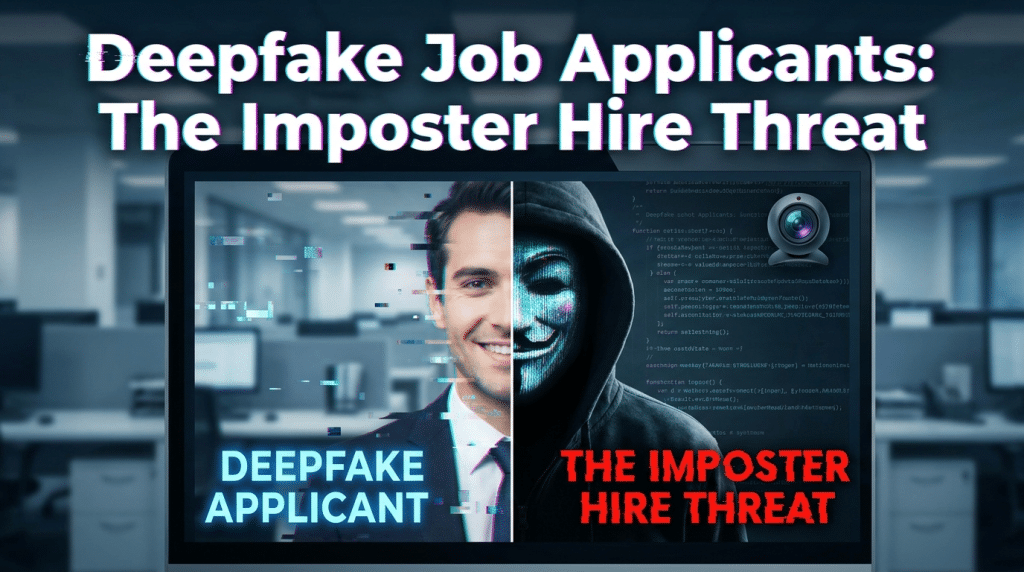
Deepfake Job Applicants: How Remote Teams Are Targeted by Imposters
The shift toward remote-first hiring opened up global talent pools for growing businesses. Today, companies can recruit top-tier software engineers, database administrators, and operational specialists regardless of zip code.
However, this entirely virtual onboarding process has introduced a sophisticated attack vector that many hiring managers and executives never anticipated: the deepfake job applicant.
Cybercriminal syndicates and nation-state threat actors—including well-documented state-sponsored groups from North Korea—are deploying artificial intelligence, real-time facial overlays, voice modulation tools, and stolen identities to infiltrate organizations under the guise of legitimate remote hires.
These imposter candidates ace virtual interviews, pass superficial background checks, and get handed enterprise credentials and corporate hardware.
For modern businesses, the human resources pipeline is no longer just a recruitment workflow; it has become the front door of enterprise cyber defense.
The Mechanics of an Imposter Hire
Fraudulent candidates rarely operate alone. Most are backed by organized cybercrime networks that treat corporate hiring as an industrial infiltration campaign. The typical operation unfolds across four distinct phases:
1. Synthetic Identities and Stolen PII
Attackers purchase legitimate Personally Identifiable Information (PII) from dark web credential breaches or create synthetic identities combining real Social Security numbers with fabricated work histories. They generate polished LinkedIn profiles, clone legitimate software project portfolios on GitHub, and generate AI-assisted resumes tailored precisely to the target company’s job description.
2. Real-Time Deepfake Video Interviews
When invited to a video interview, the attacker uses software that overlays the facial features of the stolen persona onto an operator sitting in front of a webcam. Advanced AI voice clones or real-time voice-changing algorithms are applied to disguise accents and pitch. In many cases, an experienced, highly articulate technical proxy conducts the interview to secure the offer, while an entirely different person takes over the actual job once hired.
3. Laptop “Farms” and Proxy Reshipping
Because many corporate IT departments require company-managed laptops, attackers use third-party “mule” addresses in the United States. An accomplice receives the corporate laptop, connects it to an in-home commercial laptop farm, and installs remote desktop software. The overseas operative then logs in through the local machine, masking their foreign IP address and appearing as a domestic remote worker.
4. Lateral Movement and Data Exfiltration
Once onboarded, the objective shifts. Some fraudulent hires simply collect multiple corporate paychecks while doing minimal work. However, higher-level threat actors use their legitimate internal credentials to map the corporate network, exfiltrate confidential customer databases, compromise GitHub repositories, and plant persistent backdoors or ransomware.
Operational Red Flags During the Hiring Process
Hiring teams must look beyond technical competency and train recruiters to spot the subtle indicators of synthetic identities:
- Audio-Visual Desynchronization: Audio that lags behind lip movements, or natural human reflexes like sneezing, coughing, or clearing the throat occurring without corresponding visual changes on camera.
- Visual Distortions around Edge Boundaries: Flickering, warping, or blurring around the jawline, neck, earlobes, and hair when the applicant moves quickly or turns their head.
- Reluctance to Perform Natural Gestures: Candidates who refuse to wave their hand across their face, adjust their glasses, or turn their head completely in profile—actions that disrupt real-time facial overlay rendering algorithms.
- Address and Banking Discrepancies: Requests to route payroll to fintech banks, third-party payment platforms, or checking accounts that do not match the applicant’s legal name, or shipping corporate equipment to residential reshipping services rather than a permanent home address.
Defensive Strategies: Hardening the Remote Onboarding Pipeline
Stopping imposter candidates requires bridging the gap between human resources workflows and technical cybersecurity controls.
1. Require Multi-Factor Identity Verification
Never rely on a virtual interview or an emailed PDF of a driver’s license as identity verification. Implement automated identity verification platforms that require candidates to scan a government-issued photo ID via an encrypted mobile session and capture biometric liveness selfies to confirm physical authenticity.
2. Implement Video Interview Micro-Challenges
Train interviewers to naturally ask candidates to turn sideways to look at a whiteboard, hold up a specific object, or pass a hand in front of their nose during conversational technical discussions. Real-time deepfake filters frequently tear, flicker, or drop completely when physical objects break the facial tracking plane.
3. Enforce Zero Trust Access on Day One
Treat all new remote employee accounts under strict Zero Trust principles. Do not provide broad network or repository access on an employee’s first week. Implement role-based access control (RBAC), enforce hardware security keys (such as FIDO2 tokens) for multi-factor authentication, and monitor initial device telemetry for anomalous VPN usage or proxy connections.
4. Verify Hardware Geolocation and Connection Telemetry
Configure Endpoint Detection and Response (EDR) agents to flag remote desktop software, unauthorized virtual machines, or discrepancies between reported location and physical device IP telemetry the moment corporate equipment boots up.
Secure Your Organization with Krypto IT
In a remote-first work environment, identity verification is the cornerstone of corporate cybersecurity. Securing your business requires holistic controls that protect your infrastructure from the recruitment pipeline to daily operations.
At Krypto IT, we help Houston and remote-first businesses implement robust Zero Trust architectures, advanced endpoint monitoring, and comprehensive identity management solutions to neutralize insider threats and secure remote workflows.
Are your remote onboarding and access management protocols protected against synthetic threats? Contact Krypto IT today to schedule a comprehensive identity and access security review.