Why Small Businesses Are the Fortune 500 Backdoor
August 17, 2026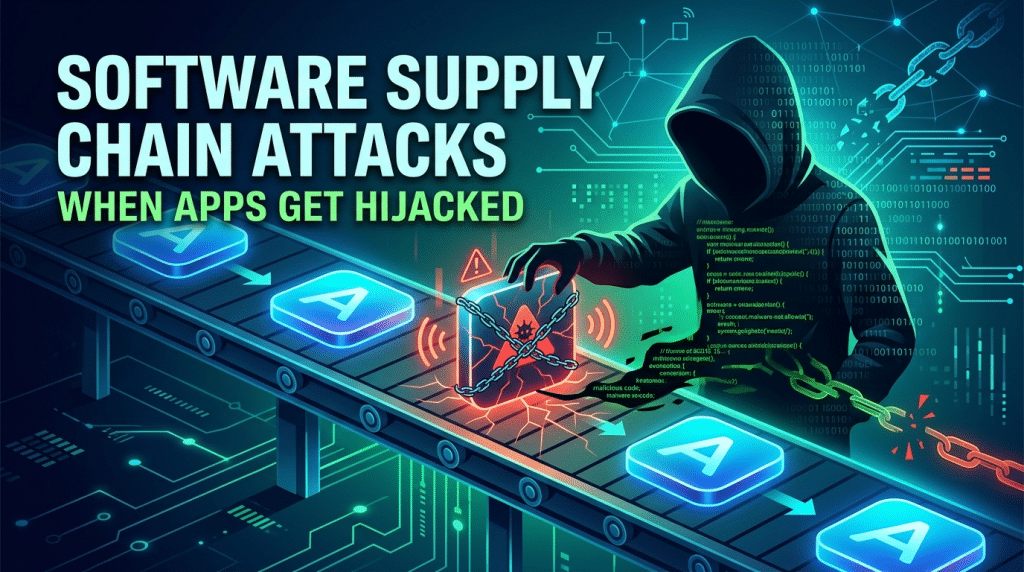
Software Supply Chain Attacks: What Happens When a Trusted App Gets Hijacked?
When discussing digital defense, businesses often focus on keeping unauthorized intruders out of their systems. They invest in strong firewalls, train staff to spot suspicious phishing links, and lock down user permissions. The working assumption is straightforward: as long as employees avoid downloading untrusted files or clicking rogue links, the network remains secure.
However, a software supply chain attack shatters this traditional assumption. In these sophisticated campaigns, the threat does not arrive via an obvious scam or an unverified download. Instead, the malware is delivered directly through the legitimate, digitally signed updates of trusted software applications your team already uses every day.
When a trusted vendor’s software supply chain gets hijacked, everyday business tools become the direct vehicle for widespread enterprise compromise.
How a Software Supply Chain Attack Unfolds
To understand why these breaches are dangerous, it helps to examine how modern software is built and distributed.
Software applications are rarely coded entirely from scratch. Developers rely on third-party dependencies, open-source libraries, automated build environments (CI/CD pipelines), and digital certificate signing authorities. An attacker does not need to target your specific business network directly; they only need to compromise one weak link in the software vendor’s development lifecycle.
A software supply chain attack follows a multi-stage path:
- 1. Infiltrating the Vendor’s Environment: Attackers identify vulnerabilities in an application developer’s infrastructure, such as poorly protected build servers, weak developer credentials, or unmaintained open-source package repositories.
- 2. Injecting the Malicious Payload: Once inside the build pipeline, the attacker subtly inserts malicious code into the application’s source repository or update scripts.
- 3. Legitimate Code Signing: Because the malicious code is integrated directly during the official build process, the software is compiled and stamped with the vendor’s genuine digital certificate.
- 4. Automated Downstream Distribution: The compromised vendor pushes out a routine software update. Your systems receive the update, recognize the valid cryptographic signature, and install the backdoor automatically without raising alarms.
Why Traditional Antivirus Misses the Threat
Supply chain attacks succeed because they weaponize implicit organizational trust.
Traditional antivirus software relies heavily on signature-based detection and digital reputation scanning. When an incoming file is signed by a recognized, reputable software publisher, security scanners classify the file as safe.
Furthermore, many business applications require elevated administrative privileges and unrestricted outbound communication to operate smoothly. Once the hijacked software is running inside your network, the embedded backdoor can execute commands, harvest credentials, and communicate with external command-and-control servers under the cover of normal, approved business traffic.
High-Profile Lessons: The Blueprint of Supply Chain Exploits
Supply chain compromises have produced some of the most impactful breaches in cybersecurity history:
- SolarWinds Orion (2020): Nation-state attackers breached the build environment of SolarWinds, injecting a backdoor into legitimate Orion network management updates. Over 18,000 public and private organizations installed the poisoned update, providing attackers with deep access to sensitive corporate networks.
- 3CX Desktop Application (2023): Attackers infiltrated the software build pipeline of 3CX, a widely used voice and video communications provider. The official desktop client was signed with valid developer certificates, distributing infostealing malware to hundreds of thousands of downstream endpoints.
- MOVEit Transfer (2023): A zero-day vulnerability in widely trusted managed file transfer software allowed threat actors to systematically exfiltrate sensitive data from hundreds of enterprise and government entities simultaneously.
Defensive Strategies: Protecting Against Hijacked Software
While you cannot directly control a third-party vendor’s internal coding security, you can build architectural guardrails to neutralize compromised software within your own network:
1. Adopt Behavioral Endpoint Detection and Response (EDR)
Move beyond traditional signature antivirus. Modern EDR solutions monitor real-time process behavior. If a legitimate, trusted VoIP app or file transfer utility suddenly attempts to inject code into system processes, launch PowerShell commands, or connect to suspicious IP addresses, EDR automatically detects the anomalous activity and isolates the machine immediately.
2. Implement Network Micro-Segmentation and Zero Trust
Never give any software application unrestricted run of your entire network. By isolating workstations, servers, and IoT gear into micro-segmented Virtual Local Area Networks (VLANs), an attacker who compromises a single application cannot move laterally to high-value database servers or backup repositories.
3. Maintain a Software Inventory and Monitor SBOMs
Keep an accurate, centralized inventory of every software application, browser extension, and agent running across your endpoints. Where applicable, evaluate Software Bills of Materials (SBOMs) to track nested dependencies and ensure rapid patching when upstream libraries are flagged for vulnerabilities.
4. Restrict Outbound Network Traffic
Enforce strict egress filtering at the firewall level. Limit internal servers and critical workstations so they can only communicate outbound with verified, necessary business domains, making it significantly harder for backdoors to establish command-and-control communication.
Harden Your Digital Supply Chain with Krypto IT
In a threat landscape where even trusted software can be hijacked, relying on blind trust is no longer a viable security posture.
At Krypto IT, we help Houston businesses deploy robust Zero-Trust architectures, continuous behavioral threat monitoring, and proactive endpoint defense to stop supply chain threats before they disrupt daily operations.
Are your security controls prepared to detect a compromised third-party application? Contact Krypto IT today to schedule a comprehensive network security evaluation.