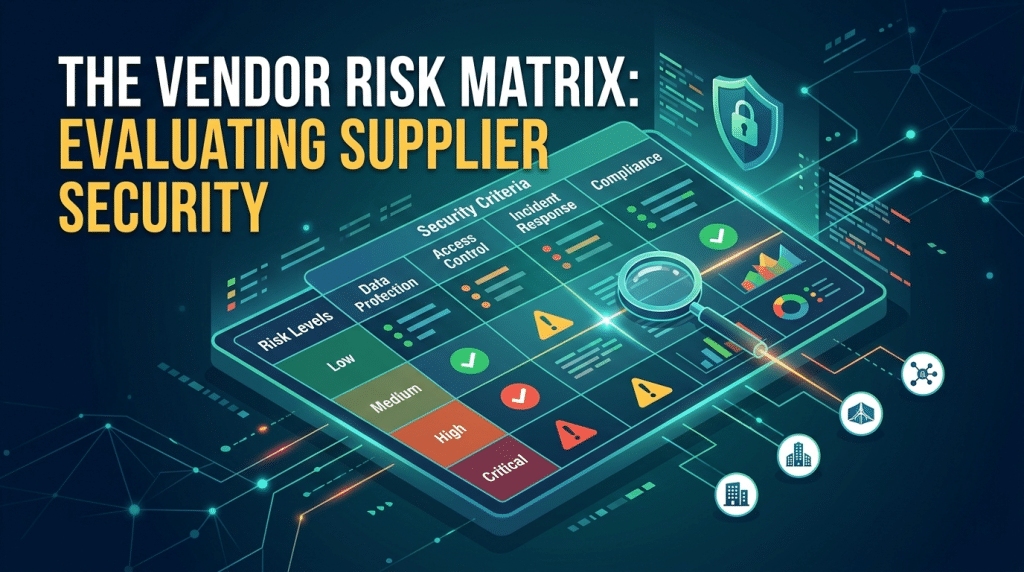
The Vendor Risk Matrix: Evaluating Supplier Security
August 17, 2026
Why Small Businesses Are the “Backdoor” into Fortune 500 Networks
Many small and mid-sized business (SMB) owners operate under a dangerous misconception: “We’re too small to be a target for cybercriminals. Why would an elite hacker care about our 30-person firm when they could go after a multinational corporation?”
The reality is that attackers target small businesses precisely because they are going after multinational corporations.
Fortune 500 enterprises invest tens of millions of dollars into cybersecurity annually. They employ dedicated 24/7 Security Operations Centers (SOCs), deploy cutting-edge artificial intelligence defenses, and maintain hardened network perimeters. Breaching a Fortune 500 company through direct, front-door brute force is extraordinarily difficult, time-consuming, and expensive for threat actors.
Instead, cybercriminals look for the path of least resistance. That path almost always leads directly through trusted third-party vendors, suppliers, contractors, and specialized service providers who maintain active digital connections to enterprise systems.
The Rise of Supply Chain and “Island-Hopping” Attacks
In cybersecurity, using a vulnerable third-party partner to pivot into a larger target is known as an “island-hopping” or supply chain attack.
Enterprise organizations do not operate in a vacuum. To function, a Fortune 500 company relies on thousands of external partners: boutique law firms handling mergers, regional HVAC and facility management companies, marketing agencies managing social feeds, specialized IT consultants, and accounting vendors.
To collaborate efficiently, enterprises grant these smaller vendors direct access to their ecosystem:
- Shared cloud storage repositories and project workspaces.
- Dedicated VPN credentials or remote desktop portals.
- Direct API integrations between software tools.
- Whitelisted email domains that bypass standard spam and phishing scrutiny.
When an attacker breaches an SMB vendor who lacks multi-factor authentication, endpoint monitoring, or network segmentation, the attacker does not just compromise that small business. They gain access to legitimate credentials that lead straight into the enterprise network.
Why Small Businesses Are the Prime Target
Cybercriminals understand the structural realities of smaller organizations:
1. The Resource and Expertise Gap
While enterprise organizations have specialized security engineers for every layer of their infrastructure, SMBs often rely on a single internal technician or unmanaged systems. Security patches may lag, firewalls often remain misconfigured, and behavioral threat detection is frequently absent.
2. High Trust, Low Verification
Enterprises frequently establish persistent trusted connections with long-standing vendors. When an email or invoice arrives from a trusted partner’s legitimate email address, enterprise employees are much more likely to open attachments, approve wire transfers, or execute scripts without suspicion.
3. Credential Harvesting at Scale
Attackers frequently launch automated phishing campaigns targeting small suppliers specifically to harvest Microsoft 365 or Google Workspace credentials. Once inside the vendor’s inbox, they quietly monitor email threads involving enterprise clients, waiting for the ideal moment to inject malicious links, fraudulent banking changes, or weaponized documents into active enterprise conversations.
The Business Consequence: Losing Enterprise Contracts
Being used as a launchpad for an enterprise cyberattack is catastrophic for a small business. Beyond immediate forensic and legal costs, the loss of business credibility is often fatal.
Enterprise organizations are aggressively tightening third-party risk management standards. Today, major corporations require suppliers to prove compliance with frameworks like SOC 2, ISO 27001, or NIST, while demonstrating active Endpoint Detection and Response (EDR) and Zero-Trust identity controls. If your business cannot prove that its digital house is in order, you risk being disqualified from bidding on high-value corporate contracts.
How Small Businesses Can Close the Backdoor
Securing your business against supply chain exploitation does not require a Fortune 500 budget. Implementing fundamental security guardrails dramatically elevates your defense posture:
- Enforce Multi-Factor Authentication Everywhere: Mandate phishing-resistant MFA across every email account, cloud platform, and remote access tool to shut down credential-stuffing attacks.
- Deploy Managed Endpoint Detection and Response (EDR): Replace basic antivirus with behavioral EDR tools that continuously detect and isolate anomalous activity around the clock.
- Practice the Principle of Least Privilege: Restrict employee and vendor access so users only interact with the exact files and networks necessary for daily duties.
- Conduct Regular Security Audits: Continuously evaluate firewall configurations, active user permissions, and email forwarding rules to eliminate forgotten entry points.
Protect Your Business and Enterprise Partnerships with Krypto IT
Your cybersecurity posture is no longer just an internal IT concern—it is a critical sales enabler and a safeguard for your most valuable client relationships.
At Krypto IT, we help small and mid-sized businesses build enterprise-grade security defenses. From continuous threat monitoring to vendor compliance alignment, our team ensures your organization remains a secure, trusted partner.
Are your security controls strong enough to protect your enterprise client connections? Contact Krypto IT today to schedule a comprehensive cybersecurity assessment.