Managing “Shadow AI”: When Teams Use Unpermitted ChatGPT
June 16, 2026
Why Your Smart Office Might Be Spying on You
June 18, 2026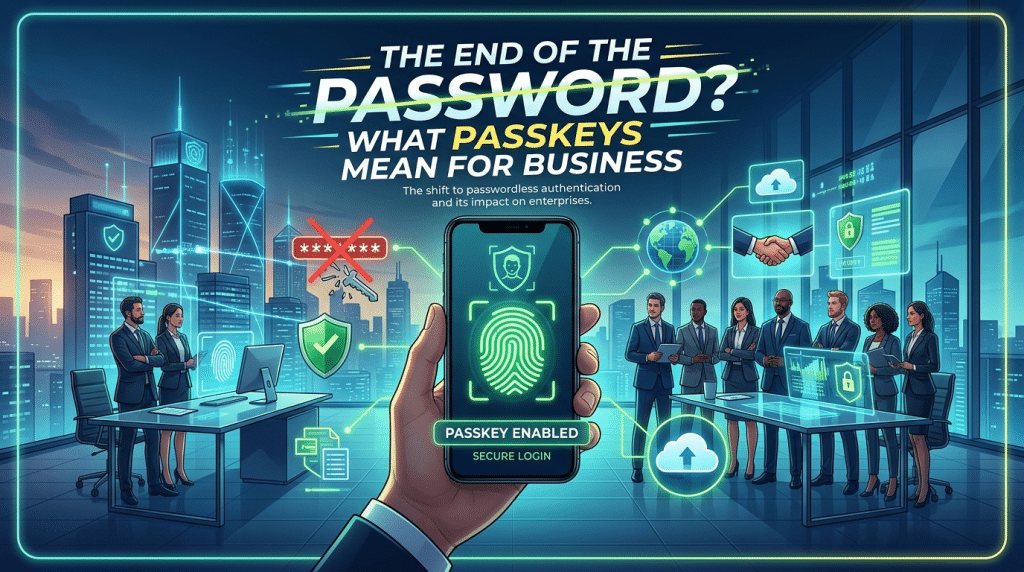
Moving Past the Password: Why Passkeys Are the New Standard for Workforce Security
For over three decades, the foundational lock on corporate data has been the traditional text password. Business owners have spent years engineering increasingly strict rules to keep these credentials safe. We forced our teams to create long strings of uppercase letters, numbers, and special symbols. We mandated frequent resets, and we stacked multi-factor authentication codes on top of them.
Yet, despite all these rules, credential vulnerability remains a massive liability. The data shows that over eighty percent of confirmed corporate data breaches still involve compromised or reused user passwords.
The core issue isn’t that your employees are careless. The problem is that the password model itself is fundamentally broken. Humans cannot memorize hundreds of unique, complex secrets, leading to dangerous habits like password recycling. More importantly, even the most complex text string can be instantly stolen by an AI-driven phishing page or a silent intercept script.
A major shift in network engineering has arrived. Backed by tech giants like Apple, Google, and Microsoft, and formalized by updated federal security guidelines, passkeys have officially moved from an optional upgrade to an operational baseline. According to the FIDO Alliance, over sixty-eight percent of organizations are now deploying or actively piloting passkeys for employee authentication.
Understanding the Mechanics of a Passkey
A passkey completely eliminates the concept of a shared text secret. Instead of requiring an employee to remember a password, it relies on public-key cryptography bound directly to their physical hardware.
When an employee registers a passkey on a work computer or smartphone, two distinct cryptographic elements are created. The first is a public key, which is sent to your corporate server. The second is a private key, which is locked inside the secure hardware enclave of the user’s device. The private key is entirely un-copyable and never travels across the internet.
When logging in, the server issues a quick digital challenge. The employee’s device answers the challenge by signing it with the private key. To authorize the use of that private key, the employee simply unlocks their device using what they already use every day: a fingerprint touch, facial recognition, or a local hardware PIN.
Why Passkeys Outperform Traditional Logistics
Shifting your organization to a passwordless infrastructure provides deep operational and defensive advantages.
First, passkeys are inherently phishing-proof. Because a passkey is cryptographically bound to the specific domain it was created for, it cannot be tricked. If an employee clicks a highly sophisticated phishing link that looks exactly like your company login portal, their device will recognize that the underlying website URL does not match the public key registration. The device will refuse to present the private key, completely neutralizing the attack.
Second, passkeys erase server target risks. In a traditional setup, database servers hold user passwords, creating a massive target for hackers. If a third-party application or internal server is breached, those passwords are stolen in bulk. With passkeys, the server only holds public keys. A public key is entirely useless to an intruder without physical possession of the employee’s un-exportable device and biometric confirmation.
Finally, this technology dramatically reduces IT operational friction. Approximately thirty-five percent of corporate IT helpdesk costs are driven entirely by manual password resets and account lockouts. Passkeys eliminate this time drain completely. There is nothing for your staff to forget, type incorrectly, or lose track of, resulting in faster login times and improved daily productivity.
Implementing a Frictionless Transition
Transitioning away from legacy text credentials does not mean executing a disruptive, overnight technology overhaul. True business continuity relies on a progressive, managed migration that supports your team through every step of the workflow.
At Krypto IT, we help organizations systemize their shift to a passwordless perimeter through structured deployment steps. We begin by auditing your current application estate, mapping out which core systems and cloud platforms natively support FIDO2 standards. From there, we introduce passkeys in controlled employee cohorts, allowing your staff to experience the speed of biometric logins while maintaining a secure, non-phishable administrative recovery path for device losses.
By connecting your access controls with hardware-bound credentials, your business bypasses credential-stuffing exploits entirely. You protect your capital, secure your client records, and give your team a faster, safer mechanism to hit their daily deadlines.
Conclusion: Build a Bulletproof Perimeter
In the modern digital landscape, sticking with legacy text passwords is an unnecessary risk that invites network intrusion. The security standard has evolved, and the businesses that adapt earliest will secure the strongest market confidence. By replacing fragile text secrets with secure passkeys, you transform your access points into an invisible, self-healing fortress, ensuring your data and your capital remain under your absolute control.
Are your corporate networks still relying on vulnerable text passwords? Contact Krypto IT today for a comprehensive Workforce Security and Passkey Readiness Review, and let’s future-proof your digital perimeter.