Dark Web Scanning: Finding Leaks Before Hackers
June 11, 2026
Port Scanning: Why We Keep Your “Digital Doors” Locked
June 14, 2026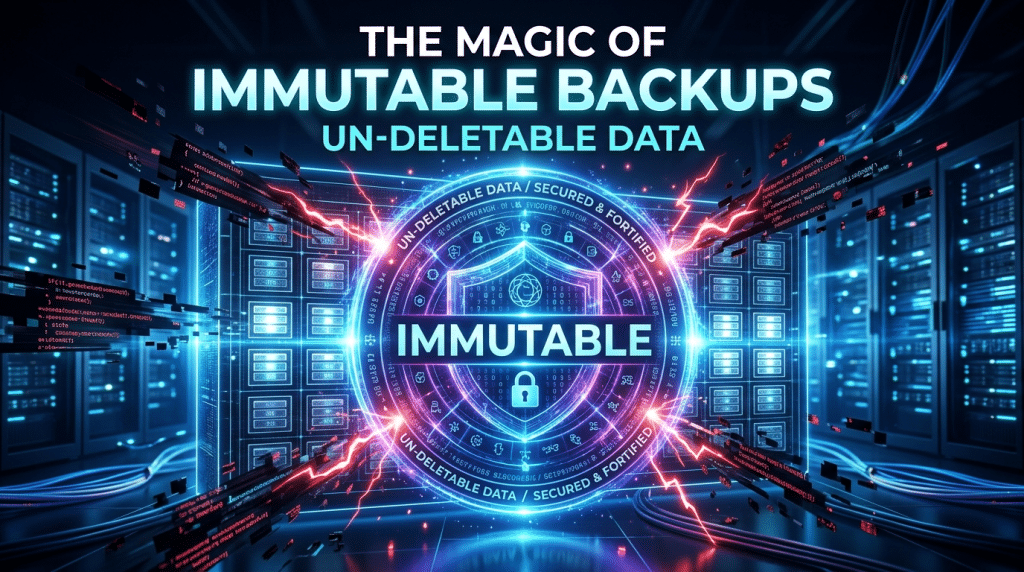
The Ultimate Insurance: Why Immutable Backups Are Your Final Defense Against Ransomware
When business owners and corporate executives build their disaster recovery plans, they naturally treat data backups as their ultimate safety net. The operational logic is comforting: even if a highly sophisticated cyberattack bypasses our multi-layered perimeters, scrambles our local file servers, and brings our daily operations to a grinding halt, we can simply wipe the compromised hardware and restore our entire business footprint from yesterday’s backup files.
As we navigate the severe corporate threat landscape of 2026, relying on that traditional strategy is a massive, often fatal liability.
Modern cybercriminals understand your recovery playbook inside and out. They are no longer content with just encrypting your live workstations. Instead, when a ransomware syndicate slips into your network, they spend days or weeks executing a silent, low-and-slow reconnaissance phase with one specific primary objective: locating and permanently deleting your backup archives.
If your backups are connected to the main network with standard read-write permissions, they will vanish right before the hacker triggers the live ransomware attack. To guarantee true survival and protect your corporate capital, your enterprise must implement the absolute gold standard of data preservation: Immutable Backups.
What Makes a Backup Immutable?
To understand the core mechanics of immutability, think of standard data storage as a whiteboard. Under normal operating conditions, your network administration software can continuously write new data, modify existing files, or wipe out old records to free up disk space.
Immutability transforms that whiteboard into a block of solid granite.
An immutable backup is a data architecture that utilizes a strict WORM (Write Once, Read Many) security protocol. The moment an automated backup cycle finishes writing your files, system configurations, and directory frameworks to the storage vault, the underlying file structure is instantly locked with a cryptographic time-seal.
Once that time-seal is applied, the data becomes entirely un-deletable, un-alterable, and un-encryptable by anyone—including your internal IT staff, your cloud vendor, an entry-level worker who misclicks a phishing link, or an external hacker wielding domain-administrator credentials. The data is structurally frozen for a predetermined retention window (e.g., 30 or 60 days).
Neutralizing the Ransomware Extortion Cycle
Implementing immutable infrastructure completely alters the power dynamic during a cyber crisis. When an organization falls victim to a sophisticated modern ransomware strain, the attack typically unfolds across a predictable, high-pressure extortion cycle:
[Infiltration] ──> [Backup Destruction] ──> [Live Encryption] ──> [Financial Extortion]
If your firm relies on traditional, non-immutable backups, the destruction phase leaves you completely exposed. With your safety net erased, the threat actors hold all the leverage, demanding an exorbitant ransom payment to hand over the decryption keys.
Immutability completely breaks this chain at the second link.
When a ransomware affiliate attempts to execute a deletion script or inject malicious encryption code into an immutable storage locker, the underlying operating architecture completely rejects the command. Because the restriction is hardcoded into the data repository layer itself, the hacker’s administrative keys are entirely useless.
When the live encryption phase hits your main office, your safety net remains 100% intact, clean, and accessible. Instead of engaging in a high-risk financial negotiation with an international cybercrime ring, your leadership team can confidently authorize your technical partners to isolate the compromised systems, pull the un-alterable backup vaults, and restore your full operational uptime without paying a single dollar to the extortionists.
Designing an Enterprise-Grade Immutability Vault
Building a resilient, human-friendly backup environment requires moving past basic automated settings and engineering an infrastructure that operates quietly in the background without introducing administrative headaches.
At Krypto IT, we help organizations build this ironclad redundancy by systemizing multi-layered data vaults:
* Compliant Local and Cloud Tiering: We deploy a hybrid protection framework. Your data is backed up to a hardened local storage appliance for lightning-fast recovery times, while an identical copy is instantly replicated to an out-of-region, isolated cloud repository, satisfying the strict 3-2-1 data protection standard.
* True Logical Air-Gapping: We ensure your immutable repositories utilize distinct, zero-trust authentication paths completely separate from your primary corporate network. Even if an intruder gains total control over your local active directory, they possess zero architectural pathway to interface with the backup infrastructure.
* Frictionless Restores: We combine our structural data locks with identity-first biometrics (such as Windows Hello and Touch ID). When your team needs to test a recovery cycle or pull an old archive file, authentication takes under one second, keeping your operations fast, agile, and secure.
Conclusion: Lock Your Data, Secure Your Future
In the modern digital economy, data availability is the ultimate foundation of corporate trust, regulatory compliance, and brand survival. Counting on traditional, vulnerable backup files to protect your enterprise against modern, highly targeted ransomware syndicates is an operational gamble that can result in total business closure. By embracing the magic of immutable storage, you turn your corporate archives into an un-deletable digital fortress, ensuring your capital and your continuity remain under your absolute control.
Are you certain your current backup strategy can survive a targeted ransomware deletion sweep? Contact Krypto IT today for a comprehensive “Disaster Recovery and Data Immutability Review” and let’s secure your final line of defense.