Why Cybersecurity Is Now a Boardroom Issue
May 21, 2026
Building a No-Blame Culture for Faster Security
May 22, 2026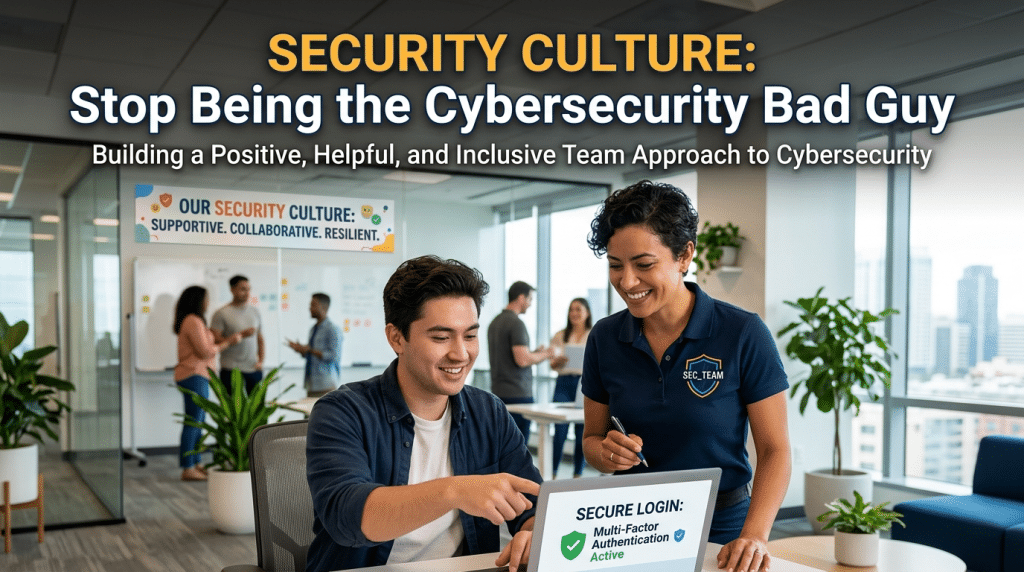
Cultivating a Human Firewall: How to Talk to Staff About Security Without Being “The Bad Guy”
Every business leader knows that employees are often the weakest link in the corporate security chain. A single misclicked link in a phishing email, a reused password on a personal account, or an unauthorized AI application can instantly compromise an entire network. Yet, when management tries to enforce strict cybersecurity protocols, they often run into a wall of internal resistance.
To the average employee, the IT security team behaves like a digital police force. They block useful websites, mandate complex password rotations, enforce tedious multi-factor authentication (MFA) prompts, and issue stern warnings. Security becomes synonymous with friction.
When security is viewed entirely as a set of restrictive rules, employees will actively look for workarounds to do their jobs faster. To build a resilient organization, leadership must stop playing the role of the cybersecurity “bad guy” and learn to transform security into a collaborative, community-wide asset.
The Flaw of the “Fear-Based” Approach
For years, corporate cybersecurity training relied almost exclusively on fear, uncertainty, and doubt (FUD). Employees were forced to sit through annual, dry slideshow presentations filled with catastrophic statistics and technical jargon. The underlying message was clear: If you make a mistake, you will crash the company and face disciplinary action.
This punitive approach backfires. When employees are driven by fear of punishment, they do not become more secure; they become more secretive. If a staff member realizes they clicked on a suspicious attachment but fears getting fired or publicly shamed by the IT department, they will hide the mistake.
In a digital crisis, the most valuable asset you have is Time. A delay of even a few hours because an employee was too intimidated to report a potential breach can turn a minor, isolated containment issue into a full-scale corporate network encryption.
Shifting from Restriction to Partnership
To change how your team feels about security, you must change how you pitch it to them. The goal is to move from a culture of enforcement to a culture of shared responsibility.
1. Explain the “Why” Behind the Rule
Employees rarely push back against security measures when they understand the functional threat behind them. Instead of simply announcing that “all external USB drives are now blocked on company laptops,” take five minutes in an all-hands meeting to explain the mechanics of a USB drop attack. Show them how a single infected drive can automatically inject malicious scripts into the motherboard. When you explain the rationale, the rule stops feeling like bureaucratic micromanagement and starts feeling like an operational shield.
2. Humanize the IT Department
If your employees only interact with your technology team when they are being reprimanded or locked out of an account, the relationship will remain adversarial. Break down this silo by encouraging open lines of communication. Reframe your IT staff not as auditors, but as Operational Facilitators whose primary job is to help the team work safely, efficiently, and with minimal interruption.
3. Connect Security to Personal Life
One of the most effective ways to build a natural “security mindset” in your staff is to show them how these habits protect their personal digital worlds. Teach your team the value of password managers, biometric locks, and freeze-alerts for their personal credit scores and bank accounts. Once an employee builds a habit of securing their personal data, those exact same defensive behaviors automatically carry over into their professional workflow.
Building the Post-Incident Safety Net
If you want your team to be transparent, you must build a culture that celebrates early reporting rather than punishing the initial human error.
Consider implementing a “Good Catch” initiative. When an employee flags a highly convincing, targeted phishing email or reports a suspicious phone anomaly, publicly praise their vigilance. If an employee does make a mistake and clicks a link but reports it within the first ten minutes, treat it as a successful training moment rather than a performance failure.
By removing the stigma of human error, you turn your entire workforce into an active, alert network of human sensors that can spot and neutralize incoming threats faster than software alone.
The Non-Intrusive Security Stack
Educating your team is crucial, but leadership must also deploy technology that protects staff quietly in the background without creating massive roadblocks in their daily operations. At Krypto IT, we help organizations build this frictionless infrastructure by focusing on modern, user-friendly security protocols:
- Single Sign-On (SSO): We eliminate the frustration of memorizing dozens of complex corporate logins by consolidating access into a single, highly secure, biometrically validated dashboard.
- Contextual Access Control: We implement intelligent guardrails that recognize when an employee is working from a trusted, secure device and network, reducing unnecessary MFA prompts and allowing them to focus entirely on their tasks.
- Continuous Micro-Learning: We replace long, boring annual training seminars with short, engaging, 2-minute monthly video modules that keep security top-of-mind without disrupting the weekly calendar.
Conclusion: Culture Beats Compliance
In the modern business landscape, true resilience cannot be forced through a policy handbook alone. It requires a supportive, transparent corporate culture. When you stop acting like the cybersecurity police and start empowering your team as active digital partners, you build an organization that is naturally hardened against any crisis.
Are your security policies driving your team to find dangerous workarounds? Contact Krypto IT today for a “Security Culture and Friction Audit” and let’s make security work for your team, not against them.