Social Media Hijacked? How to Reclaim Your Brand
May 14, 2026
Website Down: Is It a Glitch or a DDoS Attack?
May 17, 2026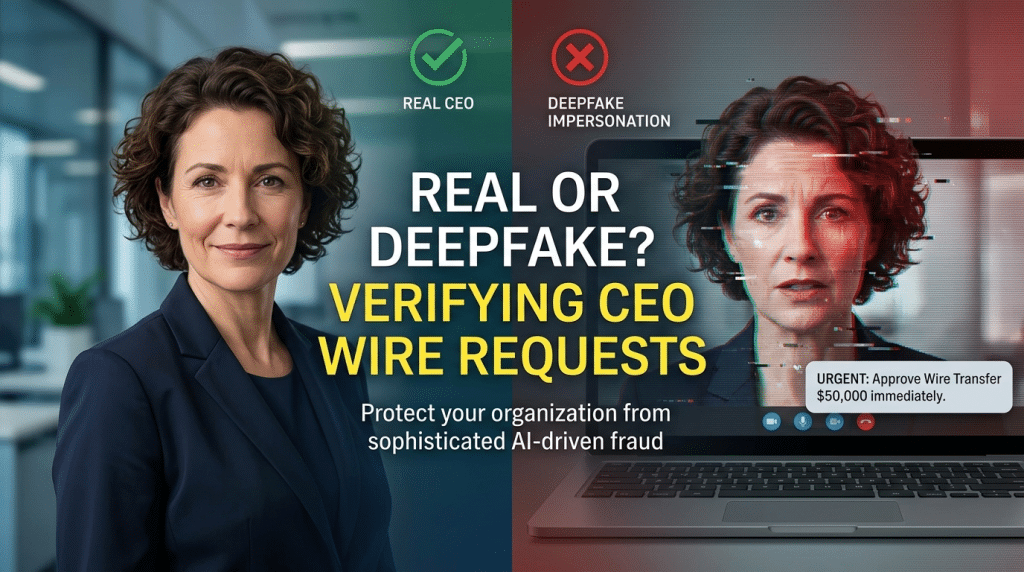
The AI Fraud Horizon: How to Spot an Urgent CEO Wire Transfer Request That Might Be a Deepfake
It is a scenario that plays out in accounting departments across the Houston region every week: An urgent email arrives from the CEO. Perhaps they are closing a time-sensitive acquisition in the Energy Corridor, or making an emergency equipment purchase near the Port of Houston. The email is direct, highly professional, and perfectly mimics the executive’s voice. It instructs the controller to bypass standard procedures and execute a $75,000 wire transfer immediately to secure the deal.
In the past, a sharp eye could spot a fraudulent email by looking for a misspelled domain name or an unusual greeting. But in 2026, the landscape has shifted dramatically. Today, hackers are pairing Business Email Compromise (BEC) with advanced generative AI.
When your financial team follows up with a phone call or a video chat to verify the request, they might not be talking to your boss. They could be interacting with an AI-generated voice or a real-time video deepfake.
As technology blurs the line between reality and replication, Houston business leaders must re-engineer their verification processes. Here is how to distinguish between a legitimate executive directive and a high-tech financial trap.
The Evolution of the “Urgency Trap”
Traditional corporate impersonation relied heavily on psychological pressure—specifically, manufactured urgency and confidentiality. The “CEO” claimed to be stuck in a boarding gate or a confidential board meeting, preventing them from taking a call but demanding immediate action via email.
With generative AI, criminals no longer have to hide behind text. They can harvest public audio from an executive’s LinkedIn videos, local media interviews, or corporate keynotes. With less than thirty seconds of high-quality reference audio, an AI model can clone a CEO’s voice with terrifying accuracy, replicating their exact cadence, accent, and verbal tics.
If your team’s only validation rule is “call the boss to confirm,” a voice clone can easily exploit that single point of vulnerability.
The Technical Reality: Compromise vs. Spoofing
To defend your organization, it is critical to understand how these deceptive emails reach your inbox.
- Email Spoofing: This occurs when a hacker alters the email header to make the message appear as though it came from your corporate domain. This type of attack can be stopped using modern email authentication protocols like SPF, DKIM, and DMARC.
- Account Compromise: This is far more dangerous. The hacker has successfully bypassed your perimeter—often through a session-hijacking phishing attack—and is logged into the CEO’s actual Microsoft 365 or Google Workspace account. Because the email originates from the real mailbox, your traditional spam filters will flag it as perfectly safe. The hacker can review past email threads to understand ongoing projects, making their fake wire request blend seamlessly into actual business conversations.
Moving Beyond “Seeing and Hearing”: Out-of-Band Protocols
Because AI can replicate an executive’s face and voice, your accounting team can no longer rely on visual or auditory confirmation alone. In the 2026 threat landscape, financial validation must be rooted in structured, cryptographic, and procedural protocols.
Every Houston firm should immediately implement a strict Dual-Authorization, Out-of-Band (OOB) verification framework for any financial transaction above a set threshold (e.g., $10,000):
- The Verbal Duress Word: Establish an internal, unwritten “safe word” or pass-phrase known only to the executive team and the accounting department. When a wire is requested, the executive must provide the phrase during the confirmation call. Because an external AI deepfake cannot guess an offline corporate secret, the attack fails.
- Multi-Channel Authentication: If a wire request arrives via email, confirmation must occur through a completely separate infrastructure. If you use Microsoft Teams for internal communication, verify the request through an encrypted WhatsApp message or a direct cell phone call—never reply to the original email thread.
- Hard Token Approvals: Eliminate manual wires via banking portals that only require a single password. Configure your corporate banking platform to require dual-factor hardware tokens (like physical YubiKeys) from two separate executives before a transfer can clear the institution.
The Sentinel Standard for Financial Defense
Protecting your capital requires a continuous combination of advanced software and human vigilance. At Krypto IT, we help local firms harden their financial operations against AI-driven fraud through a multi-layered approach:
- Identity-First Security: We implement continuous conditional access profiling, which automatically blocks login attempts to an executive’s email if the connection originates from an unusual location or an unmanaged device.
- Behavioral Email AI: We deploy advanced email security tools that look beyond the sender’s address. These tools analyze the linguistic sentiment of the email, flagging requests that display unusual urgency or deviate from the executive’s historical writing style.
- Simulation and Training: We run controlled, realistic BEC simulations to train your accounting staff to recognize the subtle markers of an AI-driven attack, transforming your team into a human firewall.
Conclusion: Trust, but Cryptographically Verify
In the 2026 digital economy, appearances are entirely deceptive. An urgent message from your CEO might look real and sound real, but without a rigorous, systemized verification process, clicking “send” on a wire transfer can be a business-ending mistake.
Are your financial controls ready for the era of deepfakes? Contact Krypto IT today for a “Financial Security Framework Audit” and let’s lock down your verification protocols.