Is Your Inbox Lying? The Rise of Deepfake Email Scams
January 7, 2026
The Invisible Threat: How Infostealers Hide in Your Network
January 9, 2026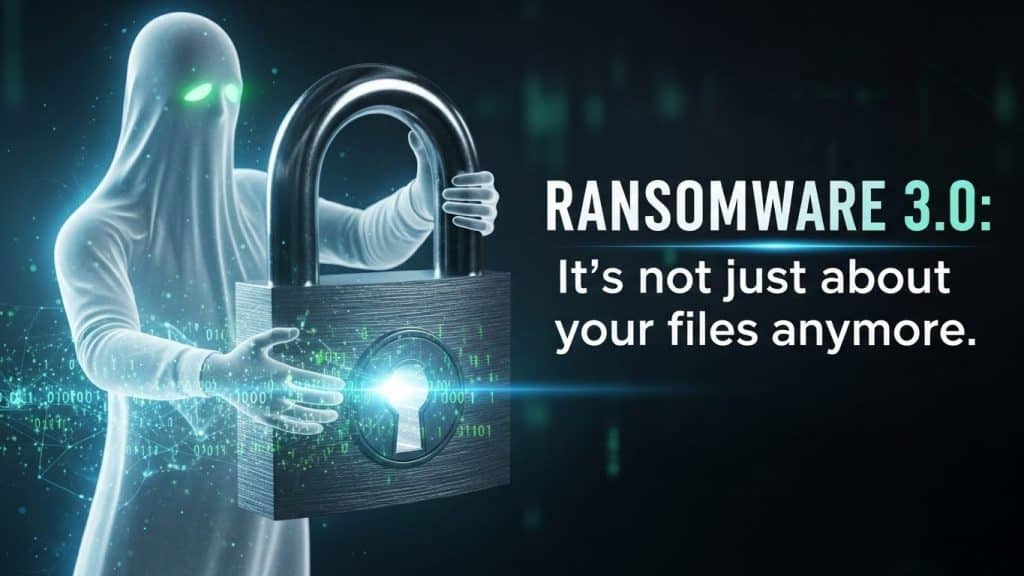
By the Team at Krypto IT | Cybersecurity Experts Serving Houston SMBs
For years, the standard advice for any Houston business owner concerned about cyberattacks was simple: “Make sure you have a good backup.” The logic was straightforward—if a hacker encrypted your files and demanded a ransom, you could simply wipe your systems, restore from your latest backup, and get back to work without paying a dime.
In the era of Ransomware 1.0, this was a winning strategy. But we aren’t in that era anymore.
As we move through 2026, we are facing the reality of Ransomware 3.0. Cybercriminals have realized that backups were making their “business model” less profitable, so they evolved. Today, simply having a copy of your data is no longer the “get out of jail free” card it used to be. At Krypto IT, we are helping Houston SMBs understand this new landscape and implement the proactive defenses needed to survive it.
The Evolution: From 1.0 to 3.0
To understand why your current strategy might be failing, you need to understand how the threat has changed:
- Ransomware 1.0 (Encryption): The goal was to lock you out of your files. Backups were the perfect antidote.
- Ransomware 2.0 (Double Extortion): Hackers realized you had backups, so they started stealing (exfiltrating) your data before encrypting it. They demand payment not just for the key, but to prevent them from leaking your sensitive client data on the “Dark Web.”
- Ransomware 3.0 (Triple Extortion): This is the modern nightmare. In addition to encrypting and stealing your data, hackers now target your third-party stakeholders. They might launch DDoS attacks against your website or, more commonly, directly harass your clients and vendors via email or phone, telling them their data was stolen from your unsecure servers.
1. The “Exfiltration” Trap: Your Backups Can’t Stop a Leak
The most devastating part of Ransomware 3.0 is that a perfect backup does nothing to stop a data leak. If a hacker steals your HR records, your intellectual property, or your customers’ credit card information, restoring your system from a backup doesn’t “un-steal” that information.
In Houston’s competitive market, a public data leak is a reputational death sentence. The cost of the ransom is often dwarfed by the legal fees, HIPAA or CMMC fines, and the permanent loss of customer trust. Ransomware 3.0 is a Privacy Crisis, not just a technical one.
2. Backup Poisoning and “Dwell Time”
Modern ransomware is patient. Hackers often sit inside a network for an average of 20 to 60 days before they strike. During this “Dwell Time,” they are doing more than just stealing data; they are looking for your backups.
If your backups are connected to your main network without proper “air-gapping” or “immutability,” the ransomware will infect the backups first. When you finally realize you’ve been hit and try to restore, you find that your backups are also encrypted—or worse, they contain the ransomware code itself, which will simply re-infect your “clean” system the moment you hit restore.
3. The Mathematics of Downtime
Even if your backups work perfectly, there is the issue of Recovery Time Objective (RTO). For a Houston SMB with 50 employees, restoring a full server from a cloud backup can take 24 to 48 hours.
If we look at the formula for downtime cost:
For many businesses, 48 hours of total shutdown costs more than the ransom itself. Relying on backups as your primary defense means you are accepting a minimum of two days of zero productivity.
How Krypto IT Defends Against Ransomware 3.0
Because backups are no longer enough, Krypto IT implements a “Prevention-First” strategy that focuses on stopping the breach before the exfiltration begins:
- Managed EDR (Endpoint Detection and Response): We use AI-powered tools that look for the behavior of ransomware. If a process starts scanning files or trying to “talk” to a strange server, our system kills it in milliseconds.
- Zero Trust Architecture: We ensure that even if one computer is compromised, the hacker cannot “hop” to your server or your backup drive.
- Immutable Backups: We provide backup solutions that are “write-once, read-many.” This means once a backup is made, it cannot be changed, deleted, or encrypted by a hacker—period.
- Data Loss Prevention (DLP): we monitor for large amounts of data leaving your network, acting as an alarm system that stops the “exfiltration” part of the attack in its tracks.
Conclusion: Don’t Rely on a Safety Net Alone
A backup is a safety net, but you shouldn’t be planning to fall. In the world of Ransomware 3.0, the goal is to keep your feet firmly on the ground through proactive, managed security.
Is your business still relying on an “Insurance and Backup” strategy? Contact Krypto IT today for a Ransomware Readiness Audit and let’s make sure your Houston business is actually unhackable.