The Human Firewall: Why Software Isn’t Enough
April 7, 2026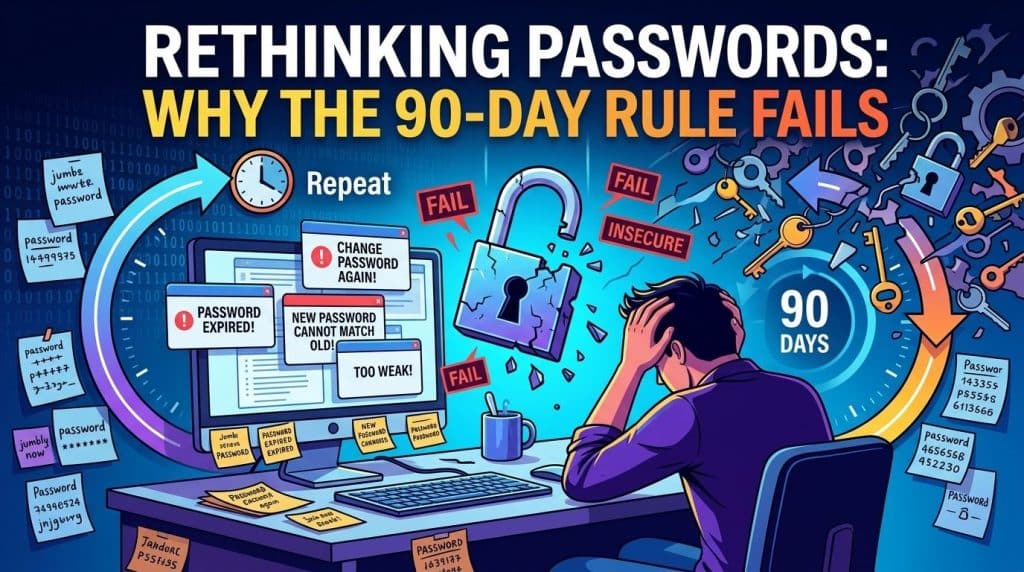
Stop Changing Your Passwords: Why the 90-Day Rotation is Outdated and Dangerous
The Contrarian’s Security Playbook by Krypto IT | Challenging Outdated IT Dogma in Houston
If you’ve worked in an office in the Houston Energy Corridor or a high-rise in Downtown over the last two decades, you know the feeling of dread that comes with the “Password Expiry” notification. It’s Monday morning, you have a 9:00 AM meeting, and your computer demands a new password. You let out a collective groan, think of a word, add a “1” and an “!” to the end, and go about your day.
For years, IT departments across the globe have preached the gospel of the 90-Day Password Rotation. The logic seemed sound: if a hacker steals your password, they only have a limited window to use it before it expires.
At Krypto IT, we’re here to tell you that this “common sense” advice is actually making your Houston business less secure in 2026. It is time to retire the 90-day rotation and embrace a strategy that actually works.
The Psychology of the “Lazy” Password
The primary reason the 90-day rule fails isn’t technical; it’s behavioral. When you force a human being to change something they have already memorized, they will almost always take the path of least resistance.
In our security assessments across Houston, we see the same patterns over and over again. An employee’s password starts as Houston2024!. Three months later, it becomes Houston2025!. Then Houston2025?.
Cybercriminals aren’t stupid. They use “Transformation Algorithms” that predict these exact changes. If a hacker has an old, leaked password of yours from three years ago, their software can guess your current “rotated” password in seconds. By forcing your team to change their passwords constantly, you are inadvertently training them to create weak, predictable patterns that are a gift to hackers.
The NIST Shift: Why the Experts Changed Their Minds
You don’t have to take our word for it. The National Institute of Standards and Technology (NIST), the organization that sets the “gold standard” for federal security, officially updated its guidelines to recommend against forced password rotation unless there is evidence of a compromise.
Why did they change their stance? Because the data proved that frequent changes lead to “Password Fatigue.” When users are overwhelmed by constant changes, they stop trying to create secure codes and start trying to create rememberable ones. Even worse, they start writing them down on Post-it notes hidden under keyboards or in unencrypted “Passwords” files on their desktops.
A single, strong, uncompromised password that stays in place for a year is infinitely more secure than four weak, predictable passwords changed every 90 days.
The “Complexity” vs. “Length” Trap
For years, we were told to use a mix of uppercase, lowercase, numbers, and symbols. This led to passwords like Tr0ub4dor&3, which are difficult for humans to remember but incredibly easy for a computer to “brute-force” (guess via rapid calculation).
The modern standard is Length over Complexity. A “Passphrase”—a string of four or five random, unrelated words—is much easier for a human to remember but mathematically impossible for a current computer to crack. For example, Blue-Cactus-Symphony-Truck is significantly more secure than P@ssword123! and requires zero mental gymnastics to recall on a Monday morning.
The Krypto IT Trinity: A Better Way to Secure Houston
If we aren’t rotating passwords, how do we keep your firm safe? At Krypto IT, we replace the 90-day annoyance with a Security Trinity that provides real-world protection:
- Multi-Factor Authentication (MFA): In 2026, a password alone is never enough. Even the strongest password can be phished. MFA is the true gatekeeper. If someone tries to log in with your password from an unrecognized device in another country, you get a notification on your phone instantly. Without that second factor, the password is useless to the hacker.
- Enterprise Password Managers: We help your team move away from “memorization” entirely. By using a secure, encrypted vault, your employees only have to remember one master passphrase. The manager generates and stores unique, 20-character random strings for every other site they use.
- Active Compromise Monitoring: Instead of guessing when a password might be stolen, we monitor the “Dark Web” in real-time. If one of your employee’s credentials appears in a new leak, our Security Operations Center (SOC) is alerted instantly, and we force a reset only for that specific, compromised account.
Conclusion: Focus on Quality, Not Frequency
In the 2026 Houston business environment, your team has enough on their plates without having to invent a new “variation” of their password every season. By moving away from forced rotation and toward a strategy of MFA and long passphrases, you increase your security while decreasing your team’s frustration.
Is your firm still following 2005 security advice? Contact Krypto IT today for a “Modern Credential Audit” and let’s simplify your security while hardening your defense.