Why Houston Firms Need a Local Cyber Partner
May 6, 2026
What If Your Lead Tech Quits Tomorrow?
May 9, 2026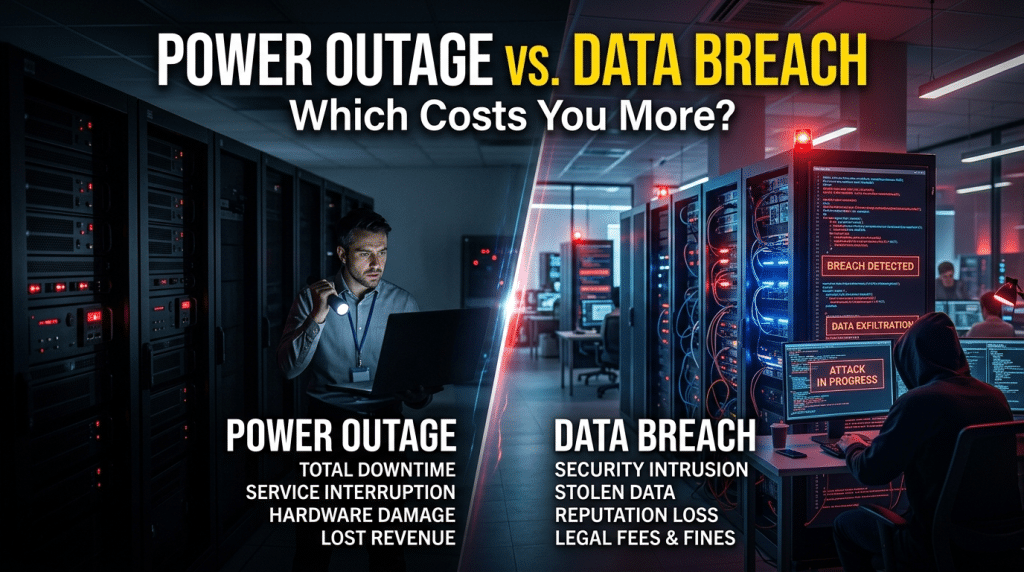
The Hidden Math of Business Downtime: Comparing Power Outages and Data Breaches
For most business owners in Houston, the threat of a power outage is a visceral reality. We have all stood in a darkened office, listening to the silence of idled computers while watching the rain lash against the windows. Because the impact is immediate and visible, we invest heavily in generators, Uninterruptible Power Supplies (UPS), and surge protectors. We treat the power grid as a known variable that requires a contingency plan.
However, there is another type of “darkness” that is far more expensive, significantly more persistent, and much harder to recover from: the data breach. While a power outage is a temporary interruption of productivity, a data breach is a fundamental threat to the integrity and future of the organization.
To build a truly resilient business in 2026, it is essential to understand the mathematical difference between these two crises.
The Power Outage: A Sprint to Restoration
The costs associated with a power outage are primarily “hard” and immediate. They are relatively easy to calculate because they are tied to the clock.
- Idle Labor Costs: If you have a 25-person team with an average burdened labor rate of $50/hour, a four-hour outage costs you $5,000 in lost productivity alone.
- Opportunity Cost: This is the value of the sales not made or the billable hours not recorded. For a service-based firm, this can often exceed the cost of labor.
- Physical Risks: Sudden outages can damage sensitive server motherboards or corrupt active databases that aren’t properly shielded by a UPS.
In most cases, the “tail” of a power outage is short. Once the lights come back on, the business returns to 95% capacity within the hour. The damage is a “bruise” on the quarterly P&L, but it rarely threatens the brand’s existence.
The Data Breach: The Marathon of Liability
A data breach operates on an entirely different scale. According to global industry reports, the average cost of a data breach for a small-to-mid-sized business has now climbed well into the six-figure range, but the composition of that cost is what makes it so lethal.
- Forensic and Legal Fees: Before you can even begin to recover, you must pay specialists to find out how the hackers got in and what they took. In 2026, with the Texas Data Privacy and Security Act (TDPSA) in full effect, your legal notification requirements are non-negotiable and expensive.
- Ransom and Recovery: If you are hit by ransomware, the cost isn’t just the potential ransom payment; it is the days—or weeks—spent rebuilding your infrastructure from backups.
- The “Trust Tax”: This is the silent killer. You do not lose a client because a hurricane knocked out your power. You do lose a client if you lose their sensitive proprietary data, their financial records, or their personal information. Reputational damage can lead to a 20-30% attrition rate in the year following a breach.
Comparing the “Tail”
The most significant difference between these two events is the duration of the impact. A power outage is a discrete event. A data breach is a “toxic” event with a long half-life.
- Duration: A power outage typically lasts 2 to 48 hours. A data breach investigation and recovery cycle typically lasts 60 to 180 days.
- Regulatory Impact: A power outage carries zero regulatory risk. A data breach can trigger state and federal audits, resulting in fines that can exceed the actual cost of the technical recovery.
- Customer Perception: Customers view a power outage as an “Act of God.” They view a data breach as an “Act of Negligence.”
Calculating Your Risk
When Krypto IT conducts a risk assessment for a Houston firm, we ask the leadership to look at their “Maximum Tolerable Downtime.”
If your business can survive a 24-hour power outage but cannot survive a 24-hour data encryption event, your spending is likely misaligned. Many firms will spend $20,000 on a backup generator while hesitating to spend $2,000 a month on a Managed Detection and Response (MDR) service.
In the 2026 Trust Economy, you are more likely to be targeted by a digital intruder than you are to be hit by a catastrophic power failure. While both require a plan, only one has the power to permanently shutter your doors.
Conclusion: Balancing the Shields
True business continuity requires a dual approach. You must protect the “Physics” of your office with surge protection and power backups, but you must protect the “Logic” of your business with a Sentinel Standard of cybersecurity.
Is your business prepared for the “Digital Darkness”? Contact Krypto IT today for a comprehensive Risk Comparison Audit and let’s ensure your recovery plan is ready for any crisis.