Public Wi-Fi Warning: Never Work on a Coffee Shop Network
December 6, 2025
What is a DDoS Attack? How Your Small Business Can Survive Being Flooded
December 10, 2025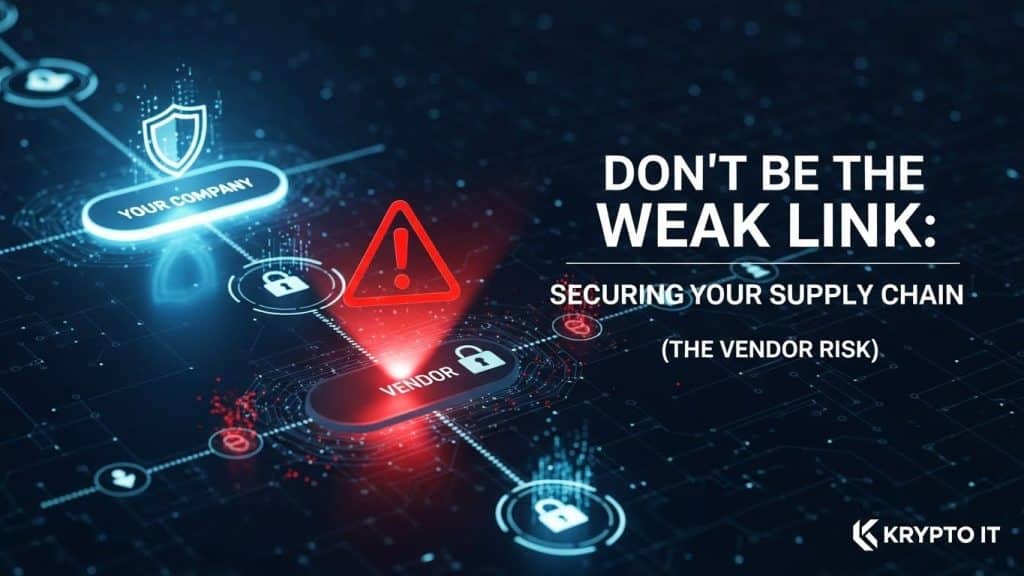
By the Team at Krypto IT | Cybersecurity Experts Serving Houston SMBs
For the small to medium-sized business (SMB), modern operations rely on a web of external tools: cloud accounting software, third-party CRM platforms, payment processors, and specialized industry applications. This network of partners is known as your Digital Supply Chain. While these vendors boost your efficiency, they introduce a massive, often overlooked, security risk.
The truth is, many of the largest and most destructive cyberattacks today don’t target the main company directly; they target the weakest link in their supply chain—often an SMB vendor with minimal security resources. When a vendor is breached, the attacker gains a trusted, authorized gateway into every client that vendor serves.
At Krypto IT in Houston, we see vendor risk as one of the most critical threats facing our clients. You can have a perfect firewall, but if your partner’s firewall is weak, you’re still exposed. Securing your business means securing your partners.
The Supply Chain Vulnerability: A Trusted Back Door
The challenge of vendor risk lies in trust. You grant your vendors a high level of access—they need it to do their job:
- Cloud Access: Your cloud provider needs full access to your stored data.
- Managed Apps: Your payroll processor needs access to sensitive employee PII and bank details.
- Remote Tools: Your maintenance contractor may need VPN access to troubleshoot.
If that vendor (or their employee) is compromised, the attacker has instant, validated access to your systems, bypassing your own perimeter defenses. This makes the supply chain a highly lucrative target for criminals.
The Vendor Vetting Gap: Why SMBs Are Exposed
Many SMBs fail to adequately vet their vendors, relying instead on marketing assurances or the vendor’s reputation. This leaves them vulnerable in four key areas:
1. Lack of Mandatory MFA
If your vendor does not enforce Multi-Factor Authentication (MFA) for their employees accessing your systems, they are a massive risk. A single compromised password at the vendor’s office gives a hacker a permanent, trusted key into your data environment. MFA must be mandatory for both your team and their team.
2. Inadequate Compliance Documentation
Compliance standards like HIPAA and PCI DSS require you to ensure your partners meet the same security levels you do. If your client data is exposed due to a vendor’s failure, the fines and legal liability fall largely on your business. If you cannot produce documentation proving the vendor met your security criteria, you have no legal defense.
3. Weak Offboarding Protocols
What happens when an employee leaves your vendor? If that employee’s access to your data isn’t immediately and completely revoked from all cloud applications and systems, they become a high-risk insider threat—potentially malicious or merely negligent.
4. Poor Incident Response (IR)
When a vendor suffers a breach, their response time directly impacts your business. If they take days to notify you, those are days you lose to downtime and increased risk. You need assurance that they have a tested IR plan that includes rapid client notification.
4 Non-Negotiable Steps to Secure Your Vendor Partners
You can’t control what your vendors do internally, but you can control who you do business with and the security standards they must meet.
1. Demand the SOC 2 Report (The Gold Standard)
The SOC 2 Type II Report is an independent auditor’s stamp of approval. It validates that the vendor maintains security controls for protecting client data. If a vendor cannot provide this report, they are likely not worth the risk. It is the clearest technical evidence you can get of their security posture.
2. Enforce Contractual Security Requirements
Ensure your contract requires the vendor to maintain specific technical controls (e.g., “Must enforce MFA on all accounts accessing PII,” “Must maintain a documented patch management schedule”). Do not rely on generic Terms of Service.
3. Strictly Limit Access (PoLP)
Require that the vendor adheres to the Principle of Least Privilege (PoLP) when accessing your network. If they are only installing a printer driver, they should only have temporary, limited access to that specific network segment, not full administrative rights to your entire server.
4. Isolate Vendor Access with Network Segmentation
When vendor access is required, Krypto IT recommends isolating them on a specific, segmented network zone (a VLAN). This ensures that even if their account or device is compromised, the threat is confined to that quarantined zone and cannot spread to your core financial or customer data servers.
Krypto IT: Your Vendor Risk Manager
Managing the security of your digital supply chain is a full-time job that requires technical expertise and auditing knowledge. SMBs cannot be expected to handle this complexity alone.
Krypto IT partners with your business to transform vendor risk from a major liability into a manageable component of your security stack. We help you:
- Audit Contracts: Review security clauses and validate technical claims.
- Enforce Controls: Implement technical policies (like MFA and VPN access) that meet vendor requirements while protecting your core network.
- Monitor Access: Provide continuous monitoring of vendor accounts for anomalous activity, ensuring they are not being used for malicious purposes.
Don’t let a vendor’s mistake cost you your business. Make vendor vetting a central part of your security strategy.
Ready to secure your partners and fortify your digital supply chain? Contact Krypto IT today for a vendor risk assessment.