Business Interruption Claims: Documenting Downtime
September 3, 2026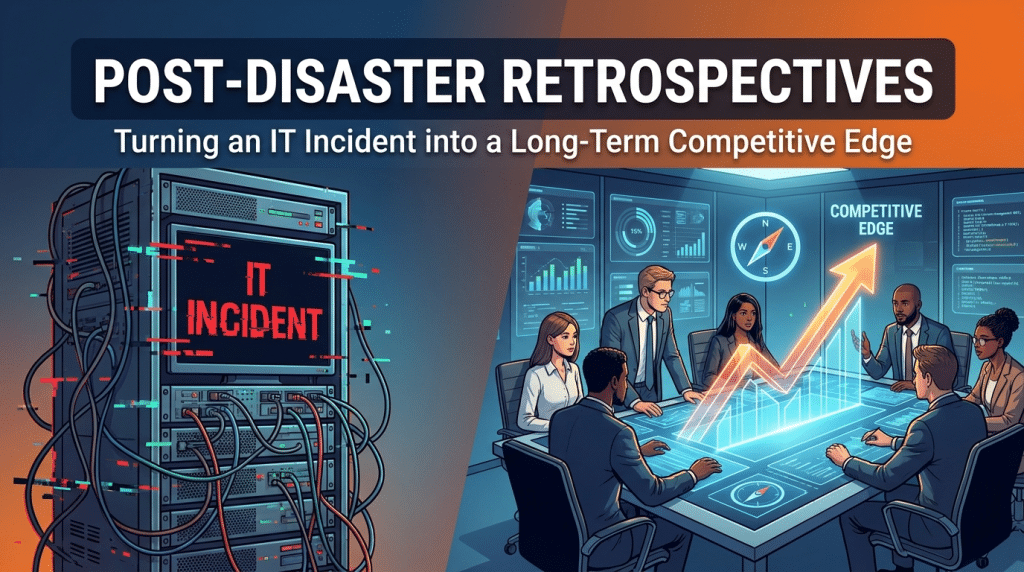
Post-Disaster Retrospectives: Turning an IT Incident into a Long-Term Competitive Edge
When a major IT disaster strikes—whether it is a disruptive ransomware attack, a protracted cloud outage, corrupted core databases, or sudden hardware failure—the recovery process is exhausting. For days or weeks, leadership teams, system administrators, and staff work around the clock to contain damage, virtualize backups, and restore operations.
Once systems are stabilized and normal operations resume, the natural human reaction across the entire organization is to breathe a collective sigh of relief, close the support tickets, and avoid talking about the crisis ever again.
Moving on without reflection is one of the costliest strategic mistakes an organization can make.
Every IT disaster leaves behind an invaluable roadmap of operational realities: exposing fragile legacy configurations, testing communication pathways under extreme stress, and highlighting process gaps between business departments and technical teams. Treating an incident merely as an unfortunate expense ignores a powerful opportunity.
By conducting a structured, blameless post-disaster retrospective, forward-thinking organizations transform emergency downtime into an enduring operational asset—building tighter operational resilience, securing customer trust, and gaining a distinct competitive advantage.
The Trap of the Blame Culture
The single greatest obstacle to conducting an effective post-disaster retrospective is the instinct to assign individual fault.
When leadership approaches an incident review with the goal of identifying a single person to reprimand—such as the employee who clicked a phishing link or the junior engineer who misapplied a firewall rule—the organization actively encourages concealment. Staff become defensive, withhold key timeline details, obscure procedural workarounds, and avoid reporting near-misses in the future.
In complex enterprise environments, incidents rarely stem from a single human mistake. Human errors are almost always the downstream symptom of systemic vulnerabilities: inadequate network segmentation, confusing software user interfaces, unrealistic deadlines, or absent secondary approval gates.
A mature retrospective operates under a core foundational principle: the Blameless Post-Mortem. The objective is never to determine who failed, but rather what structural safeguards, monitoring thresholds, or standard operating procedures failed to support the team.
The Core Framework of an Effective Incident Retrospective
To turn an operational disruption into structural strength, conduct your retrospective within five to seven business days of full recovery—while timeline details remain fresh. Structure the review around four essential phases:
1. Establish an Objective, Unified Chronology
Reconstruct an exact, indisputable timeline of the incident from initial onset to final sign-off. Gather telemetry across every relevant operational layer:
- Initial entry or component failure timestamps from firewall, EDR, and server event logs
- The exact moment monitoring alerts triggered versus when an engineer acknowledged the alert
- When leadership declared an official disaster state and activated emergency response protocols
- Timestamps for employee notifications, customer communications, and final service verification
Aligning operational logs with real-world communication threads reveals the true Recovery Time Objective (RTO) and exposes where bottlenecks caused delays.
2. Differentiate Technical Root Cause from Process Failure
Technical investigations often stop once the physical root cause is found (e.g., “the secondary storage drive controller failed”). An effective retrospective digs deeper into operational workflows:
- Why was there no automated failover notification before the drive filled to capacity?
- Did standard operating procedures clearly dictate which team member had authority to initiate an emergency cloud failover without executive sign-off?
- Were disaster recovery contact lists up to date, or did response teams lose an hour tracking down offline phone numbers?
3. Identify Operational Bright Spots
A post-mortem should not focus exclusively on failures. Documenting what functioned smoothly provides a blueprint for future incident response:
- Did an out-of-band communication channel allow executive leadership to coordinate seamlessly?
- Did immutable cloud backup snapshots prevent ransomware from deleting historical archives?
- Did a specific department execute offline manual workflows with minimal revenue disruption?
Reinforcing successful behaviors builds organizational confidence and validates past business continuity investments.
4. Create Concrete, Time-Bound Action Items
The ultimate measure of a retrospective’s value is the concrete preventative action it generates. Avoid vague takeaways like “improve employee cybersecurity awareness.” Instead, formulate specific, measurable, and assigned tasks:
- Deploy hardware-backed Multi-Factor Authentication (MFA) across all remote access tools within 30 days.
- Automate daily backup spin-up screenshot verification checks by the end of next week.
- Schedule a 30-minute disaster recovery tabletop drill for Q2 to test alternate customer intake workflows.
Turning System Resilience into Market Leadership
A resilient infrastructure does more than prevent future downtime; it creates market differentiation.
Clients, enterprise partners, and regulatory bodies demand operational reliability. Businesses that document transparent, mature post-incident remediation can candidly demonstrate to prospective customers and cyber insurance underwriters that their security posture is battle-tested, verified, and continuously improving.
While competitors remain vulnerable to the same unexamined systemic flaws, your organization operates on a hardened foundation.
Strengthen Your Business Resilience with Krypto IT
Every operational disruption carries lessons that can make your organization stronger, faster, and more resilient.
At Krypto IT, we help Houston businesses build enterprise-grade Business Continuity and Disaster Recovery (BCDR) architectures, facilitate rigorous post-incident retrospectives, and implement automated failover systems that turn disaster recovery into a core operational strength.
Is your organization learning the right lessons from technical disruptions? Contact Krypto IT today to schedule a comprehensive business continuity audit and incident readiness assessment.