From Chaos to Calm: Your First 30 Days with an MSP
August 8, 2026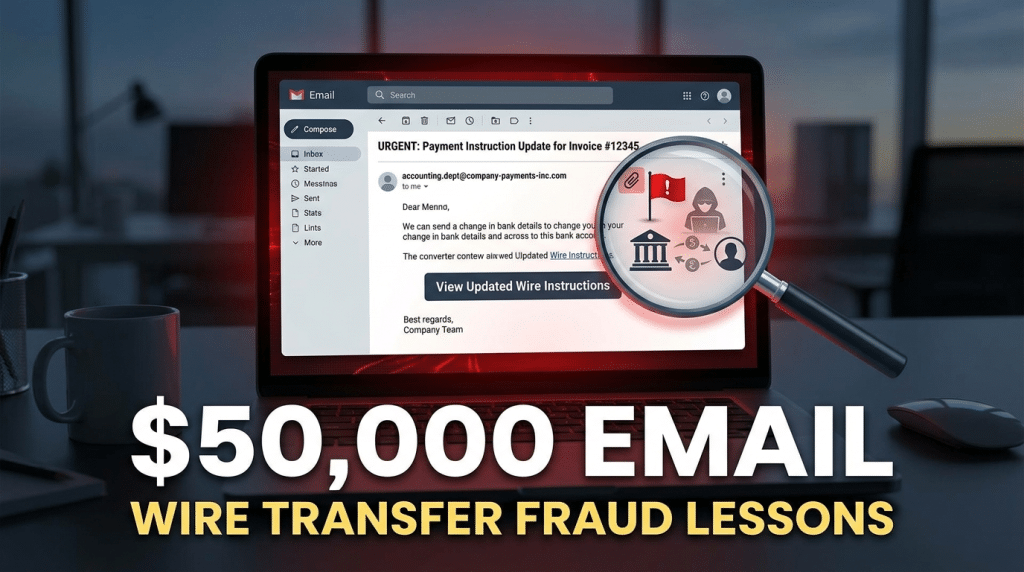
The $50,000 Email: A Real-World Lesson in Wire Transfer Fraud
It was a standard Thursday afternoon for a growing mid-sized manufacturing firm. The finance manager received an email thread that looked completely ordinary. The message appeared to come directly from the company’s primary equipment vendor, referencing an active $50,000 invoice for machinery delivered two weeks prior. Attached was an updated PDF invoice accompanied by a polite note:
“Please note that our bank details have recently updated due to an internal audit. Kindly process the pending $50,000 payment using the attached wire instructions.”
The email thread was familiar, the tone was professional, and the signature block matched the vendor contact’s details down to the phone number and logo. The finance manager processed the electronic funds transfer, marked the invoice as paid, and closed the ticket.
Four days later, the real vendor called to ask why the payment was past due. By the time the company realized what had happened, the $50,000 had already been transferred overseas, laundered through multiple bank accounts, and lost permanently.
This scenario is not a fictional cautionary tale—it is a classic Business Email Compromise (BEC) attack, and it happens to small and mid-sized businesses every single day.
How Wire Transfer Fraud Works Behind the Scenes
Wire transfer fraud rarely involves high-tech server breaches or dramatic network lockouts. Instead, it relies on human psychology, social engineering, and silent email compromise.
1. Silent Reconnaissance
Threat actors do not send payment change requests out of nowhere. Weeks before the email arrives, attackers gain unauthorized access to a business email account—either the buyer’s or the vendor’s—using credentials stolen through a prior phishing campaign or password spray attack. Once inside, the attacker sets up quiet inbox forwarding rules. They monitor ongoing email threads, study invoice templates, note the names of key staff members, and learn the company’s payment approval schedules.
2. Domain Spoofing or Compromised Accounts
When the time is right, the attacker strikes. They either send the message directly from the compromised vendor email account or register a look-alike domain (a technique known as typosquatting). For instance, replacing vendor-company.com with vendor-conpany.com. To a busy finance manager reviewing dozens of emails a day, the subtle difference is almost impossible to spot.
3. Urgency and Authority
The fake invoice usually carries a sense of subtle urgency—referencing upcoming delivery deadlines, impending late fees, or accounting period deadlines. Because the email references real project names and active invoice numbers picked up during the reconnaissance phase, the request appears completely legitimate.
Why Traditional Email Filters Miss BEC Attacks
Many business leaders wonder how a malicious email carrying a $50,000 fraud attempt can pass right through traditional spam filters.
Unlike traditional malware, BEC emails do not contain malicious file attachments or suspicious software links. They consist entirely of plain text and standard PDF documents. Because the email contains no malicious code or blacklisted URLs, standard security filters evaluate the message as safe and deliver it straight to the inbox. If the attacker uses the vendor’s actual compromised email account, the email even passes standard domain authentication protocols like SPF, DKIM, and DMARC.
Simple Protocols to Prevent Wire Transfer Fraud
Stopping wire transfer fraud does not require multi-million-dollar software upgrades; it requires establishing strict, non-negotiable internal financial protocols combined with modern email defenses.
Out-of-Band Verification (The Two-Touch Rule)
Enforce a strict company policy: Never update bank routing details, payment methods, or wire instructions based solely on an email request. Any request to change banking details must be verified via an “out-of-band” communication channel. The finance team must call the vendor using a pre-established phone number already on file—never the phone number listed in the suspicious email or attached PDF.
Multi-Person Payment Approval
Require two separate internal approvals for any outgoing wire transfer or ACH payment exceeding a specific threshold (such as $5,000). Having a second pair of eyes review the payment details creates a vital opportunity to catch domain typos or irregular requests.
Implement Advanced Email Threat Protection
Deploy AI-powered email security tools capable of analyzing behavioral patterns, domain age, and display name spoofing. Advanced email security solutions flag emails coming from newly registered look-alike domains and insert prominent banners on external messages requesting financial transactions.
Enforce Multi-Factor Authentication (MFA)
Protecting internal email accounts with hardware-backed or authenticator-app MFA stops attackers from gaining initial access to your inboxes, shutting down the reconnaissance phase before it begins.
Protect Your Financial Workflow with Krypto IT
Wire transfer fraud succeeds by exploiting trust and routine. Protecting your organization against sophisticated social engineering requires combining proactive staff awareness with robust digital guardrails.
At Krypto IT, we help businesses secure their communication channels, enforce strict identity protection, and deploy advanced email threat defenses to keep your financial operations safe.
Are your internal controls and email systems prepared to stop Business Email Compromise? Contact Krypto IT today for a comprehensive email and identity security assessment.