Secure Hardware Disposal: Safe Laptop Retirement
July 29, 2026
UPS Protection: Safeguarding Tech from Power Surges
July 30, 2026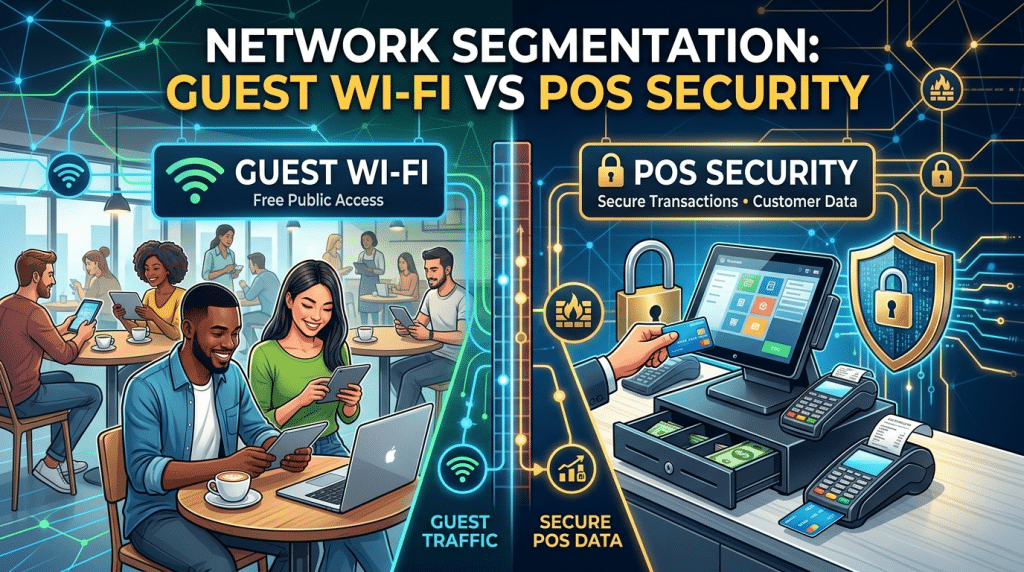
Network Segmentation: Why Your Guest Wi-Fi Should Never Touch Your Point-of-Sale System
Providing free, fast Wi-Fi to customers, visitors, and vendors has become a standard cost of doing business. Whether you operate a retail shop, a professional service firm, a healthcare clinic, or a corporate office, offering internet access creates a welcoming environment. However, allowing guests to connect to the exact same physical or logical network that handles your critical business operations—especially your Point-of-Sale (POS) system—is one of the most dangerous cybersecurity mistakes a company can make.
When a customer logs onto your guest Wi-Fi, their device joins your local area network. If that network is flat and unsegmented, their device sits right alongside your credit card terminals, administrative workstations, internal servers, and confidential files. A single infected smartphone or a bad actor sitting in your lobby can immediately scan your network for open ports, vulnerable services, and unpatched systems.
Understanding why network segmentation is mandatory—and how to implement it correctly—is essential for protecting your customer data, maintaining regulatory compliance, and securing your business.
The Danger of a “Flat” Corporate Network
In a traditional flat network setup, every connected device can communicate freely with every other connected device. There are no internal barriers, digital walls, or traffic checks between your guest access point and your payment processing environment.
This architecture creates a massive, unnecessary attack surface. Cybercriminals do not need to break through sophisticated enterprise firewalls if you invite them directly onto your internal network through an unprotected guest Wi-Fi access point. Once an attacker connects to an unsegmented network, they can use automated scanning tools to map out every IP address, identify your POS hardware, intercept unencrypted local traffic, and launch lateral movement attacks.
In many notorious retail data breaches, attackers gained initial entry through a secondary, seemingly low-risk network connection—such as an HVAC system or guest access point—and then pivoted seamlessly across the flat network directly into the payment processing database.
PCI-DSS Compliance Demands Strict Isolation
If your business accepts, processes, stores, or transmits credit card data, you are legally and contractually obligated to comply with the Payment Card Industry Data Security Standard (PCI-DSS).
PCI-DSS requirements explicitly mandate that the Cardholder Data Environment (CDE)—which includes your POS terminals, payment gateways, and connected software—must be strictly isolated from non-payment networks.
When your network is flat, every single device connected to your Wi-Fi, including guest phones and personal laptops, technically falls into the scope of your PCI audit. This makes passing a compliance assessment nearly impossible and drastically increases your liability in the event of a card data breach. Proper network segmentation shrinks your compliance scope down exclusively to the devices that handle payment data, drastically reducing audit costs and regulatory risk.
How Network Segmentation Protects Your Business
Network segmentation acts like the watertight bulkheads in a modern ship. If water breaches one compartment, the bulkheads seal off the leak and prevent the entire vessel from sinking. In IT infrastructure, segmentation isolates network segments so a compromise in one area cannot spread to another.
Key benefits of proper network segmentation include:
- VLAN Isolation: Creating Virtual Local Area Networks (VLANs) ensures that guest traffic is entirely isolated from your operational and payment traffic at Layer 2 and Layer 3 of the network stack.
- Zero Lateral Movement: Strict firewall rules between network segments block any attempt by a guest device to probe or communicate with POS terminals, internal servers, or file shares.
- Bandwidth Control and QoS: Segmenting guest traffic allows administrators to throttle guest bandwidth and prioritize business-critical applications like payment processing during peak operating hours.
- Ransomware Containment: If a guest or rogue device introduces malware or ransomware to the guest network, the infection remains isolated to that subnet and cannot encrypt corporate databases or lock down payment terminals.
Secure Your Network Architecture with Krypto IT
Offering guest Wi-Fi should enhance your customer experience, not put your merchant account and corporate reputation on the line.
At Krypto IT, we help businesses implement robust, enterprise-grade network segmentation. From configuring secure VLANs and next-generation firewalls to auditing payment environments for PCI compliance, our team ensures your core operations remain completely protected from guest traffic.
Is your guest Wi-Fi properly isolated from your credit card processing system? Contact Krypto IT today for a comprehensive network security assessment.