The Art of the Rush: Artificial Urgency in Phishing
July 4, 2026
Smishing Defense: Why Employees Click Text Scams
July 7, 2026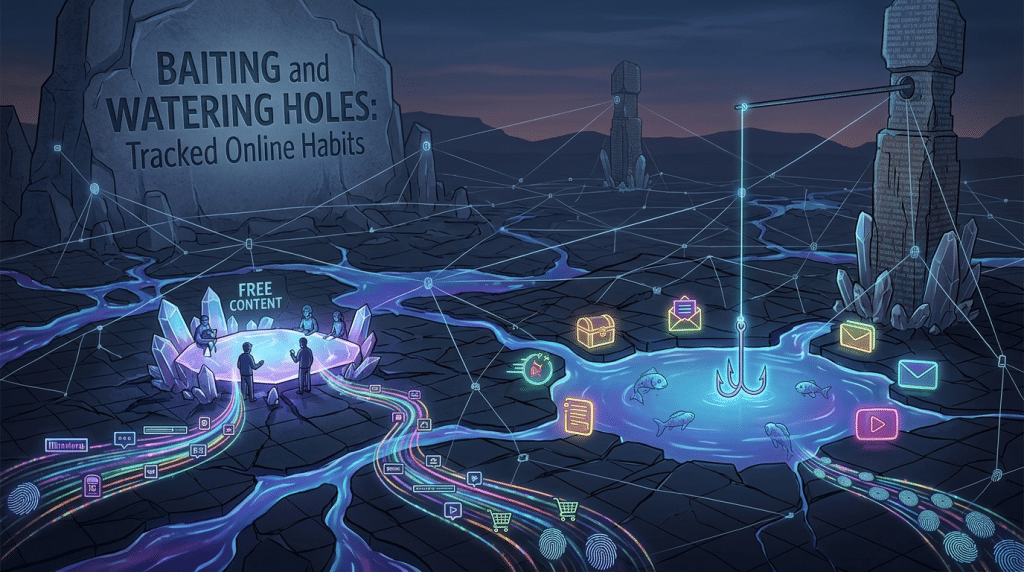
The Digital Stakeout: How Hackers Use Baiting and Watering Holes to Compromise Your Team
When business leaders evaluate their network security vulnerabilities, they typically imagine threat actors launching direct, targeted strikes against their corporate perimeter. They picture malicious actors sending targeted phishing emails to executives, executing brute-force login attacks against cloud systems, or probing internet-facing firewalls for unpatched software bugs. These standard attack vectors are well-known, and most modern firms deploy technical filters specifically designed to intercept them.
However, highly sophisticated cybercriminal syndicates frequently bypass these direct technical defenses by exploiting a much quieter strategy: observation.
Instead of aggressively attacking your corporate infrastructure, hackers spend weeks tracking the routine digital footprint and online browsing habits of your workforce. By discovering exactly where your team hangs out online, threat actors can deploy passive, highly effective traps known as baiting and watering hole attacks. To secure your corporate capital, eliminate supply chain visibility gaps, and build a truly resilient workforce, business leadership must understand how these passive traps operate and how to systematically engineer proactive network defenses.
The Art of the Lure: Deconstructing Baiting Tactics
Baiting relies on a fundamental human vulnerability: curiosity, combined with a desire for a frictionless shortcut or a compelling reward. In a baiting scenario, cybercriminals don’t trick an employee into revealing a password through text-based pressure; instead, they dangle an attractive digital asset in front of them, waiting for the worker to voluntarily pull the Trojan horse straight past your perimeter.
In the modern enterprise landscape, baiting typically manifests in two distinct operational forms:
The Physical Drop
A hacker leaves a branded, high-capacity USB flash drive or external hard drive lying on a table in a local coffee shop, hotel conference lobby, or office parking lot frequented by your staff. The drive is often explicitly labeled with a high-value corporate trigger phrase like “Q3 Executive Compensation Plan” or “Confidential Restructuring Blueprint.” When an inquisitive employee discovers the device and plugs it into a corporate workstation to see who it belongs to, a hidden, macro-enabled script executes automatically in the sub-second background, installing a persistent backdoor into your local local server arrays.
The Digital Download
Threat actors publish free, highly specialized software tools, browser extensions, or design templates tailored exactly to your industry’s daily workflows. For example, your engineering or administrative staff might find a public web repository offering a “free automated PDF converter” or a “complimentary marketing analytics dashboard.” While the tool might actually perform the basic function advertised, the installation package contains hidden spyware that monitors keyboard inputs, harvests system credentials, and siphons corporate intellectual property.
The Watering Hole: Exploiting Trusted Third-Party Ecosystems
While baiting requires an employee to actively take a lure, a watering hole attack is an entirely passive, systemic trap. The strategy borrows its name from nature: a predator doesn’t hunt a herd across miles of open savanna if they can simply hide in the brush next to the single water source where the herd is guaranteed to drink every evening.
In the digital realm, a watering hole campaign operates across four structured, sequential phases:
First, cybercriminals conduct extensive open-source intelligence (OSINT) gathering to track the browsing patterns of a specific target demographic. They identify the niche industry portals, trade association message boards, legal compliance blogs, or local lunch delivery websites that your specific workforce trusts and visits daily.
Second, rather than wasting energy attempting to pierce your highly secure primary network, the attackers compromise the defense lines of one of these weaker, third-party sites. They insert a malicious piece of JavaScript code into the trusted website’s core database or content management pipeline.
Third, the trap sits silent. When your unaware employees visit the trusted industry portal to read a regulatory update or check a scheduling board, the compromised website automatically delivers a silent drive-by download exploit to the worker’s endpoint browser.
Finally, the exploit searches the employee’s browser configuration or operating system for unpatched security flaws. The moment a vulnerability is discovered, the script executes a local infection loop, giving the threat actor a foot in the door to map your internal network topology, deploy ransomware, and corrupt your automated backup vaults.
Systemizing a Zero-Trust Network Perimeter
Defending your organization against baiting and watering hole tactics does not mean restricting your workforce from using the open web or creating administrative bottlenecks that slow down your team’s operational velocity. True organizational resilience relies on deploying automated, identity-first guardrails that keep your data safe even when an employee interacts with a compromised external environment.
At Krypto IT, we help growth-minded companies eliminate these passive supply chain blind spots by building a self-healing digital boundary:
- Deploying Enterprise-Grade Secure Web Gateways (SWG): We eliminate browser-driven vulnerabilities by implementing advanced DNS-layer filtering and automated URL isolation pipelines. Our security tools analyze web requests in real-time, instantly blocking access to compromised third-party portals and inspecting script executions in isolated cloud sandboxes before they touch your local endpoints.
- Enforcing Strict Device and Port Hardening Policies: We neutralize physical baiting vectors at the hardware level. Through advanced endpoint management, we configure your corporate workstations to automatically disable USB mass storage execution and block unauthorized external devices, ensuring that an unvetted flash drive cannot run code on your network.
- Wrapping Assets in Frictionless Biometric Identity: We isolate your core administrative channels from credential harvesting. We connect all system entry points with rapid biometric single sign-on tools (such as Windows Hello and Touch ID). This ensures that even if a watering hole script attempts to harvest an employee’s text-string password, a hacker cannot gain access to your critical data rooms without sub-second hardware-validated biometric verification, keeping your infrastructure secure, compliant, and under your absolute control.
Conclusion: Visibility Determines Security
In the modern hyper-connected marketplace, expecting a traditional firewall alone to secure your company while your workforce relies on hundreds of unvetted third-party web portals is an unsustainable approach to risk management. Cybercriminals actively weaponize the daily habits and industry trust networks of your team to execute silent, lateral infections. True resilience demands absolute visibility into every external touchpoint. By hardcoding hardware access restrictions, deploying proactive web filtering, and anchoring your perimeter in robust biometric validation, you clear the invisible tracking tax and ensure your corporate capital, data, and continuity remain entirely under your absolute control.
Are your employees’ daily online habits quietly exposing your corporate infrastructure to hidden supply chain threats? Contact Krypto IT today for a comprehensive Technical Infrastructure and Web Perimeter Vulnerability Review, and let’s harden your digital boundary.