The End of the Password? What Passkeys Mean for Business
June 17, 2026
Tech Debt: The Hidden Interest Rate Your Small Business Pays
June 20, 2026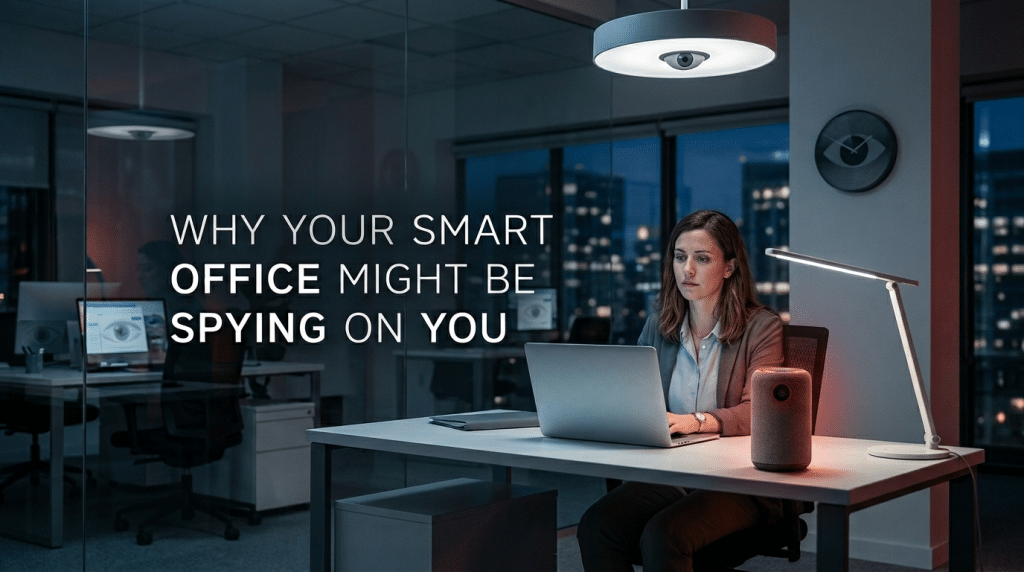
The Smart Office Trap: How IoT Devices Become Silent Network Spies
The modern corporate workspace is highly connected. To maximize daily operational efficiency and lower overhead, business owners have invested heavily in building smart office environments. We use internet-connected smart thermostats to regulate climate control automatically, install intelligent LED lighting arrays that react to room occupancy, and place voice-activated smart speakers in executive conference rooms to simplify video calls.
As we navigate 2026, the volume of these tools is staggering. Global network statistics show that there are now over twenty-one billion active Internet of Things (IoT) devices deployed worldwide, and that number continues to climb.
To an executive or business manager, a smart office represents the peak of corporate modernization. But from a cybersecurity perspective, every single connected appliance you introduce into your building is a small, unmanaged computer operating directly inside your perimeter.
Because these devices are engineered for rapid consumer convenience rather than enterprise-grade defense, your smart office infrastructure may be doing something completely unexpected: acting as a silent, outbound spy hole for global cybercriminals. To preserve your corporate capital and protect your data assets, leadership must look past the convenience of smart hardware and build a proactive network shield.
The Three Vulnerabilities of Commercial IoT
To understand how a smart appliance transitions from an office utility into a cyber spy tool, you must understand the massive structural gap between IoT manufacturing and traditional corporate IT engineering.
First, IoT hardware suffers from severe resource constraints. Your company laptops and local network servers run deep, memory-heavy endpoint detection agents that continuously scan for suspicious behaviors and block malicious scripts. A smart lightbulb or connected coffee maker runs on a tiny, low-power microchip that possesses neither the processing memory nor the storage capacity to support active security software. They operate entirely bare, with no native capacity to defend themselves if an exploit hits.
Second, default and hardcoded credentials remain an epidemic across the hardware landscape. Roughly twenty percent of commercial IoT devices still ship from the factory with universal default passwords. Because manufacturers design these products to be installed quickly by non-technical workers, they rarely force a password change during onboarding. Cybercriminals use automated scanning bots to look for these default factory settings across the public web every single hour, allowing them to take control of an appliance in seconds.
Finally, the hardware lifecycle lacks structural update support. When a vulnerability is exposed in Windows or macOS, a patch is pushed to your workstations automatically within days. When a software flaw is discovered in a smart office projector or connected refrigerator, the manufacturer rarely releases a patch. If an update is developed, it often requires manual installation by a technician. As a result, legacy appliances sit on corporate networks with known, unpatched security flaws for years at a time.
How a Compromised Appliance Spies on Your Business
When an attacker takes over an unmanaged IoT asset, their objective is rarely to manipulate the hardware itself. A hacker does not care about altering your office temperature or turning off your lights. Instead, they use the compromised appliance as a strategic backdoor to execute deep, silent corporate espionage.
Once inside an unsecured smart device, a hacker can execute network sniffing scripts. Because the appliance sits directly on your local network, an attacker can use it as a passive listening post to capture unencrypted data traffic floating through the air or down the local line, harvesting internal system layout maps and corporate communications.
Furthermore, hackers use compromised office hardware to establish beachheads for lateral movement. In a traditional network layout, devices share broad trust. If a cybercriminal compromises an insecure smart TV in the main lobby, they can use that trusted network positioning to scan the environment for high-value targets, move laterally past your perimeter filters, and slip straight into your primary file servers or accounting databases.
Unmanaged IoT devices are also heavily weaponized to build automated botnets. In mid-2025, security researchers exposed the BadBox 2.0 botnet, which silently compromised over ten million connected smart TVs and projectors worldwide, turning corporate hardware into robotic staging grounds for global denial-of-service campaigns and credential-stuffing loops.
Engineering an Invisible, Agentless Perimeter
Securing your organizational footprint does not require ripping out your smart building technology or returning to legacy utility models. True operational resilience relies on deploying network-enforced security boundaries that isolate and monitor your hardware automatically, completely independent of the device itself.
At Krypto IT, we eliminate the blind spot of unmanaged IoT assets by deploying a multi-layered, zero-trust network perimeter.
We begin by enforcing absolute network segmentation. We establish an isolated, dedicated local network enclave exclusively for your smart devices, entirely separate from your primary corporate environment. Your laptops, cloud databases, and financial portals live on a secure channel, while your smart thermostats and video screens live on an isolated island. If a hacker compromises a smart device on the IoT segment, the blast radius is completely contained; they hit a solid firewall and possess zero pathway to move laterally toward your corporate treasury.
From there, we implement continuous device behavioral profiling. We use advanced, cloud-delivered network analysis to establish the exact communication patterns for every appliance. A smart thermostat should only transmit tiny strings of numeric data to its specific vendor server. If that thermostat suddenly begins scanning internal IP addresses or attempting outbound data transfers to an unrecognized foreign server at 2:00 AM, our automated security engines recognize the deviation instantly, isolate the device, and kill its network access tokens before a data leak can occur.
Conclusion: Take Command of Your Perimeter
In the modern digital economy, operational speed and connectivity are essential for business growth, but they cannot come at the expense of your data visibility and brand reputation. Relying on passive, default settings to guard a web-connected workspace is an outdated approach that leaves your backdoor wide open to sophisticated threats. By adopting a proactive, agentless defense that monitors and limits your hardware footprint, you turn your smart environment into a secure, resilient asset, keeping your capital and your continuity under your absolute control.
Are your smart office devices quietly exposing your corporate networks to external attackers? Contact Krypto IT today for a comprehensive IoT Exposure and Network Segmentation Audit, and let’s secure your digital boundary.