Port Scanning: Why We Keep Your “Digital Doors” Locked
June 14, 2026
Managing “Shadow AI”: When Teams Use Unpermitted ChatGPT
June 16, 2026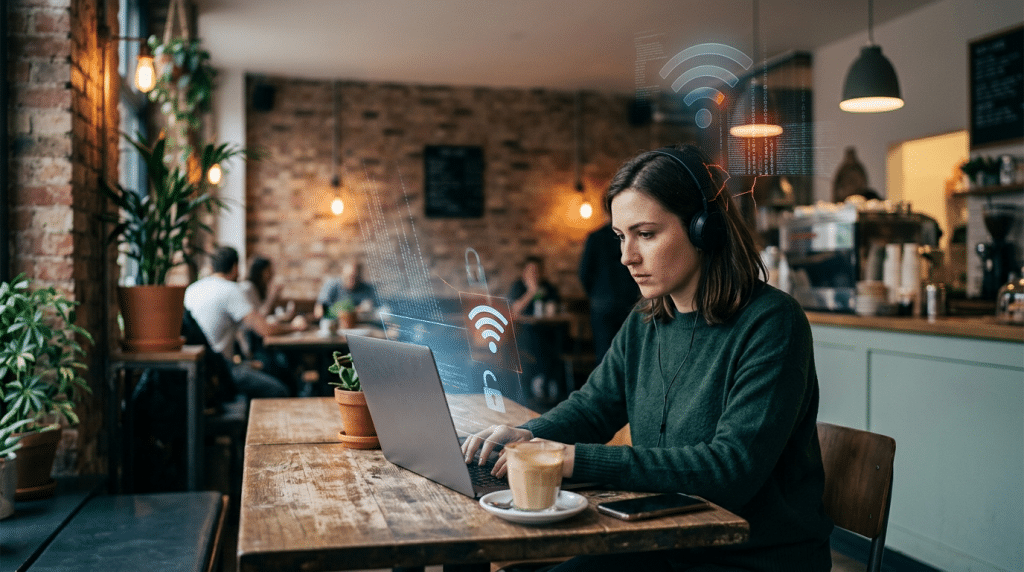
Perilous Cafes: Is Your Work From Anywhere Team Killing Your Security on Public Wi-Fi?
The concept of the corporate workspace has officially detached from physical office buildings. As we navigate 2026, flexible arrangements have stabilized into the baseline of global business operations. In the United States alone, over 32 million professionals operate in remote or hybrid capacities. Employees are no longer chained to a dedicated company desk; instead, they migrate freely between home offices, regional hubs, hotel lounges, and local coffee shops, using the freedom of the “Work from Anywhere” movement to maximize their daily productivity.
To an executive or business owner, this cultural shift represents a massive operational asset that drives workforce satisfaction and retention. But to your information security team, it represents a sprawling, unmanaged perimeter.
When an employee opens their company laptop at a local cafe and connects to the free public Wi-Fi, they aren’t just logging into an internet connection. They are potentially opening a direct, unvetted backdoor into your corporate database, active client records, and cloud repositories. To protect your company’s capital and maintain real data continuity, leadership must look past the convenience of public internet and engineering robust, location-independent digital protection.
The Anatomy of Public Network Vulnerabilities
The fundamental risk of open public Wi-Fi—whether it is hosted by a major coffee chain, a local airport, or a hotel lobby—lies in the complete absence of network isolation. Public access points are engineered for friction-free convenience, not defensive security. This open architecture creates an ideal environment for sophisticated threat actors through several common, automated attack vectors:
1. The Adversary-in-the-Middle (AiTM) Interception
When a device connects to an unmanaged public network, its data traffic travels through the air to the local router without structural segregation. Using low-cost, readily available hardware, a hacker sitting a few tables away can intercept that local wireless traffic. In a standard AiTM attack, the intruder doesn’t just look at web browsing history. They use automated proxy tools to intercept active browser session cookies and authentication tokens. Once these tokens are captured, the hacker can bypass traditional password protections entirely and log straight into your corporate cloud applications as if they were your employee.
2. Evil Twin Rogue Hotspots
Cybercriminals frequently exploit human trust by deploying fake wireless networks that mimic legitimate local business connections. An attacker might configure a portable router to broadcast an open network named “Starbucks_Guest_HighSpeed” or “Airport_Free_WiFi_Secure.” An unsuspecting employee trying to log in quickly to answer an urgent client message will connect to the rogue hotspot without a second thought. Once connected, every single byte of data their machine transmits passes directly through the hacker’s hardware, exposing internal credentials, system configurations, and private communications.
3. The Threat of Network Lateral Movement
Traditional network safety was built on the assumption that devices on the same connection are safe. If an employee connects a company-managed laptop to a public network where another user’s machine is actively infected with self-replicating malware, that malware can scan the open public network for vulnerable neighbors. If your employee’s laptop has a single unpatched software vulnerability, the malware can move laterally across the coffee shop Wi-Fi, planting code onto the corporate asset before the employee even finishes ordering their drink.
Moving Beyond the Legacy VPN
Historically, organizations attempted to secure their remote workforces by mandating the use of a traditional Virtual Private Network (VPN). The instruction was simple: if you are working out of the office, turn on your VPN to tunnel your traffic back to headquarters.
While traditional VPNs provide basic data encryption, they are rapidly becoming obsolete in modern cloud environments. A legacy VPN is an all-or-nothing access pass. Once an employee authenticates through a standard VPN, they are granted broad, trusted entry to the network perimeter. If a hacker successfully steals an employee’s VPN credentials using a targeted phishing email, the intruder can use that broad trust to explore your entire corporate environment, locate financial records, and deploy ransomware.
Furthermore, clunky, old-school VPN clients often slow down internet speeds, introducing significant friction into an employee’s daily workflow. When security tools slow down productivity, staff will naturally turn them off to meet their deadlines, leaving your business completely exposed.
Engineering an Invisible, Low-Friction Perimeter
Securing a modern, distributed workforce does not mean banning your team from working out of their favorite coffee shops. True operational resilience relies on deploying smart, identity-first security perimeters that protect your data quietly in the background, regardless of where your employees choose to set up their workstations.
At Krypto IT, we help businesses build this ironclad, human-friendly environment by systemizing next-generation cloud security architecture:
- Secure Access Service Edge (SASE): We replace outdated, centralized VPN tunnels with intelligent, cloud-native perimeters. SASE connects your remote workers directly and securely to the specific cloud applications they need to hit their deadlines, completely bypassing the local coffee shop Wi-Fi environment and isolating their data traffic from nearby threats.
- Contextual Conditional Access: We implement intelligent guardrails that evaluate the safety of a connection in real-time. If an employee logs in from a familiar, secure home network, the system keeps verification simple. But if they attempt to access sensitive client databases or initiate a financial transaction from an unmanaged public network, the system automatically triggers an extra layer of validation, demanding a biometric verification or a physical cryptographic hardware token before granting entry.
- Biometric Passwordless Logins: We eliminate password fatigue and credential harvesting by replacing traditional text passwords with rapid, unique biometrics (such as Windows Hello and Touch ID). Because biometric identity is bound to the physical hardware of the company device, a stolen text string becomes entirely useless to an external threat actor.
Conclusion: Security Follows the User, Not the Office
In the modern digital landscape, corporate data no longer lives inside a physical brick-and-mortar building, and your workforce cannot be locked behind an office wall. Your business agility relies on the freedom to work from anywhere. But that freedom demands an updated defensive mindset. By moving away from outdated perimeter trust and embracing a zero-trust, identity-first architecture, you ensure that your corporate safety shield follows your employees wherever they go—keeping your data, your capital, and your reputation completely secure, whether they are sitting at headquarters or connecting from a local cafe.
Are your remote employees exposing your corporate network to coffee shop data leaks? Contact Krypto IT today for a comprehensive “Remote Workforce Risk and Zero-Trust Readiness Review” and let’s secure your digital boundary.